
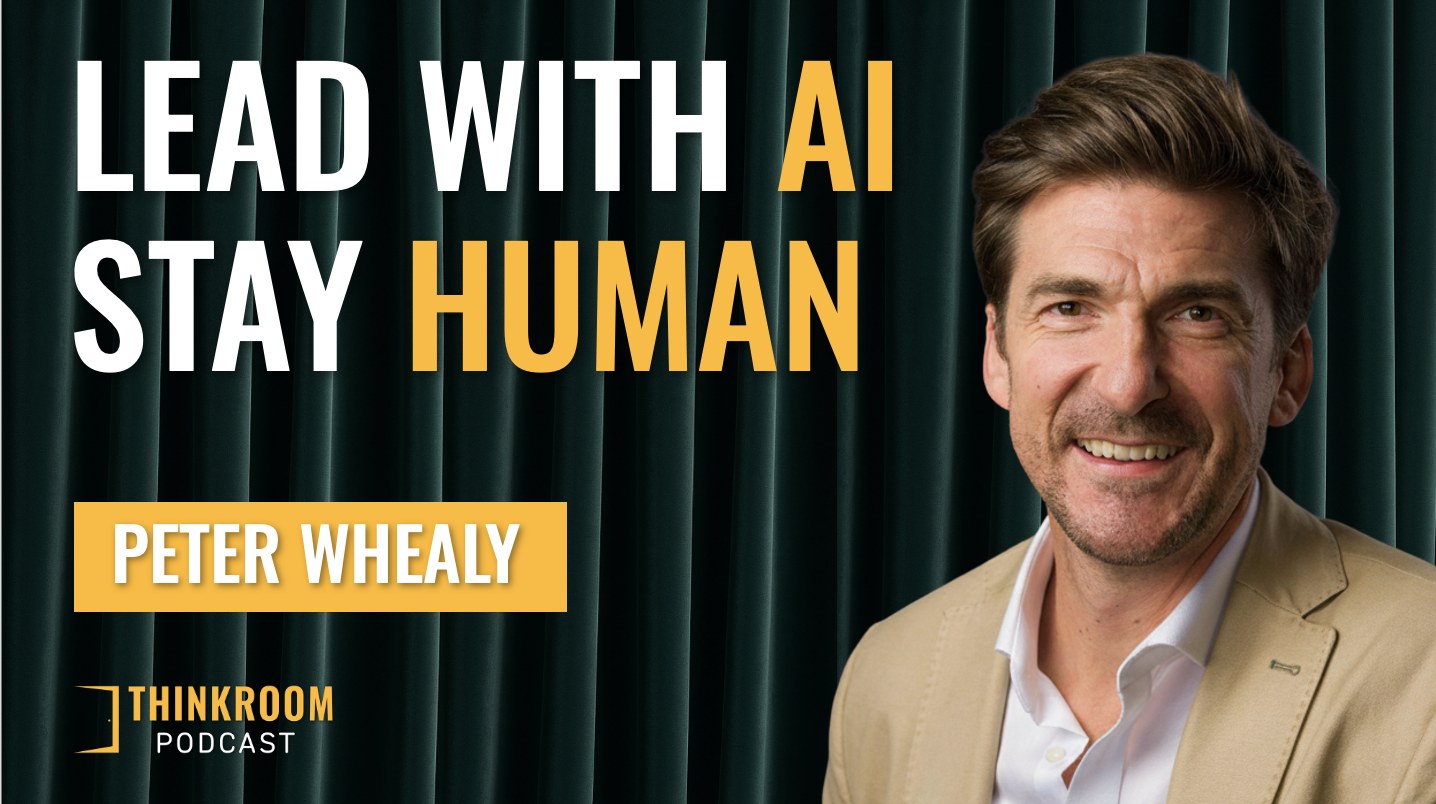
Prefer audio? Listen anywhere
Peter Whealy made equity partner at EY. Great career trajectory. Bigger teams, larger projects, more responsibility. Then one day he was brought into a Teams meeting and told he was being restructured. Thirty equity partners, gone.
What hit hardest wasn't the job loss. It was that his identity collapsed with it. Everything he believed about success, about what made him valuable, was tied to a role that no longer existed. And when he looked around at the organizations he'd spent years advising, he saw the same fragility everywhere. Leaders whose sense of authority rested on knowledge that was rapidly being democratized. Companies spending billions on AI transformations that failed because nobody addressed the humans inside the machine.
🎙️ Guest
Peter Whealy built his career at the intersection of learning, leadership and large-scale transformation. As an equity partner at EY, he watched a pharma client burn over a billion dollars on a CRM nobody used. He was there the day Lehman Brothers collapsed, where every trader had perfect training completion records and none of it mattered.
That pattern, organizations investing in systems while ignoring the humans who have to actually change, is what his book Lead with AI, Stay Human takes apart. Not a tech manual. A leadership reckoning, shaped by having his own professional identity dismantled overnight.
🔥 Key Insights
✅ The lawyer who thought he was bulletproof
An immigration lawyer told Peter the book was brilliant but irrelevant to him. His identity was his expertise. Untouchable. Then they walked through his tasks. 70% automatable. This is happening in every knowledge role. The question is whether you audit yours before someone else does.
✅ Artificial ignorance is the real threat
Ten fires burning, you throw each into an AI model, grab the answer, move on. Deloitte Australia charged $400,000 for AI-generated reports full of fictitious data. Nobody could defend the recommendations because nobody had actually thought. Peter calls it artificial ignorance. It's making us dumber, one shortcut at a time.
✅ The doorman isn't opening doors
Cost-cutters see a doorman and install a revolving door. But the doorman was never about the door. It was exclusivity, returning guests greeted by name, trust at the threshold. Jensen Huang wants to double Nvidia's headcount. His view: leaders who only chase automation lack imagination.
✅ Three clocks, one always too slow
Strategy moves fast. Operations take longer. People are slowest of all. Peter's framework asks leaders to get these three in sync, not at the same speed, but aware of each other. The best strategies die in the gap between vision and the people clock.
✅ The town hall that never happened
A commodities firm spent three months preparing a presentation on learning and trust. Two days before: cancel everything, massive restructuring. For a year, employees heard "AI will make you better." Now the message was: we have your data, we don't need you. The high performers were already looking for exits before the announcement landed.
✅ Your 10% is the only thing that matters
Peter designed his book cover with AI. Got 90% there. A designer friend nailed the last 10% in a weekend. That 10%, the judgment, the taste, the thing a client actually came to you for, is now exposed. Either you own it or someone with a better 10% will.
▶️ Listen now
Peter's book is Lead with AI, Stay Human. Available globally. And yes, you can ask the book questions at peterwhaley.com. He built an AI into it. Which, given the thesis, feels about right.
Read the full transcript
Um, so that's, that's been my, my career up until this point. And I think in terms of why I wrote the book, I'd probably describe it as a perfect storm. Uh, a few things happened about a year ago where, you know, firstly my career had been this linear journey. It had always been more responsibility, bigger teams, larger transformation projects, more responsibility.
And that got me to equity partner at ey, which in some respects, I think, looking back at that moment, I felt like I had, you know, achieved success. Yes,
Yeah. You made it.
I had made it. Um, but of course it was just the beginning of the journey and, um, the, the, the roles and the responsibilities that you have as, as a, as a partner in a, in one of the big four is significant.
But I still, I enjoyed it. I really enjoyed it. I learned so much. Um, but about a year ago from now, I was then brought into a teams meeting and told that I was gonna be restructured. Um,
hmm.
and that hit me so hard. I had no idea that this was gonna happen. That linear trajectory of continued success and, and, and improvement was suddenly, you know, taken from me
Hmm.
alongside 30 other equity partners that, that were also restructured at the same time.
And I think that was a huge moment around reimagining my own identity.
What did I believe was success versus fulfillment? Um, how had I not seen the fundamental changes that were happening in the consulting world? And the changes are meant to be a leader yourself and how you lead a team very differently and how organizations should be adapting themselves to
Was this restructuring, uh, in itself a, a response to ai?
So a few things had happened. So of course, you know, a few years back, COVID happened. Best times in consulting, huge growth, revenue
growth. the consulting firms had then overhired, and then of course that led to two years of retrenchment and reduced revenues, which then had a knee jerk reaction for a lot of the leadership.
And that also came coincided with huge investments into ai.
So revenues were down, investments into AI were up. Therefore, restructuring needed to happen. From the leadership's perspective, and this is the fundamental point to my book, uh, and which we can come on to talk about later, the shortsightedness versus the long-term views.
Hmm.
So, yeah, that was the first part of the perfect storm. You know, my own identity crisis and re-imagining that. I think the second part had been, uh, the A large part of my last four years had been leading big transformation projects, uh, tech transformation projects, of course, AI being part of that and, and watching firms make huge investments.
And then at the end of those transformation projects, failing to achieve the return on investment, failing to achieve the mindset and the behavior change. Uh, one of those projects cost a pharmaceutical, uh, company that I was working for over a billion dollars and they are now re-implementing this, a new CRM that they started five years ago.
hmm.
So that really led me to think what is, what is the reason for this? Why are leaders making so many bad decisions and not learning from those decisions?
Hmm.
And the third element of that perfect storm was, was really from the advent of AI and watching two divergent paths happening. One is that shortsighted approach of leaders looking for cost cutting and efficiency gain,
Hmm.
and using AI to replace tasks and processes and therefore cut people.
Hmm.
And they, they are typically a lot of the tech organizations, but it's not only limited to technology firms. We're seeing, you know, huge cuts at firms like UPS, Nestle. Um, and then of course, you know, tech firms like Microsoft, Salesforce, IBM today, uh, I saw 30,000 jobs going at another one of the big tech, uh, SaaS providers.
The other path are the organizations taking a much longer term view to ai. So IKEA would certainly be one of those, and Mars another. They're saying we want a people first approach to how we adopt ai, and recognizing that that is a long-term aspiration that requires foundational changes.
So that was the perfect storm, those sort of three areas coming together at the same time about a year ago. And yeah, really wanting to spend the time myself to learn to step back from running at speed as a consultant and saying, okay, I want to learn myself. This is entirely new, and how can I take that experience?
How can I take my, my own identity crisis, if you like. And then apply that to others so that others can also learn, um, how can I see the transformations that have gone wrong and think of a better approach? And how can I advise and help leaders to take Path Two, to think about the long term approach and how people are fundamentally valuable to organizations versus just task automation and process, um, uh, automation, which, which for me is a, a race to the bottom.
I, I think it in the, in the race logic, that is a lot of why we race towards task automation because it's very clear, it's quite linear in terms of the path to return investment, and you don't really have the time as the average leader to think about the second and third order consequences.
So that's really interesting. And I, I'd agree and I will discuss a lot more about it. But before we do, I, I, I'd like to explore the lens of a learning and development specialist. Like what, what do you see has been the response from, from. Professional kinda circus of, of learning development departments and consultants, especially now when it comes to AI because the implementation is so like fragmented in a sense.
Some people approach it as a tech project delegated to the CTO. Some people have some type of chief AI officer, uh, some companies do a very cross-functional integrated approach to it. Uh, what's been your experience specifically through the lens of learning and development? What role do they typically take and what should they take?
This is a, a big question. So I think if we go back to the basic learning architecture of most organizations, they typically have a COE Center of Excellence for Learning, often not always sitting within the HR department, and they've gone through generations, uh, all from the digital, sort of, even sometimes industrial revolution, but certainly the DI digital, um, uh, period of we need a filing cabinet, which is a learning management system.
So we need to put all of this content, this learning material, and we, our job, the learning department, is to make sure that we're updating that content and our metrics of success is learning hours and completion rates.
That approach is driven by compliance. It's driven by sort of tick the box. Uh, yes, I've done this.
And that doesn't lead to behavior change,
but if you look at any, pretty much any global organization that is their foundation from a learning department,
they then transition from that sort of LMS, um, uh, platform to an LXPA learning experience platform with the ambition of trying to create more of a Netflix type experience for a learner, which then can learn my behaviors, learning my interests, and start recommending content.
Hmm.
And that was definitely a step forward. But what has never really happened is transition from learning, let's say in this filing cabinet to learning in the flow of work.
Yeah, exactly.
The organizations that are really starting to stand out, I think from a learning space, are ones that are moving from that carrot and stick approach to, ah, you've made this mistake.
Let's share that so that we can learn. You are experimenting with this. What has worked, what hasn't worked? How can the organization achieve the same level of, uh, of experimentation success?
And it's interesting, especially now in the, in the age of ai, because to me at least, it's not a. First off, it's not a, a, a one time and you're done kind of thing given how, how fast the technology is changing and the, uh, the way that you adopt the technology successfully is changing. Uh, so you can't really check the box in that sense.
It needs to be a continuous learning and, and second, in order for like to get the more human-centric approach, you really need to get all of the people to feel like I own this change for, for my own sake as much as the company's sake. Right? So it's a very, very different approach compared to, I don't know, a risk and compliance training.
yeah, absolutely. It makes me think of, of an example. So, um, I used to work for the company that was responsible for all of the training at Lehman Brothers,
the investment bank. And, uh, I was actually there on the day of the announcement
hmm.
and watching an institution disappear overnight, uh, was was of course just incredible.
Like, how can this even happen? And when we looked at the training records, every single one of the desk heads, the risk managers, the traders, they had all completed their learning. They were all compliant. And that is completely different to the mindset and the behavior change because actually they all breached their limits.
They did not do what their learning had done. So it was just a tick in the box.
And the the contrary approach is, as you say, sort of learning from each other, learning in the flow of work, learning from how the organization evolves, and that's a complete mindset shift. Um, and that is quite a, is a, it's a unique culture for an organization to create where, uh, we see, you know, organizations, let's take Bayer as an example, you know, sort of agri farmer, uh, organization.
They've really focused on learning. Enabling the organization that is expected, that everyone is learning and understanding that what got us to this point is not what's going to get us to the future. And I think when you take a an AI lens to this, the rate of change is so fast and so significant. The learning debt in most organizations is increasing.
Yeah. Absolutely.
A week ago, or well a month ago I'd never even heard of openclaw
Hmm,
within a week of the announcement Anthropic then creates NEMO and is now available on everyone's desktops. The level of of change in the speed of advancement is, is extreme. And so for an organization to react to that level of change is really requires, uh, a very open mindset to, to learning and to accepting that knowledge is now democratized.
Hmm,
That control of, you know, that comes in a hierarchy, that I'm more senior, therefore I know more. Therefore, you do as you're told, that completely needs to disappear..
Yeah, absolutely. Uh, it's gonna be fascinating to see 'cause from, from the academic space now. I do hear more about, okay, we need to rethink organizational design, for example, and, and challenge the assumption of traditional hierarchies. I haven't seen it in practice yet. Uh, so, so we all kind of know. And this in general, I think it's so interesting now in the age of ai, the same was true when we started talking about like agentic systems.
Everybody could kind of see like, this is where we are going, but we're not seeing that much of it yet in terms of actual implementations. And it's gonna be so fascinating seeing the first organizations successfully experimenting, for example, with a completely different look and feel to an organizational chart.
Yep, '
cause it's been unchallenged since the 1850s.
Exactly. Absolutely. Yep. The, the, that were built based on standardization, so let's do more of the same faster. And then of course the digital revolution happened, which is more of the same thing, faster at a global scale with technology behind.
Now we're at a point where we need to rethink absolutely everything.
And I think the, the, the challenge that you are sort of hinting to here is that most of those legacy organizations are built on a, a set of processes, uh, data architectures, foundations, that just adding AI onto the top of it is breaking the
foundations. Whereas if you look at the frontier firms, they're starting from the ground upwards.
So it's very hard to see those who are re, you know, let's call them legacy firms who are transforming for success versus the frontier firms who are coming and disrupting. 'cause you can't compare, like, for like,
but I'll come back to the example of Bayer. I mean, they had 14 layers of hierarchy,
Hmm.
and they're trying to cut that to four.
Hmm.
So whether that ends up being successful, we, we don't know.
Hmm
Um, we've gone through various, uh, stages of organizational transformation org design, uh, from, you know, from, you know, scrum and Agile squads, and then teal and all these different approaches. And some have created disorganized chaos or organized chaos.
In some cases, um, others have been more successful. But what's down to culture? What's down to technology? What's down to people? It's, it, it is hard to know, but I think one thing is for sure there's a lot of experimentation going. Um, there are organizations who are, for instance, merging it and hr and we're starting to see the silos starting to blur and, and merge.
Whether that is successful, we, you know, we're still in the early stages of, of watching those types of things happen. I've been in strategy for forever, like 15 years and, uh, over those, uh, not forever, but for 15 years, over those 15 years. I would say that strategy completely without AI became more and more cross-functional for every year. And strategy horizons were, uh, shrinking in, in time horizon as well, and like plan planning cycles.
And the, the idea fundamentally of strategy, then execution was just starting to become challenged just by the time of, of, uh, AI becoming a thing. And one of the things the traditional hierarchy is built around is the idea of higher level executives has better information. So they have, as a consequence of better information, a broader picture, broader, they have the mandate to, to take the big decisions.
And with ai, AI, now that assumption does the top level has the best quality information. That's not necessarily true anymore. So it, it's completely fascinating to, and what's also really fascinating, I think, at this period of time is that we're all experimenting. Like there aren't, like, almost always, there's been playbooks and best practices to follow, but there aren't really clear best practices for what does the, the future org design look like in, in a, in a best practice scenario. And it's interesting too, like how do we, do you find from, sorry, a learning and development perspective that the companies are open enough in terms of their experimentation in order for us to learn from each other?
I would say it's is very similar to values and vision of a company. It's up on the wall. This is our, these are our values. Whether they're lived is a very different question. And I think the same thing would be from innovation, learning from failure. Um, they, most organizations say, yes, we want to learn, we want to iterate.
We wanna allow you to, uh, have a safe space for, uh, for failure.
Yeah.
The reality, however. Is often very, very different.
Hmm.
And I think, you know, earlier in this, this conversation you, you talked about the shortening cycles of, you know, leadership. I think if you just look at a average tenure of a chief executive, I think it was around seven years, it's now dropping on average I believe to around two years.
Hmm.
And so if that's what's happening, there is an increase pressure on the quarterly and of course annual cycles
and that then flows down through the organization. Whereas yes, we're saying there's psychological safety. Yes, we're saying that you can iterate and learn, but actually if you don't hit your numbers or if you don't reduce your costs in finance or if you don't come up with new solutions in r and d, then you are no use to us.
So I think it's the, where I, my advice to leaders is, is to make sure that the, the message aligns with behaviors and that that flows through the organization. And that is a yearly process. It's a continual, uh, ambition that needs to be crafted and lived
rather than just
And culture is
slow. Right. That, that's also really fascinating to me, like looking at the, the successful. But in, in a large organization, uh, cultural transformation programs, they are multi-year efforts because it takes time to build the trust that this is not just a, a fly on the wall that will be a new fly on the wall the next week or, or, um, so it, it's kind of an interesting timeline where you'd kind of re-engineer a culture over say three to seven years in, in a typical big transformation case around a technology that changes every quarter.
Uh, and this is, um, yeah, it's a challenge for sure.
And then you add on top of that the geopolitical instability,
Yeah. Absolutely.
the exponential improvements in technology, plus the huge investments that most firms are plowing into ai.
hmm.
And so that, that in itself is another perfect storm of pressure on organizations that, that, that then says, well, that five seven year cycle that we know is what is going to take time for the culture change, but yet we don't have time 'cause we've got shareholders, we've got our annual meeting and we need to show improvement.
So it takes a very brave leadership team to take that, that view I had. Um, so one of the contributors from, um, in my book was, uh, the chief executive, uh, sorry, the, the CHRO from Mars. And what I loved about what she said is Mars is 150 year old organization and their values go back to that period in time and they make no decisions now unless they align to their values.
That have been generational. And, and when, when your, your shareholders, and when your owners know that that is the context that you're working in, it gives you a much more breathing space to make those long-term decisions and those long-term investments. So I, I think that is the responsibility of leaders to manage those expectations.
Yeah, and I think it pivots us really nicely. Also, a little bit more concretely into to your book as well, because you talk a lot about. Traditional leadership behaviors in the human sense. For example, judgment is like the role of leadership doesn't change that much, but some things are increasingly amplified.
So judgment was important, but now judgment under ambiguity is like the hyper skill to hit.
absolutely. Perfectly, perfectly explained. So what I did is I took it back to what I believed are those universal leadership
truths. So as you say, you know, judgment is always going to be important. Trust, curiosity, vision, integrity.
mm.
All leaders have always needed those. Whether they've had them is a different question and they are going to continue. But in the AI era where there is more data, more pressure, less time, uh, more information, um, more ambiguity, uh, and, and greater levels of, of uncertainty and change, how a, how a leader shows up and demonstrates those universal truths. Of course needs to adapt. And so I, yeah, so judgment by itself sort of transitions to judgment under ambiguity because I no longer can verify the probability this outcome, I can't verify the data this has come from because agents have perhaps given me this data or because I'm making a decision now that in the next month or two, the, the, the rationale for taking that decision could have changed.
And that is linking to the identity of that leader to allow themselves to move from control
Hmm.
to one of trying to assure the organization but not having certainty, not having absolutes. And I think that is a huge transition for most leaders to be comfortable with that level of ambiguity and change.
Yeah. 'cause you have most of, of the current generation leaders, and I'm not sure if most is accurate, but at least a lot of current generation leaders that became leaders as a consequence of being a deeper subject matter expert in my role. Uh, and I thought it was very interesting in your, in your book you mentioned it as there's a set of conductor capabilities, and I like the, the idea of leadership becoming more and more of a conductor in the H of ai.
Perhaps you can elaborate on, on the conductor concept a little bit, what that means to you and what you wanted to mean to your readers.
you, you're absolutely right. I think in, in the past we look at those silos and then you, we could even call them kingdoms. So I'm the CFO, I'm responsible for my budgets within finance. I'm responsible for the team within finance and how we do our job. And that is measured based on a certain set of metrics.
And as long as my set of metrics are achieved, then, then brilliant. And that's then replicated across the commercial organization, across HR and all of the other, let's call them silos, but but also functions. And I think this is the, one of the, the biggest changes that AI is bringing is because it doesn't respect functions.
It doesn't respect silos, it's end to end.
Yeah.
And so the idea of conductor capabilities is exactly as you would imagine, that conductor creating incredible music with the orchestra. And the idea is that every single leader needs to move from that functional excellence to one that creates enterprise value.
these. So judgment, under ambiguity, trust, stewardship, and I think stewardship for me is that is the critical word there,
what, what does stewardship mean in that context?
So I think that that maybe even comes back to the difference between a manager and a and a leader. Because a manager will tell people to do things, to do tasks and to be the the person who says yes or no to, to those, those roles. And, and, and a and a and a manager will often take credit when things go well or blame when things go badly.
hmm,
The difference for me with a leader is somebody who is guiding the team, who is wanting them to be better than themselves, wanting collective ownership within the team. And I think trust for me sits within that, that bucket that you are a steward of other people's trust. You cannot demand trust.
Certainly when the, with the significant changes that are happening, um, and, and the level of ambiguity and change. So how do I steward trust within the organization over a period of time By showing the right behaviors,
Hmm.
by saying and doing the same thing without the, the, the mixed messages. And I think learning has always been critical.
So curiosity being the sort of the foundation of that. But, but, but in the AI era, I've then transitioned that into adaptive learning, which is never believing that what got me here is going to get me there. What I thought I knew and had certainty to, that's changed.
I had a, another author on who had wr written a book around organizational curiosity, and he mentioned in, in his research that there's an expert trap that you fall into. So the more that you know about a subject, actually the less curious you are about it, uh, today.
So, uh, kind of translating that over to the idea of the traditional manager being the subject matter expert, perhaps also being the least curious, which is super interesting now in the age of them, curiosity becoming a hyper skill and adaptive learning and, and kind of challenging, is this leader the correct steward then, uh, for, for this transition?
yeah. No, I love, I love that idea. And, and, and exactly as you say, I mean, most of those functional experts have got into a leadership position based on their knowledge. And now that that knowledge is democratized, I could be an expert in legal field, in hr, in psychology, in in finance quicker than I can get time in my manager's diary.
So if the knowledge that they have
Yeah.
is no longer important, that the 20% that they need to be that real steward, that real, you know, leader who uses the judgment correctly under ambiguity, who is not trying to control who's, who's constantly adaptive to the, the changes that are happening, who is using judgment despite ambiguity. That is the type of leader who is going to remain and I think will reveal themselves as a great leader versus those who hold onto control and say, well, you need to, I need to approve this and you need to tell me where this data has come from. And that's the legacy management sort of type of, uh, uh, of manager that doesn't have the curiosity that you are, you're talking about.
Yeah. And it's super interesting as well. You can almost think about it as like the, the clock frequency or, or the heartbeat of an organization. So one of the things that is happening a lot quicker is like, how quickly can we get to a point of a, um, uh, like this is a new direction where a frontline level team wants to take a product or service or something like that, but they, they quite.
Quickly hit the governance cycle that is much slower. And I got to think about it in when you said, uh, like, how quickly can I get access to my manager? And I think this is another one of those things from a strategic perspective, most companies still run a yearly strategic cycle and quarterly business reviews.
And man, a lot of things can change in a quarter nowadays. So how, how do we even structure these processes, um, in order to, to still maintain some, some level of, of control? Yes, sure. You need that in terms of, of managing risk and, and kind of coordinating efforts and so forth.
anthropic's a good example, they're, they're now doing weekly releases,
Yeah.
not annual, not quarterly, not monthly. Now, the risk of that, and we've certainly seen in the news in the last week, lots of, uh, leaks of code. So even if you've got incredibly competent workforce and you're working to, you know, to, to, uh, you know, using AI in the best potential that it was designed for, there's still gonna be governance, guardrail, control breaches and issues.
So of course that that is the risk. But I think that that is the, the, the trajectory that we're seeing with most companies is that you, if you do wait for those quarterly or annual cycles, you're too late in, uh, in the period that's, that's moving. But I do, in, in, in one of the chapters in the book, I talk about the, the three clocks, um, and trying to get the three clocks in sync.
So not necessarily at the same time, but in sync with each other.
And they're the strategic,
strategic clock, operational clock. And then the people clock. So strategy can be relatively quick. This is a new strategy. Go and
do the operation. So the machine behind that can take a lot longer
to really sort of get into sync with, with the strategy.
And then of course the people clock is the slowest of all,
Yeah.
and those three things need to work in sync. So you can't just say, I've got a new idea. Go and do. Jeff Bezos a great idea. I think his number two said to him, you've got so many ideas you could break.
mm
So think about how you filter those through to the organization so that operations have time to catch up.
And then people have the ability to understand, you know, your creativity and your ideas. I'd love to bring in your, uh, SPAR Spar, uh, concept from the book. Can you explain what that is?
you know, a lot of companies go straight to the solution. They say, okay, AI is the answer. Let's implement AI and let's just change the organization.
Hmm,
And that's just, that's why we are seeing from MIT Gartner, various other pieces of research. The huge levels of failure, anywhere between 70 and 95% of all transformations don't, don't return the, the investment that, um, that the firms have put in.
So what I try to do is to take the book chronologically through a process where it is, first of all, you need to strengthen your own identity as a leader. Until you work on yourself and you understand that control and knowledge is now no longer those leader, the leadership qualities that you need, then you are never going to be able to lead your team. So once you've really strengthened your own identity, you can then start thinking about how you partner, how do you partner with ai? How do you use that to be a, a true sparring partner? To make yourself better, to, um, to challenge your bias? To, to think very differently from different perspectives. Like if I'm gonna make a decision, what is the impact on the finances?
What's the impact on the strategy? What is the impact on the people? So hearing different voices as part of your challenge.
Um,
So the partner with intelligence is using AI to improve yourself and to improve your team. And to think through very different perspectives that your team can, can and yourself. You know, you the leader, can work through collectively and transparently.
And once you start doing that, you can then start thinking about how the decisions that you make in your function can then transition to the rest of the organization. So that then moves into the A, which is amplify.
You wanna amplify your team's capabilities and think about how the decisions that you and your team make within your function are going to transition and carry through the organization.
How are you bringing in the trade offs that your function might have with others? How are you making sure that those decisions are gonna travel? That people are gonna buy into those decisions.
hmm.
Uh, and this is then sort of really tying into coordination, uh, shared ownership and making sure that you are not, uh, just working in, in a sort of functional excellence that we, we talked about.
Hmm,
And then the last stage of spa is then for flow. So how, once you've got all of those principles in place, how do you really reshape the organization? How do you have return readiness into results?
hmm,
And at the last part of this book, I, I worked with, uh, an incredible professor, Howard Yu, from IMD Business School in Switzerland, to work with him to understand from his research, what does a ready organization look like?
What are the foundations and the principles that those organizations need to have done in terms of years worth sometimes of, of groundwork. and then what does that actually look like in reality? So spa is the central spine. It's the f it's, it is a framework, but for me it's really a set of principles that I, I want leaders to think through so that you don't just jump the various stages and try to make quick decisions without building the foundations that, that you need.
there's interesting things in all of these buckets. Uh, to me, let's begin with the identity question as leaders and, and again, asking you through the lens of AA learning and development, uh, professional where, where you think a lot about how can we scale behavior change. And to me, identity is such a personal question.
So, so really getting deep into. Who am I as a leader in the self-development work? It's very difficult to kind of institutionalize, but you kinda have to as an organization, like how, how do you strike that balance? Because to me that that's, that self work like identity is, is like my identity that I bring to, to my employer is still my identity.
Right. And my work and my shadows and, and my, all of the things. Right. So, so how would you approach this from, from like an enterprise perspective?
So, lemme give you a few examples now. I'll start with the personal and then maybe move to, to the enterprise because I think unless each leader works on themselves, the enterprise doesn't stand a chance. So if you look at pretty much any knowledge role, knowledge role at a task level that might between be between 30 and 50 tasks, that that role has
Hmm.
up to probably 70% of the majority of those tasks can probably be automated.
Correct.
So if that is the, the situation, I'll give you a really good example of a, uh, a lawyer I spoke to recently.
Hmm
He said, I love your book. It's absolutely brilliant. I love everything you're saying, but this is not, this is not important for me.
hmm.
He's an immigration lawyer. And where he saw his identity was in the fact that he knew absolutely everything about the laws that he was dealing with, about the, the, the potential, um, hurdles and loops that you need to go through to approve the, uh, the, the, the mobility, uh, process.
And therefore he was infallible. AI was not gonna change him because his role was his identity and that identity is not going to change. And when I spent time talking to him about the reality that probably, and he agreed that about 70% of his tasks can be automated,
Hmm.
he realized that he fundamentally needed to change his mindset.
I'll give you a second example. My book,
the front cover of this book I did with ai.
Yeah.
I couldn't get the last 10% right?
Hmm.
So I had to go to a really good friend of mine, a designer,
and in a weekend he did all of the finishing touches In the past, that would've taken two weeks for him to have done his identity would've been on that two weeks of work from the capture of the, the customer's need, the client's needs all the way through to the finished product.
So he has had to say, okay, 90% of my job has disappeared,
Yeah.
but the 10% is uniquely critical, and only a human can do that at this point in time.
Yeah. And I think what's exciting about that as well is 'cause, because most people that I speak to have a tendency to become quite afraid of the idea of 90% of, of the value that I bring is, is disappearing or, or becoming commoditized or, or price, uh, is, is approaching zero or the cost of compute. To me it's a little bit different.
I feel like what was in the 90%, for example, as a X management consultant is, for example, the ability to format slides in PowerPoint, like a huge amount of my actual time went into that super low value. Um, so if I get. 10 hours, 15 hours a week back, I don't format slides anymore. Claude can do that for me or whatever.
What can I then do? So, so one thing on the identity question that I think would be a great conversation for a lot of, of any knowledge workers and also leaders to reflect on is being very aware of where do I want to reinvest towards? And to me, there's a lot of agency there. This happened to me two, three years ago 'cause I was quite early in kind of re-imagining my, my then role, uh, with, with ai.
And to me there's a lot of agency around the idea that I have the ability to choose. Where I reinvest towards. And, and yes, the company should have some type of idea, like, we want to capture this value. We don't want you to only reinvest this into the golf course or, or picking up kids earlier. Maybe there's a certain element of, of that being good for, for more work-life balance, but also for me as a professional.
So I really, uh, for example, in my professional life, I really like conversations. So I had the ability to reinvest towards a podcast, or I love being creative, or I really like problem solving. So whenever I free up time, not see it only as well, my value is disappearing, but really thinking about, I have the ability to kind of design the ideal role for myself of the future.
And, and this opportunity won't come that many times over the course of your career. So it, it's a message of hope more than just a message of fear for me.
Hundred percent. Hundred percent. So that's why I've called my company Elevate Potential. 'cause I believe empowerment is so much more energetic, fulfilling, and hopeful, as you say, rather than being like this lawyer where, yes, I think fear and the blinkers to say, I don't want to change.
I don't need to change, and I'll just keep doing this until change happens to me.
Yeah.
That's unempowering. So I think two, two things I'll, I'll, I'll say to to, to this. I think first of all, a really good way of thinking about every single job role is what are those tasks that are going to be automated? AI can do your point about the PowerPoint slides or Excel spreadsheets and so on, they're disappearing.
That's automated. Then there's augmented, so there's going to be a, a a a period of time where, where a lot needs to be augmented. So AI is going to do a large part of it, but you still need to be in the loop. Your judgment, your decision, even claw cowork, I'm still doing this, it's not a hundred percent autonomous yet, and then there is the part that is uniquely human.
So I think compartmentalize your job into those three buckets. Really take the time to pause. To think through how those three areas are going to impact your world before it happens.
Hmm,
And then I think to your point around hope and empowerment and agency, I thought I absolutely love is if you can make yourself 1% better every day, just spend half an hour learning, reading, playing with agents, playing with ai, thinking about your role, just 1% better per day that compounds over a period of a year to
Hmm.
actually mathematically to 38%.
Imagine if you could make yourself nearly 40% better in one year. Imagine that over two, over five years, so that the time that you are freeing up from the, the boring process and the boring tasks that you don't wanna do, if you could really make that a focus on, as you say, your, the conversations and learning and the, that, that 10, 20, 30% of unique human capability that you need for your role, which whatever it might be, relationships or building trust or using your ability to coordinate complex tasks.
AI can't do that yet,
Hmm.
so how are you gonna make yourself better in those areas? That I think is, is incredibly empowering to, to think about.
Yeah, absolutely. I lean on a similar framework that I, uh, stole or got inspired by Eric Brynjolfsson at Stanford, and he has this two by two matrix where he looks at task complexity. On one and, uh, the level of human judgment needed on the other axis. And then you get these four quadrants where bottom left with low complexity and low human judgment.
That's the automation zone,
right?
Yeah, exactly. Uh, and then audit your last week and, and, and break it down into tasks, right? And, and see how much of my tasks are automatable and being quite aggressive in automating that stuff. So it's interesting, like the, the whole idea of your book is everybody only chases automation, whereas we don't chase enough of augmentation and, and the increasing and elevating the human potential.
So I, I agree with that. It's very easy to see, but at least to me, the message is, yes, you should do that. But not only that, right? That's kind of table stakes. Everybody will do that and should do that, but the real value comes from, from kind of the o other quadrants. Right?
Yeah.
And
how can I bring, uh, a wider scope of insights into my decisions by leveraging ai, by building better dashboards or, or better decision, um, uh, documents and so forth. Bringing, bringing a bigger set of data.
And that to me has been very, very valuable. Uh, so I remember when I was usually in a management consultancy role, you would read. Okay, I'm, I'm going into a new industry. I need to learn about this industry. And you'd spend two, three weeks reading reports, right? That today can be compressed into a, a two hour session to get what I want because I have a framework on, on how I want to look at the market or something like that.
So I think always like bring better data, more data into decisions. Uh, I think that's a huge potential, just elevating your game and especially talking to management teams as well. I've been in so many management teams where they are. They kind of over lean on, on the data they have or the gut feeling that they have and, and they're quite unaware of the unknown unknowns, if that makes sense.
And I also think one of the, the, the favorite things that I like to do nowadays is being way more cross disciplinarian. So what could actually social science bring me into this strategic communication or storytelling or, I don't know, tantra or whatever you, you know, you can mix and match different disciplines with each other and, and find a lot of value. And then when you go to, to more the, um, to the writing, in terms of human judgment, obviously it's augmentation. Like how can I have really what I think you talk about as partnering with my, uh, with my ai, how can I really get it to the point of being a thinking partner? And from the very like operator lens, speaking specifically with like senior managers, that's one of the things that they struggle a lot with.
They're, they're kind of stuck in the Google area, um, or Google era where ask a question, expect a result back and, and just, it's a very, very different skillset being successful in, in intellectually iterating and partnering with, uh, your AI thinking partner. Do you have any practical tips on, on the kind of partnering approach, because we've, we've talked a lot about identity now, but like on the, on the partnering level, what does that look like when it's really well executed?
So you, you mentioned bias. Um. AI has its own bias. Humans have their own bias. And you know, if you are, take it to the very simple prompts, which is, I have this strategy, this is what I would like to do. Do you agree? Of course the prompt is gonna tell you, you are amazing. This is really good. Like how you think, and it might give you a little bit of challenge.
It's really important to learn that, that, that the bias is to kind of agree with you.
Absolutely. Yeah, yeah. Um, that is dangerous. Really, really dangerous.
uh, so, so one of the big kind of hidden use cases for AI is actually emotional support, right? So we've started seeing reports coming out of, of, um, the US where they see, uh, divorce rates increasing. And part of, of the explanation as far as I've heard it, is that spouses, they get emotional support on, on, on either end from the a from ai, and they start using their ais to communicate to each other.
And it kinda amplifies, uh, the differences, right? Because both ais agree that, yes, your partner is being very abusive at this time and you shouldn't take it. And it, it kind of
Exactly.
I'm not listening to you and you, you know, your emotional and he is not giving you the emotional needs. Absolutely. Because both, both users have their own perspective. That ais are also under understanding the attachment styles and the perspective of each of those individuals, and they're giving, it could be the same model. Different advice to two different people.
Yeah.
Absolutely. So, so individual sparring is around being aware of those biases and asking for challenge.
Yeah.
I have this strategy. Tell me five things, why this won't work. Number one, use it for challenge. I talk about artificial ignorance,
so that's the idea that I have 10 burning fires.
I need to get 10 answers. I just need to get the answer quickly. Check, check, chuck it into a, an AI model. I get the answer. Great one fire's done. Another fire's done. And I'm just literally throwing things from AI into it. And we've seen plenty of reports. You know, Deloitte was a good one. In, in Australia.
They took, uh, confidential client information, put it into an engine, gave it back to the client, charged 400,000 for the reports. Fictitious data
Hmm.
incorrect, and it was all AI generated. So the person that we would've done that report would not have been able to argue their recommendations.
So for me, that's artificial ignorance.
That is using AI for firefighting and quick answers without using it for challenge. So we then become more stupid as a human race over time, if that's the approach that we take. So I'm really, really strongly advocating that people think about that. They use it to make themselves smarter.
Hmm.
another one of the other chapters is on, uh, strategic decision making, and I bring in the, the idea of using four different voices into each of those, uh, decisions that you are, that you are making.
So thinking about risk and ethics, the future impact of the decision. The people proxy. So what is the impact on the people and then the implementation realist? So the implementation realist is, if I do this, what is the likelihood of success? What happens if the Iran rule is not over in four weeks like we've been told.
What is the potential impact on my supply chain
Yeah.
if I make this decision, okay, yes, I'm going to cut costs by reducing people, but actually what knowledge am I losing? What customer value am I losing as a result of that decision? And that's the, that's the, the rigor, um, that I'm advocating that every leader takes.
And that sometimes needs time. And if a leader is back to back with meetings and not giving themselves the time to really think and to challenge themselves,
Hmm.
I, I think AI can be used, um, quite dangerously.
think it's Rory Sutherland, the, uh, British marketing guy. He has this, um, idea of that we kinda misunderstand the value of some roles when we look at it from this kind of cost cutting perspective. And, and the example that he'd bring is, is the doorman at a hotel. And this is probably a well known example, but I think it's very like, clear.
So, so when the, the cost cutting management consultants come in and, and look at the function of a doorman, they, they think they open doors, right? Uh, so they install a, a rotating door and, and, uh, take a share of the profits, uh, or the savings. Whereas they, they kind of misunderstand that in reality there's a lot of kind of hidden and more nuanced, uh, roles that the doorman fills.
It's, it's a signal of exclusivity. It's the greeting of recurring guests. It's the, uh, the security factor and. When we see these massive layoffs now I wonder so much about, yes, we can automate the kind of core task of what you did, but how much of, of the kind of institutional value that was kind of surrounding this role, are we
Yeah,
a sudden risking as well?
absolutely. And, and they're the hidden things that most organizations don't measure trust, uh, emotional impact, uh, empathy, psychological safety, decision making, uh, or trade-offs. You know, those are the things that humans are doing. And I, so I loved what Jensen Huang said, the chief executive of Nvidia, I think just a week or two weeks ago, he said, the leaders who are chasing that path, one, the, you know, the ones who are coming in and firing the, the doormans cost cutting automation, efficiency gain, what they want as leaders is more from less.
Yeah.
They want more profits, more revenue, more growth from less people, and by automating his reflection on that is that those types of leaders lack imagination.
mm.
He wants to double the headcounts. In Nvidia, he says that he imagines a future where one person is gonna manage, it's gonna manage a hundred agents. So if that is the way that he is opening, you know, an expansive mindset, which is I actually want to hire more people and I wanna automate all of the tasks, but I want those humans to be exceptional at those critical human skills. So your doorman, I need that doorman because without him or her, I've lost the trust, I've lost the connection with the customer.
I've lost the, the, the, the, the experience of the hotel. So I need them, but I need that person to also manage the agents, which is going to give me all of the data of every single person who comes into the hotel so that I can then tell them, happy birthday, or How was your daughter's wedding today?
yeah.
That is where AI can be used,
Hmm.
not just purely automation.
So I think he's a, a really good example of, of that in practice.
I've had similar conversations in the client work that I do at Grail as well, that it's fundamentally a lack of imagination that comes when we only see the, the path one in, in, in your words, uh, the, the automation. And, and yes, we need to do that. But what fundamentally is exciting to me is what used to be a scarce resource that suddenly isn't anymore?
What does that enable in terms of new product services, markets, business models? And that to me is, is kind of like that moment in the management teams where things start to click. You get out of this, uh, scarcity mindset a little bit afraid, feeling hunted by investors or, or, uh, other stakeholders into, wow, we have this huge opportunity now in the markets.
Let's sit down and think about this, and that's exciting.. And I do think one of the values, and this is probably true for any management consultant, one of the values that you'd bring is that you actually sit down with a management team for three hours, half a day, a full day, and just think about it. 'cause they don't take the time normally 'cause they're so stressed, right?
So there's this little bit of that artificial element of we've actually invested in this. We actually sit down for the first team as management, or for the first time as the collected management team and really discussing these things.
And I think what they, they, when you have those opportunities, what you need to do is step back
Mm.
to consider the end goal. What is the value we are bringing to our customers? How are we creating the experience that we wanna create as a business without just saying, okay, we need to cut costs here, or we need to make this investment here, or we need to acquire this company.
You know, they're not the outcomes, they're not the value of the enterprise. And I, I, I think, you know, we can, we can automate a lot of the thinking. So what used to be valuable was the knowledge that, that's now, now, now not the case. What is valuable is that ability to step back and think about the value, think about the organization as a whole, think about the, the trajectory that the business is going in, and then the alignment to the values of the business.
So yeah, there should be more time in, in boards and, and leadership groups to, to think about those, those parts.
how do you think about the kinda talent management question here? Because one of the things that I see a lot, or, or this is more like informal, uh, discussions that I have with like close friends to mine that are thinking about their, their careers at this moment in time and, and.
I see two or three kind of archetypes as companies. One, one company is very hesitant to invest at all. Um, mostly behind some, some smoke and mirrors, uh, something, something security risks. So, so we don't allow any AI tools being implemented. The second one has these massive, in reality, just cost saving programs running, uh, under the mirage of some type of AI promise.
And then you have the third companies that are doing more kind of long-term substantial things with ai. And then the first two camps I have. Almost all of these conversations saying to me, I cannot stay at this company. I, I take too big of a career risk, either being completely sidelined as this technology rolls into to, uh, professional work or secondly, it's, it's just a question of time until I'm, I'm, uh, downsized the rationalized way.
So better be proactive. Before, before I'm reactively fired. Where do you kind of see the, the market going here and, and what are the conversations that you're hearing from a talent management perspective?
So I'll give you a, a an example just recently. So I spent nearly three months talking to a commodities trading business. And what they wanted me to do was to help them to bring the message to, to a town hall about the importance of learning of self-improvement, of career pathway conversations with your manager about trust in the organization and about using AI to make yourself better. And this is. This has been a conversation, I'd say nearly for three months. At the same time, this organization has invested over 10 million in copilot licenses, change management, telling people to use ai, telling people that they will be better with it. Now let's track your usage out. You are in the low, uh, distribution of usage.
What's the problem? What's holding you back? You need to do more learning. You need to understand, and so, so this is the message that people have been hearing. You need to use more AI because it's good for you.
hmm.
Two days before my presentation,
Hmm.
they called me to say, Peter, we need to cancel the presentation with tomorrow.
We're announcing a massive restructuring,
Hmm.
the impact on the business, firstly to those who are being restructured, but then secondly, to everyone who has left in the organization for a year, they have heard AI is good for you.
Yeah.
You are going to be better. You are gonna be smarter. You are gonna do your job quicker.
Then they are seeing a very different set of behaviors, which is great. We've now got all of your data. We've now got your information. We don't need you anymore. We've invested in AI and we're not gonna invest in people,
Hmm.
The entire culture of the organization. Literally in one decision like that. And then maybe the corridor whispers a month before the termination or the, the restructuring happens.
That's gonna break trust in the business for, for, for years.
Hmm.
But then you take an individual perspective who is in that situation. To your point, they will say, this is not a business I wanna stay in.
They could be a high performer,
Hmm.
unknown to the leaders who make those decisions. Your high performers are then looking in the market for their next job.
The juniors who you want to, to, to, to bring in the graduates. They're then saying, well, if this is the environment, then I'm not sure that I'm gonna have the grandfathering over the years that I need to get to this point. And then the organization stops hiring those graduate roles. So you move from the pyramids to the diamond, so few coming in, more in the middle managers, and then a, you know, a few at the, at the senior level. So I think, you know, from an organizational perspective, problems are being created. And then from the individual's perspective, you know, there's a culture being created that doesn't feel like it's investing in me and my long-term career pathway. So my advice and what I work with organizations and leaders to do is to have those open and transparent conversations. Sometimes you even say, okay, we are going to be doing this, but your job is safe for two years.
Hmm,
Name it. Be transparent.
We are going to go through an AI transformation. We are going to invest. If we get the return investment that we want, then your role is going to change
Yeah.
60%. I think. Well, the world economics said that at least 40% of what you are doing now is no longer relevant in four years time.
So by 2030, only 60% of what you're doing now is gonna be relevant.
Yeah.
It could even be more. So we then, as leaders, have a responsibility to guide those people over that 1, 2, 3 year period to say, look, your role is fundamentally changing. You cannot think about your identity being roles and responsibilities.
You need to look at yourself as as skilled labor with many skills that can be used in different parts of the organization. And that type of conversation opens up to. Like one, I'll give you one, one example of a, a pharmaceutical company that has created this impromptu platform of impact outcomes. So they've said, um, we want to cure breast cancer or reduce breast cancer in Southeast Asia, who wants to be part of this project?
So you could have somebody from finance, from legal, from hr, from one of the shared service centers. It doesn't matter if that's your goal, you then join that team. And actually those people have got the skills needed for that. So you then break the silos, you break the functions and you aligning around common causes.
So, uh, things, things like that can be done in an organization.
It's such an interesting interplay between individual responsibility and organizational responsibility. 'cause I, I've been thinking about say that. Assume that it's correct, and I think it's correct that your role is changing, right? In one scenario, you're completely reactive as the individual. You're opening yourself up to the, the kind of, uh, cost cutting individual that comes with a clipboard and, and looks at your role as the doorman, uh, like reduces it down to something that's, that's easily measurable.
Find a technical solution for it and say, great, you're out of here. In an alternative scenario, you are the proactive partner on, on this, right? So, so you, you automate all of this stuff and you start filling your role with all of the new stuff that you couldn't do before that's suddenly unlocked, and suddenly you are a really high value individual in this company.
So I think there's a huge element of you being proactive in this change will really impact how you come out of this change. And then you also have, as you mentioned, the, the, the kind of organizational perspective, being more open and honest about this. And I, I think it comes down to that kind of, um, expansive mindset, being honest.
That this change is happening and there are financial realities that we go through. But if anything, like being even more curious and diligent with a second and third order consequences from a leadership perspective, both in the kind of negative things where, where do we, what do we need to, to kind of handle from a market perspective, but also the potential upside in bringing that story.
And I like so much storytelling from CEOs in like, what are we unlocking? Where are we going? Who are we becoming as an organization? What, what is the value that fundamentally only we can deliver in this new AI area? It's interesting. I've, I've had just in the last two weeks, I've had four CEO discussions that are saying fundamentally the same thing they say.
I've been getting pressured on AI from my board now for quite some time, and I'm, I'm a quite seasoned CEO professional, so I've been kind of bullshitting my way through these answers. But the question is, it's pretty simple. Are we winners or losers as a consequence of ai? And now it's time. I really need an answer.
I really need an answer. And it's so interesting how like most companies have these kind of AI bravado, the, the public image of what, what we're doing with ai. But, but there's a lot of confusion, uh, I feel in, in, especially in the senior manager, um, positions. don't know if there was question in there or not, but it's in such an interesting time.
I, I would say to that chief executive, don't automate for the sake of it. Don't just invest because everyone else is investing and you're worried about being left behind. I had a conversation with a leader in an NGO, so a non nonprofit,
Mm.
and they were really worried that they're behind the curve. I said, it's the opposite.
Learn from the MIT research. mm Don't, you are not going to be one of those 95% failure statistics.
mm
Um, but I would take it back to first principles, which is how are you bringing customer
mm.
value? How is your existing workforce doing that? And how can AI then be used to improve that experience and the value? So avoid isolated excellence.
So take talent acquisition recruitment.
hmm.
I can onboard the entire recruitment process. But if the data that sits there doesn't then transition to moving the right person around for new job opportunities and new skill building, if it doesn't go into the performance management of who should be rewarded for the right values, the right behaviors, and the right performance, if it doesn't go into, um, the learning team that then says, okay, these are, these are the skills that we need to hire.
So don't hire this, the, the, the skills that we've already got, hire the skills that we need. And if the knowledge in the data sits in a, in a, in a silo, then there's no enterprise value. So yeah. For the chief executives like, like this, I would go back to those first principles, which is how are we gonna help the customers?
And how by, let's call it process automation or, or, or, or reimagining. Certain activities that people need to do, can AI use where the data then brings more value to the organization and ultimately to the customer?
whenever you work on strategy with a lot of companies, they, they like to point out the change that they need to make in order to become more competitive or something like that.
And I think it's Jeff Bezos who made famous the idea of what if we take the opposite approach, like what are always gonna be true. So I think in his example, he, he brings up customers will always like cheap and fast delivery. So any investment we make this year will benefit us over a 10 year period. Um, and I think that that is interesting when you bring in what are the, the kind of fundamental human elements of our product, service, whatever, that is always gonna be delightful to customers and kind of double clicking and hedging on those bets.
Yeah. Really good example. I, I, I, I spoke to, to one chief executive executive who had just literally acquired this business under huge pressure by the investors to cut costs. And he went exactly as you say to those first principles. If I automate this, I have lost the legacy of that relationship and the customer service, so I'm only going to automate part of it rather than the entire process.
So yes, we're not gonna make the cost cuts, the significant cost cuts we want, but we're not gonna lose that, that unchangeable value that we need to retain in the business.
Yeah, and I think there'll be a price premium on just humans moving forward as we automate more and more stuff. I had this really good conversation with a, a, uh, chief Revenue Officer where he said that when we look at how should we bring in AI to our sales and marketing organization, I see two paths. One path is kind of the traditional sauce playbook where we start to, you can, you can buy the service directly from the web.
You have an automated onboarding flow, you have a customer success department that is all chatbots of, uh, so, so we invest everything to the point of a human never has to meet a human. Or you have the alternative approach, which is we should automate everything around a salesperson that is administrative.
So taking meeting notes, doing email follow ups, uh, filling in the CRM system with the explicit intent of. Making a salesperson meet a customer, maybe 30% of their active time. And the rest is like admin. We should make salespeople make, uh, meet clients 90% of the time and every interaction should feel like super prepared, tailored.
And I think these two approaches are like, they're both really investing in ai, but they're ending up in completely different ways. And I, I think there's a great argument for, for going the second route, like using a AI to elevate the, the human elements of, of how we deliver our services.
Yeah. The, the example I mentioned earlier, this, this pharmaceutical business spent a billion dollars implementing a CRM.
Hmm,
Five years later, they are, they found that there is poor behaviors from the sales and the marketeers who are not inputting the information into the CRM. So no behaviors.
Therefore, the entire billion dollars that's been spent is completely pointless because, as you say, the, the experience you want to change is the data. Gives insights to the salespeople that then give a better experience to the customer. And that is then self-fulfilling because then people will put the data back into the rm.
They can see the value of the, of the data. So if it doesn't happen, they don't change the behaviors. So,
So, Peter, this has been absolutely fascinating. If you were to suggest maybe two or three Monday morning questions, things from the book to really bring with you into your kind of weekend reflections or your Monday morning meeting, what would that be?
I think firstly it would be to be proactive about your future. Be curious. Take the time to pause, take the time to reflect on your current identity. How AI is going to fundamentally change the roles that you're doing and therefore the identity that you, you have. and to give yourself that space to proactively think about what part is going to change, what's, which is gonna be automated, what should be augmented, and where you bring that unique value.
Because that is gonna be universal, that is eternal for you as an individual. And the more you can dial that up, the more beneficial you're going to be to your team, to yourself. of course then to, to, to the company.
How would one go about doing that process? 'cause I could see two paths. One is AI might actually be a great thinking partner. You enter, I'm a marketing manager today. Let's deconstruct my role into tasks and look into like what should get automated and so forth. On the other hand, this feels like an exercise that you do on top of a mountain as well, like in, in complete digital isolation, just reflection.
Thinking about the broader questions of identity and so forth. What would you suggest? Or is it a combination?
I think it is a combination. I think you do need to pause. I do think you need space to do this because if we're all frenetic meeting to meeting no time to pause, you just keep doing what you've always done. 'cause that's got you there. Back to the very beginning of this conversation. That's what I was doing.
Hmm.
I just kept doing the same because it was a self-fulfilling prophecy. So yes, it is that top of the mo mounting experience of taking the time and the space. But it all is also going back to the basics, which is, okay, I am a marketing manager, this is what I'm currently doing at the moment. And actually why is a client coming to me?
Why are they trusting me?
And what part is irrelevant? And competitors are going to do the example I gave of the graphic designer
doing the front cover, that's the reality. So give yourself space and time to think about that. And, and I went to the graphic designer 'cause I needed that 10%.
Mm-hmm.
that human intervention,
Yeah.
rather than him holding onto his identity.
Hmm.
Don't accept that this is my role, this is what I've been hired into. Be proactive and think about how you can ask for a small budget or a sandbox to play.
Yeah.
Look at what you're doing, try to automate it. Create an agent. You can, everyone can just code their own agent, you know, within the constructs of the organization's security.
But yeah, and reimagine the customer journey end to end from start to finish rather than saying, this is my job and I hand off to somebody else. 'cause that's sequential way of working. That's finished with ai.
Yeah. Fantastic. And, and so, so lead with ai, stay human. Where can you find the book?
So you can order it in any bookshop. Uh, it's available globally. Uh, and then of course on Amazon and many, many online areas. And then@peterwhaley.com. you can also ask the book any questions, so peter
that, that that was
really fun. Uh, it is a good example of doing something innovative with a book launch.
Yeah. Good. Thank you very much. I'm glad you enjoyed it. It's, um, yeah, it's, it's basically an experimentation myself to then say, look, this is, this is an open dialogue. You know, this is not read the book and now I'm an excellent leader. This is a continual process and you need to apply your real business challenges to the story that I've created.
And of course, wider context is also important. So, you know, that's not a finished, uh, solution that's gonna be, evolved over time.
Fantastic. Peter, thank you so much for coming on. It's been a pleasure.
Yeah. Really enjoyed it too. Thank you very much, Johan.
There we're at the end of the episode. I think it's so amazing that almost 70% of you actually listen to the end of the episodes, especially for long format. I'm, I'm so thankful for that. Like the engagement numbers is fantastic. Before we leave each other, two things, first off. This episode was sponsored by Grail and I'll make no secret about Grail is the company that I'm starting.
So it's the future of AI and how can we unlock value that's not just automation, but actually building towards a future that we want to live in, like a future where I want to work augmentation. So head over to Grail Works to know more. Secondly, I'd appreciate so much that you listened to this podcast.
Even though 70% listen to the end, almost 70% are not subscribed either. So if you can give, a like button a subscribe to all my channels. We're on LinkedIn, we're on Instagram, we're on TikTok. Apparently, uh, we have an awesome webpage There's so much more content, like yes, the reels and so forth. But what, what I really would like to push for is that every week I publish a long format article, which is the pinnacle of my thinking.
So it's the most interesting thing that I come across that week, either in podcasts or in other endeavors. I try to write about it towards you, a senior leader, like what is the crucial takeaway from the most important part of my week, let's say. I publish that on LinkedIn and on my webpage podcast. Thank you so much and see you next time.
That was Peter Whealey on ThinkRoom — where exceptional minds think out loud.