Prefer audio? Listen anywhere
In the boardroom, strategy often gets buried under data, dashboards, and efficiency metrics. But what actually mobilizes people - employees, investors, or markets - is not more information, but a story worth believing in.
Anthony “Tas” Tasgal argues that the greatest risk leaders face is confusing facts with persuasion. In an era where trust is scarce and attention fragmented, storytelling isn’t decoration; it’s the difference between leaders who inspire followership and those who merely manage compliance.
This conversation challenges the modern C-suite to ask: Are we optimizing for control and measurement at the expense of meaning and magnetic appeal?
🎙️ Guest
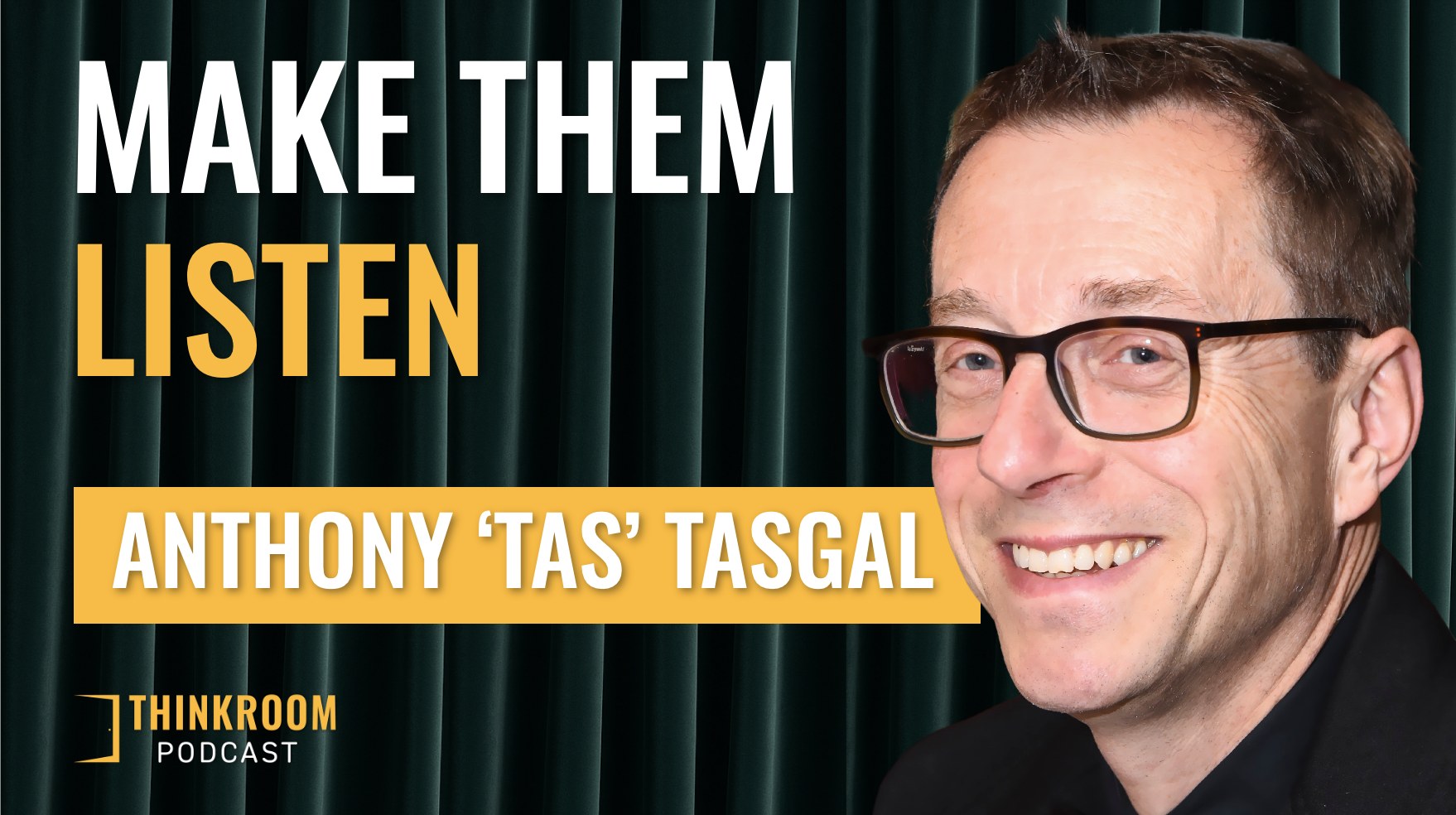
Anthony ‘Tas’ Tasgal - author, strategist, and trainer - has one foot in the classics and the other in corporate strategy. From Homer and Cicero to brand campaigns and boardrooms, Tas has spent his career decoding how stories move people. With seven books published, he works globally with executives and companies to replace lifeless presentations and sterile strategies with narratives that captivate, persuade, and endure.
🔥 Key insights
✅ The lost art of persuasion
Data convinces the mind, but stories win the heart. What does it take for leaders to move beyond rational arguments and into emotional resonance?
✅ Fear versus hope in leadership
Fear grabs attention but rarely sustains action. How can executives balance urgency with vision to mobilize teams and stakeholders?
✅ Attention spam: the hidden enemy of strategy
Most corporate messages get filtered into irrelevance. How do leaders craft stories that break through noise and inspire followership?
✅ The narrative fallacy
Stories can liberate but also mislead. How do responsible leaders harness storytelling without falling into manipulation or demagoguery?
✅ Play as a strategic asset
In times of pressure, organizations tend to clamp down on creativity. What if playfulness is the hidden driver of innovation, resilience, and long-term value creation?
Read the full transcript
\[00:00:00\] **Johan:** Anthony TAs, Tasca.
Welcome.
\[00:00:04\] **Tas:** Good morning, Johan.
\[00:00:07\] **Johan:** I'm really looking forward to this conversation. I'll be brutally honest. Uh, I think it's gonna be fascinating. Uh, but for people who don't know you since, uh, before, what is it that you do and and why does that feel important to you?
\[00:00:18\] **Tas:** Uh, I think on Google now, it describes me as one word author, which is interesting.
Um,
as, uh, I mentioned to you, I, I like to get called Taz since I've been known that as. Since I was even shorter than I am now. Um, and actually conveniently, it now also works as an acronym. So if people want a sort of three word description of me, I'll say trainer, author, strategist.
Did you set out to be an author?
It's funny. I'd always loved books. I'd al I've always been a voracious reader. Um, and I'm sure we'll get onto this later, Johan, but I, I studied Latin, Greek and ancient history at university. I was obsessed with stories and books and writing. Um, and I'd always do, always did a little bit of sort of writing as well as speaking.
And I, I did think one day, yeah, I'd like to have a go. I like to have a go and yeah, here we are, seven books later. So
\[00:01:14\] **Johan:** there's something, 'cause I've obviously had to confront it with one book under my belt. Um, yeah. As well there there's something, 'cause I also, I have this reverence around authors, ideas, books.
Always been an avid reader and, and really felt a connection through books to something much greater. Yes. And it's weird that I can't really, uh, internalize the identity to me. Uh, almost like it's, um, I don't allow, it is almost like an ego thing. I don't know. Doesn't does it get easier with time? 'cause you've, you obviously are an author.
\[00:01:50\] **Tas:** Yes. I've sort of come to, come to that conclusion now. Um, I was, I was, I came across a quote, which I think might be from sort of Cicero, um, in Latin out, Libery out Libery. Which is a beautiful pun in Latin. It means you either have children or books. Mm-hmm. I've managed to just about to have both. Not seven, thank God.
I'm seven children, three children, uh, which is enough. Um, but now I've sort of, I'm quite comfortable with that now. And because I do a lot of speaking as well, I just find all of those sort of different legs, the speaking, the writing and the training, and also just working with brands and, and on strategy and communication.
I think one of the joys of that is, is actually being able to dip in and out and pick things from one area and learn things from one area. Um, and that's what I think just keeps me curious really. So,
\[00:02:43\] **Johan:** so one of the things that I look forward to discussing today is, is kind of the art of storytelling, but through a very specific lens as well.
You mentioned Cicero and the Romans and, and these very old ideals. Uh, you're a marketer by trade and. I'm an ad man. Yes. Yeah, exactly. Or at least you were. How did you end up so fascinated by storytelling?
\[00:03:07\] **Tas:** Well, it's in a sense, it was like a return, really. So, so the second act, so my first act was, as I said, I studied lass in Greek ancient history, um, since I was like a child and always assumed I was gonna go into academia and I had a sort of possible job in that area.
Um, and then I met as, as often these things, do you know how I met a woman? And, uh, she, uh, wanted again to work. So she worked in market research. So I thought, okay, I'll, I'll try having a proper job. Um, so I applied for this thing called advertising and especially something called account planning, which people have said is a bit more, it's not just pouring Perrier, which is what account managers do.
Um, and I didn't think I was up to like being a creative or an art director or. A writer, writer. So I thought it'd be quite interesting 'cause it was about psychology, it was about human behavior, and I thought advertising, if you like, was about creating stories. Um, so I fell into the sort of world of account planning, uh, and then made two discoveries.
One was that, um, an awful lot of brands didn't seem to want to tell stories. They just wanted to beat consumers around the head with facts.
Hmm. Which
I always thought was maybe not the right way to do it. And secondly, I was exposed to more presentations than I ever thought possible. Uh, almost all of which were unbearably dull.
Hmm. Um, so because I hadn't lost my interest in homeroom Virgil and everyone else, I thought, well actually, why don't we apply some of the thinking or some of the ideas or just some of the practices of storytelling. Whether it's in order to make brands more relevant, motivating, emotional, um, or even make our presentations less awful to to watch.
So all the time these were sort of going under the, the surface. So after working quite a while in the ad industry, um, and then getting bored with the idea that the answer to every question was a 42nd television commercial. Hmm. Um, I thought I'd give it a go, go back to my first love, uh, and look at how I could use storytelling in both of those areas.
So that's sort of the origin story really. I think
\[00:05:25\] **Johan:** it's interesting 'cause you could absolutely argue that Homer went viral a couple of thousand years ago and, and, and sustained the virality for a couple of thousand years, which is. Really impactful. Uh, and we're kind of drenched in information. Um, yeah.
But lacks stories a lot. Like my world has been strategy for the last 15 years. Hmm. And strategy is a lot about selling the vision on of where are we going and, and what's unique and perhaps a little bit contrarian in how we do it. So storytelling fits into that perfectly. And both in the internal narrative of how do we build engagement and the external narrative, how do we build attraction?
But I do think that my reflection is that so few people are good at storytelling. Storytelling. It really feels like I lost art in many ways.
\[00:06:20\] **Tas:** It is one of the, the, uh, I have a number of like, you know, sayings and mantras, which I'm sure we'll talk about over the next hour. Um, so one of them is that numbers numb us, but story stir us.
Hmm. So after a while, our brain just gets numbed by sort of numbers, facts, information, just by being bludgeoned into submission, but stories stir our emotions. Mm-hmm. So, again, as in, in most Latin LA languages, romance languages, motion and emotion are the same. Mm-hmm. In English, we say, I feel moved. I was moved by that.
I was moved by that music. Um, so you're absolutely right. So I often say my, my role, my mission, if I use that humble, humble term, is to restore, restore storytelling, restore the lost art of storytelling. Um, and you mentioned the word strategy. So again, as somebody that used to be a planner and ad agencies, I'm legally obliged to use the word strategy at least once every half an hour.
We're doing quite well. It's about 15 minutes. And again, um, uh, when you, and I've talked in the past, you had, um, uh, you know how obsessed I'm with etymology, where words come from. Um, and strategy is what I think is quite a fascinating word. 'cause when I lecture at universities to students, um, they'll say, oh, it's very complicated.
We've had to read loads of books about strategy, or loads of articles about strategy. I say it's actually really simply, if you go back to the origin of the word, ergos is the Greek word for general. So I just say, imagine a general standing on the top of a mountain, and in the background are the enemy, the infantry, their cavalry.
So the general's decision is how does, does they, how do they deploy their own infantry? How do they arrange them? And the ar the word for arrangement in Greek is taxes from which we get tactics.
Mm.
So I would say Stratos is just, you are on the top of a mountain, you're having the big picture. That's all a strategy is.
And the best way of making a big picture come to life, I think is, is through having a story. And I think good leaders, good speakers. Good statesmen, politicians know that. Um, and there's a great book, it's over there, I'll dig it out later, by a man called Philip Collins. Uh, not the guy who was in Genesis, um, who was Tony Blair, the UK Prime Minister's speech writer.
Um, and it's a really interesting book about great speakers through the past. And he talks about Pericles in Peloponnesia war. He talks about Martin Luther King. He talks about at least one, if not both of the Obamas. And again, when you look at these people, you realize that that ability to, to tell a story and create empathy is a really important feature, not just for sort of politicians and statesmen, but for leaders, people who call themselves strategists.
And as I say, it's, it's part of what I'm interested in, which is how do you create that sense of, of empathy and emotional sort of involvement with an audience.
\[00:09:19\] **Johan:** Do you find that. I would imagine that for, for the Greeks for example, or for the Romans, there wasn't necessarily a separation between the, uh, world in which they inhabited, they lived the, the kind of rational, logical world and the mythical world.
And do you find that the, the very distinct separation that we've tried to do, especially in the business world, run like fact logic, uh, goes against our ability to tell successful stories?
\[00:09:52\] **Tas:** I think I could, I need about half an hour to answer that one. Yeah, it's interesting. There's three, well, there's, let me try and unpack it.
'cause you mentioned rational. And when you say rational, I, I immediately have to put my behavioral economics hat on.
\[00:10:05\] **Johan:** Hmm.
\[00:10:06\] **Tas:** So my three areas that I'm, I sort of write and talk about storytelling is one, then behavioral economics. Insight, and I'm sure we'll talk about all of those. Um, so when you talk about rationality, you are right.
We've, we've become in sort of broad Carmen terms, uh, in business, we've become absolutely focused on system two and facts and rationality
\[00:10:30\] **Johan:** and system two, for people who don't know that specific work is
\[00:10:35\] **Tas:** what condoms popularized a man called Stankovich came up with. It was system one and system two. So there are two processes going on in our brains all the time in parallel, and it's a slightly artificial, uh, division, but it, it's, it's still worth using.
So system two is your conscious, rational brain, which is hopefully listening to what I'm saying now later and thinking about it. But system one is your unconscious or your subconscious. Um, and Freud was half right. It's very powerful. Carman calls it the secret author of Our Choices, which I like. Mm-hmm.
Uh, but Freud was wrong in thinking it was just populated by dark myth freak myths about incest. Um, but what is happening is that all the things that evolution is working on to make sure that we survive and thrive happen in the unconscious. So our emotions are there to regulate our behavior, to direct our behavior, which is why emotions are so important.
So you are right. Business often goes wrong in, in defaulting to this very narrow, rationalistic logical way of thinking. And there's a great quote, which I always attribute, um, to man called David Eagleman, um, a very bright and annoyingly handsome, uh, neuroscientist axis. And he says, we don't think the way we think we think, which I just think is a beautiful piece of writing apart from anything.
Um, so again, when I'm doing training on this with clients or students or whatever, I'll just say, we like to think, don't we, that we're rational, logical, and independent. But I think probably in our heart of hearts, we know that most of the time that's not true. Hmm. Bring it back to the other part of your question, Johan.
Is, um, funny enough, in London there's a, a production of the back eye, which I'm hoping to see, which for me was just the play that I read in, uh, ides play in the fifth century, b, c, a. And it's about Dionysus, the goddess, the God of luxury, indulgence, wine, sexual behavior, et cetera. Um, and how he tries to come to Thieves and the King of Thieves, Pentheus resists that.
And it's not too far, I think to, to look in that at that play and think that was the first way of exploring in a sort of poetic, dramatic way, the difference between the, the power of the rational, but also not ignoring the power of the emotional.
\[00:13:06\] **Johan:** Hmm.
\[00:13:07\] **Tas:** The very play and spoiler alert, you know, it doesn't end well for Pentheus is really about not forcing yourself to abandon all of the emotions and because that is what makes us human.
So again, one of the things I think that ties up a lot of what you are sort of suggesting Johan and what I've talked about and written about is in business we've tried to do that. We've tried to sort of almost minimize, I think the emotional, and obviously people I work with who are creative know that you can't do that, you shouldn't do that.
But often in business, because business is often led by, directed by, I'm gonna be rude to various groups of people now. So apologies in advance accountants. IT people, engineers, academics, scientists, often they have a way of thinking, which as I say, tends to sort of diminish or actually just depend on anything that is ra.
Yeah. Anything is emotional. So a lot of what I'm doing, especially at the higher levels of working with CEOs, CFOs, is just saying to them, do you realize this is what you are doing? And do you realize that you are depriving yourself, your customers, your stakeholders, your colleagues of all the richness that is involved in storytelling and emotion?
\[00:14:22\] **Johan:** Yeah. 'cause one could quite easily imagine in, in. The mental image of, of the strategos, uh, the general standing on top of the hill and, and his, his true arrangement. If that is solely a mathematical equation, there's something missing in that we're fighting for something bigger than ourselves, perhaps for the protection of our, our, our families, for our legacies.
Yes. For, for our freedom, whatever it is. And if you have one strategist who, who taps into that, that will quite massively impact the, the, the troops, the morale of the troops. Um, yeah, I do agree. But do you find that there's a, a primarily, when you talk specifically to the business audience about these concepts, is the reaction, a squirming reaction that this feels very uncomfortable or is rather a longing for a permission to finally let free What, what's the gut reaction that you meet A lot of times,
\[00:15:22\] **Tas:** um.
I know English is not your first language, but that is a beautiful use, like squirming. You're right. A lot of, a lot of this language, I think is about, again, acknowledging the human side of, uh, behavior. So yes, I do feel, I was in um, uh, Amsterdam about two weeks ago. I think I mentioned to you, funny enough, working with a Swedish company in Vaal.
Um, I was working with their procurement people, which I found very odd. I thought, why did storytelling procurement, you know? Yeah. Usually I hear the word procurement and I run away screaming because I've got three hours filling in a spreadsheet. Um, but they were really good and they said, no, we are, we are in procurement.
We have to negotiate, we have to do deals. We understand, again, human behavior. And I found it really refreshing 'cause they were very open. They said yes, we know we are very spreadsheet driven. My definition of an accountant, by the way, is somebody that really wishes human beings with spreadsheets. Um. And I, it was really quite refreshing.
'cause often when I work with people from marketing or communications or strategy, they're often sort of quite cold and they often don't want to open up. But they were really, they were really good about this. So I, I think that's interesting. And I think there were two emotional, one emotion and another, I dunno, whatever it is, that, that really are incredibly powerful.
And I think we have to acknowledge them. And again, partly it goes back to the Greeks. So of all the big six emotions, which are gen, there's a big debate about how culturally sort of driven they are. Uh, but Paul Ekman came up with the six emotions, which are sort of expressions, facial expressions.
Hmm.
Um, anyone who's watching this, if you don't wanna listen any further, just watch Inside Out.
But then Oh
\[00:17:12\] **Johan:** yeah. Ooh. I, I listened to a podcast with him. Uh, now that you mention it, it's a beautiful movie. Um, it's great. Together with our kids Yeah.
\[00:17:21\] **Tas:** About teenagers. Yeah. If any anyone who's listening or watching has teenage children go watch Inside Out too. Um, so yeah, one of the big six emotions, and I would argue probably the most important one for human survival is fear.
Hmm.
And again, I think it, it is one of those things that we have to be honest about and acknowledge. Because a lot of this is about, you know, self-awareness and fear drives an awful lot of what we like to think of as rational behavioral gut instinct. Mm. A lot of it is fear. Fear of doing something different, fear of being exposed, fear of being wrong.
Um, bit of ology.
\[00:18:03\] **Johan:** Fear is interesting and, and tricky in so many ways because one of the consequences of fear, I've been unpacking this for, for, for myself a lot, especially over the summer, is that there's a self censorship that you end up doing a lot around fear. You, you kind of reverse, uh, justify a lot of, of, um, decisions or, or bets that you don't take.
Um, and it, it's, it's tricky. And now it became more, more psychological than storytelling. But, uh, it's tricky because it's so self-censoring that you don't realize that you self-censor. As the slave to fear. And it's really empowering to start dealing more directly with fear, pulling it out in the light, you know?
\[00:18:50\] **Tas:** Yeah. I mean, I, I, I was about to give another bit of etymology since it's, I don't know, 10 minutes or so since I've done it, um, which is, uh, error. So we talk about error in English failure.
Oh yeah. You know,
you've made an error. Um, and again, if you go back to the Latin Re, um, IRA in Latin means to wander to, to severe all over the place.
And yes, there's a slight negative element to that. So again, in English, we were talk about driving erratically, you know, the person was driving erratically.
\[00:19:22\] **Johan:** Did it used to have a, a negative connotation to it? Or is it something that we in the more modern society has a science
\[00:19:28\] **Tas:** to? It's more modern because, um, I think it was Tolkien who wrote, uh, Lord Rigg said not all those who wander are lost.
\[00:19:34\] **Johan:** Hmm. Yeah. Beautiful.
\[00:19:36\] **Tas:** And it, the, the Latin era. And also in, in, I think in sort of, um, social sciences and social work, people will talk about ab errant behavior. So behavior that deviates from the norm, again, deviates the same Latin word, it means to move away. So via means just root away. Um, so I always like to say, uh, to people, it's okay to to be error, to make error, an error 'cause you are not all is, you are wandering.
So I think we've gotta legitimize failure.
\[00:20:09\] **Johan:** Do you think that a lot of these, these kind of con negative connotations as a recent through almost like the Christianity culture in a, in a sense because, uh, when, when you mention, uh, being erratic at as something more wandering without the destination, that that could also be very positive in terms of open explorative.
Do you feel that a lot of, of these ideals of, of conformity has a recent through more monotheistic religion?
\[00:20:41\] **Tas:** Um, yeah. I, I, I probably should be slightly careful here, but, um, I think you're right.
If you look at, um, the Greeks and then the Romans and then you look at the rise of Christianity, Christianity and them trying to sort of remove a lot of pagan, what they considered pagan beliefs again about, you know, sexual conduct, about all sorts of other areas. Yeah, there's definitely, there's definitely a sense of of authority.
Control and submission. And again, it's, it's all there in the back eye. That's exactly what happens. Ionis says to Pentheus, stop trying to control this. It will end badly. Um, and it, and it does. And I think one of the other things that I throw into the mix, if I can, um, somebody asked me, uh, recently I was talking about behavioral economics.
What's the single most important, most significant driver of human behavior? And I usually answer confirmation bias.
Hmm. Other
words, because our brain, and I haven't really talked about the brain very much, but that's, you know, what drives all of this? Because your brain runs on energy. Your brain doesn't wanna make the best decision.
He wants to make the most effortless decision because the brain is something like 2% of the average person's body weight, but the brain consumes something like 20 to 25%. All the energy. So I always tell again, my people I'm training or talking to stop thinking about the brain as a computer or a sponge.
It's actually a muscle and one that draws energy and needs energy. So anything that makes the brain use less energy is gonna be a good idea. So think about changing your ideas about something. So whatever you wanna think about, you know, what's going on in the world, Donald Trump, any, whatever, it's not in your brain's interest.
Having invested all this energy in believing X. Hmm. Suddenly throw all of that out and invest a lot of new energy in believing why. Mm-hmm. The reason that economists go wrong, and often business people, accountants, politicians, is they think. Here, you know, you may have your own beliefs, but here are some better ones.
Mm. And that's just what the brain's interested in. The brain's not particularly a lawyer or a scientist, it's more of a storyteller. And as I say, it's also more interested in conserving energy. So confirmation bias means the brain will go out of its way to ignore anything that doesn't conform with what it already believes.
\[00:23:21\] **Johan:** And how, how does storytelling tie into this? Is, is it the sheet code to, to kind of bypass the confirmation bias? Or is it to, to anchor it better into already existing concepts or,
\[00:23:33\] **Tas:** I'm gonna say both. It might seem odd, Johan, but you're right. Yeah. It's a cheat code. And often when I get asked this, how do you overcome confirmation bias?
Mm-hmm. Storytelling is a great way of doing that because the joy of storytelling, of which obviously I can talk about for ages. Um, your brain is in a diff a different mode. If I start telling you facts or giving you statistics, your brain goes into sort of analytic system too. Mode.
Hmm.
But your story with a moral, your brain is in a different sort of mood, different tone.
Hmm. And the whole point of, of me talking about storytelling is to say to people, if you can create a story that is captivating, that is emotional, that draws people in, that makes them care, and then you can slip some facts in there. Mm-hmm. More likely that you are going to affect people's behavior.
Mm.
The other thing you said, which is fascinating as well, 'cause I don't get off this very often, is the downside of storytelling. So there is something called a narrative fallacy, which is the dark side of what you were just asking me about, Johan. In other words, our brain, because it's designed to think in stories, often we can be misled.
The power of storytelling. And Ian, this is why politicians of all, you know, of all denominations know the
\[00:24:58\] **Johan:** populists. I would assume that they're, they're quite good at capturing that.
\[00:25:02\] **Tas:** Yours, not mine.
\[00:25:04\] **Johan:** No, but that's one of the things, it, it's also dangerously interesting to experiment with the fact that populists on average are excellent storytellers.
Yeah. Whatever you think about their politics, they're really good storytellers lot of the time.
\[00:25:20\] **Tas:** Oh, we got, we've opened up a whole new front now here. Yeah, man. Uh, 'cause I'm gonna use the word demagogue.
\[00:25:27\] **Johan:** Yeah.
\[00:25:28\] **Tas:** So again, if you look at, I mean, I dunno, you can take this out if you like Trump or Ban Putin, whatever, you know, these are, as you say, they're populist demagogues.
Um, and again, anyone who's interested, by the way, I'll plug the new book, the classical marketing book. Yeah, go ahead. Um, um, and one of the things I talk about is the power of politics and stories on it. So again, one of my favorite, um, people ever was Aristophanes, who wrote a number of very satirical, very funny, biting political comedies, again, around the era of Peloponnesian War 4 34, 4 0 9.
Um, at the time, later on there was a demagogue called Cleon. And everything you read about Cleon, you can look at demagogues now. And in the last several hundred years, somebody who pretended to be on the side of the people was mainly interested in self-enrichment and leading the people to his own ends.
And Aristo was vicious about Cle, absolutely hated him. Now in the US you know anyone who's listening around, you know, this, uh, 22nd of September last week, we saw another front opened up by the US government in their attempt to. Quell any sort of opposition. You, I took Jimmy Kimmel off air for criticizing, you know, the Trump administration.
So for me, I look back at this, and I think this has got, this has literally got history behind it. Mm. The hundreds, thousands of years now, we've looked at people in, in positions of power who cannot tolerate dissidents, and we look at what they do. So the Trump administration forcing Kimmel off air or getting Colbert, um, not renewed.
These are issues. These are topics which again, go back to and a half thousand years, which is one of the reasons I still think they're valid.
\[00:27:26\] **Johan:** But if we assume that part of the populist charm is the ability to tell. Really captivating stories. Hmm. I remember growing up I used to love reading fantasy and yeah, especially the, the kind of rites of passages of, of young majors, magicians, and experimenting, wow, I have suddenly all of this power.
And then, and there's this choice of will I use it for good or for bad? And there's this tension there as well and this pull into ego versus, uh, service. And I think it's fascinating how uncomfortable we probably are with what can be the dark arts. So much so that we who want to serve the light are afraid in a sense of the tactics or, or the skills of those we see serve the dark so that we as a consequence stay away from storytelling, for example, because we see as something that only the populist politicians do.
Uh, but in my world, and it became quite, uh, uh, a question of morals here when we talk about politician is so, so divisive. And, and to me, the skillset are quite separate from, from the content, right? You have the moral choice, what you do with the skillset, but the skillset in itself is just a skillset, the ability to tell a story, right?
And it's your choice if you use that for good or bad.
\[00:28:58\] **Tas:** Yes. Um, there's a great book, uh, it's on my shelf somewhere. Uh, I think his name is Drew. We. Uh, American Democratic strategist and it's called I think, the political brain. Um, and he is both a neuroscientist and a, as I say, democratic strategist in the US And you know, it's a fascinating argument, um, that especially in the us which is where he comes from, but elsewhere, that generally the right, the right wing is happier using emotions and stories.
He, he usually, he talks more about emotions, but also mm-hmm. And he gives examples of campaigns in the states, which were very, very emotional and also quite sort of fearmongering. Mm-hmm. And he says, usually in politics the left are less happy using emotions 'cause they worry that they're manipulating the people.
Mm-hmm. And I think it's a fascinating discussion and I, I often get into it and I, I think he's right. Um, and in the UK I can't mention the, the B word. Brexit because I will stop, you know? No, I, I can't go there. Um, but we, we found that in the, in the uk the campaign to, to get Britain out, which was obviously a complete disaster.
Um, used fear. It was the fear of immigration. It was all about that and the absence of control and all those sorts of things. So you're absolutely right. I think the, the politics of storytelling or the storytelling of politics is a whole fascinating area. And I think, I think it would be more sensible if we all understood the power of storytelling and then agreed that as long as we, we understand how it works, that we also understand the narrative fallacy, that we might be leading people by the power or seducing people by the power of storytelling to do what isn't right.
I think it would be, it would be more sensible if we just understood, as I say, collectively across different. Societies, cultures how storytelling can work so that we're also alert to, if it's being used against us
\[00:31:06\] **Johan:** now, there's, yeah, there, there's two arguments that could be made you, you can be more alert to, to when you're being manipulated.
Absolutely. Whereas also filling the void with storytelling that is in service of something good, right? Yes. So it's filling the world with what you believe is, is
\[00:31:26\] **Tas:** the right thing to, yeah. I just, I wanted to talk a bit about schools actually. 'cause I have a bit of another mission actually. Yeah, go ahead.
Which is, uh, at the end of one of my books, I think it was the Consumer Behavior book, which was one on behavioral economics. Um, I sort of issued a plea to local authorities and governments around the world to bring this to schools. Probably storytelling, storytelling, and also behavioral economics. Okay.
For me, those are opposite sort of sides of the same coin.
\[00:32:00\] **Johan:** Yeah. I can see that.
\[00:32:01\] **Tas:** Teach pupils, because increasingly now, not just with social media, but across all media, people are exposed to not just branding, message, political messages, social messages, and I think it's really important that people are equipped with these skills from an age of 11, 12, 13, so they know what people are trying to get them to do.
Mm. So whether it's, you know, buying Nike versus Haded ass, or drinking less alcohol, or, you know, voting in a particular way. So I, I have said this and I've had a couple of conversations in London with different authorities about trying to bring it into a, a school curriculum. So behavioral economics, understanding why you are emotionally driven.
Politicians and brands are trying to target your emotions. As I said the other side of that, why you are gonna be much more easily seduced by a story. So again, whether it's online, social media, Instagram, whatever, and again that you are aware of what people are trying to get you to do. I dunno, maybe in five or 10 years we'll see Johan, but I do think you so
\[00:33:11\] **Johan:** much that I wish that the school, especially in, in system one, took a bigger ownership in, I, I've been reflecting so much about why do we learn all of the different lakes in Sweden, which I remember was one of the big tests when I was 12 years old to be able to name all the different lakes and we have plenty of lakes in Sweden.
Um, but why didn't I ever get any even attempt at under or, or or at teaching me about my own relationship to my emotions, for example. Like that, that's interesting to me. Where, where do we put our attention? And, and it's squarely into system two all the time.
\[00:33:54\] **Tas:** Yeah. Again, I, I was just talking about this, um, a talk I did about the new book, uh, the other day.
Um, and again, someone was asking me about my, you know, origin story. Um, and yeah, I remember when I was, what, 14, 15. Um, so we get, we get taught Shakespeare, you know, 'cause you're English and you know, he's pretty good. You can't, they can't argue that. Um, but I remember picking up, um, Oedipus Rex and thinking, I couldn't believe this story.
'cause it was like, and I, I'm sure I'm not the first person to say this. It, it seemed to me the world's first detective story. Hmm. And spoiler alert, um, you know, it was the detective who did it. Um, I remember reading the story and thinking who's soles and who is who he ja casta and EDUs. And the fact that he realizes gradually it's pieced together.
He doesn't wanna admit the truth. I thought this is just what, this is amazing. I love, you know, you like fancy, I like detective stories as well. Mm-hmm. And then I came across the backhoe and they came across all these other examples and I thought, this is stuff that are we allowed to read this at school?
It felt, and it wasn't matter.
\[00:35:08\] **Johan:** And it's also fantastic how, how ate often feels. Uh, I was surprised I reread the works, not the complete works, but some of the works of, uh, SAR Conan Dale, Sherlock Holmes over the summer.
Yes.
And it is fascinating how. Absolutely modern. It is in its, uh, emotions, in its writing.
It doesn't read like a book that has the number of years on it that it has. And I would imagine I haven't read that much actual, uh, ancient, uh, Greek or Roman literature, but I would imagine it's, it's quite similar or surprisingly similar.
\[00:35:47\] **Tas:** It's, and again, all these issues, the reason why I've written about it in the book and I talk about it, is.
I dunno if I used the word timeless yet, but I'll Now these are timeless things. You know, these are about discovery, these are about birth, these are about identity. They're about the power of the subconscious. They're about sex and they're about extraordinarily open. And this was the flowering Greek renaissance around sort of fifth century, where you effectively had philosophy, tragedy, comedy, democracy, a limited form of democracy, but democracy.
Um, you had Plato, you had, and in that short period of time, largely in Athens, but not just, you had this extraordinary outburst, this creation of all these sort of ideas and an architecture, of course the splendor of, you know, architecture and the partner. So for me, what's fascinating is just seeing in modern society and, and I was, I went on a tour yesterday, we had this thing called Open House in London where you can go on free tours.
So I did a couple of them yesterday. So I went to some Roman baths in London. Mm, any big city, um, a lot of the big monuments, museums, whatever, are based on Greek, doric, ionic, cian cos and why? Because we want to sort of continue that sort of tradition of learning and tion. So all those things sort of haven't, haven't gone away.
And again, politics, if you look at the Peloponnesian War between Athens and Sparta, again, it's a brilliant story between two different, completely different characteristics. The Athenians were outgoing and thoughtful and emotional and creative. The spawns were inward looking and militaristic and okay, there's some lit, excuse me, a little bit of simplification in there, but by and large, that was true.
It was the original clash of cultures. And if you look at what's going on in global politics now, there is an awful lot of clashes of culture. Hmm. So again, look back and see, I think you used, used the term right at the beginning, Johan through the lens. We can look through the lens of the past and think about the present in a different way.
And that's another element for me that we can learn from
\[00:38:10\] **Johan:** when diving deep into the intersection of, of the ancient wisdom and modern marketing. And what was the kind of surprising revelations for you doing this work?
\[00:38:26\] **Tas:** I think a lot of it, um, I'd sort of, again, what was interesting for me was I learned this at school before I went into advertising.
I had no idea. 'cause people said to me, people who knew me when I was, what, 21 or something said, sorry, you spent all your life with Homer Inversion and Aristophanes. And now you're gonna work with Pergo and Cavalry. And so I pointed out that Nike always is a Greek word. It's the goddess of victory. Um, actually a bit of, a little bit of it.
So a bit of, so not etymology exactly, but brand origins. Right. So Nike again is the Greek goddess of victory, but people dunno. Asics. So I'll tell, I'll just brief digression for your listeners and viewers. I, Asics, which hopefully most people know as a, a sports brand. And everyone, I, every time I ask people, they'll say, oh, is it basics without a beam?
No, it's, mm-hmm. That so was a Roman satist, I talked about aristo, that juvenile was a Roman satirist in the first century ce. Mm-hmm. And he wrote these again, absolutely devastatingly, uh, violent, aggressive political satires. And he gave us a few expressions that we still use. So he coined bread and circuses.
In other words, what you need to keep the people happy as long as you give them bread. And yeah. He also said quiz custodian custodial days. Ipsos, who will guard the guards themselves?
\[00:39:50\] **Johan:** Oh, yeah. Uh, famous from a Will Smith movie, uh, much later. Yeah.
\[00:39:57\] **Tas:** You don't have to look too far in politics again to ask that question.
Um, but the other thing he came up with is healthy mind and a healthy body. Wow. Which again, we know men's sauna incorporates sauna. The lain. Now the people behind Asics like that expression, but it didn't quite work. So they swapped, they changed the word mens, which means mind as in mental, they swapped it for anima as in anime or animism, which means soul or spirit.
So they be, it became Anima. Sauna incorporates sauna. A-S-I-C-S. Asics.
\[00:40:37\] **Johan:** Mm-hmm.
\[00:40:38\] **Tas:** Wow. So there you go. Little bit of fantastic. As I said, I can't, I can't resist that. Um, but no, I mean, I, I think one of the other things that I wanna pick up that you mentioned was fantasy. 'cause again, so much storytelling is fantasy.
I mean, one of the areas that I like bridging between storytelling in its sort of natural form and how we can use it is I often say when you're doing a presentation, excuse me, when you're thinking about a brand, think about it as a what if, what if we did this? What if this happened? What if this didn't happen?
Because some of the greatest stories we all know are what if stories. Hmm. So, you know, 1984, what if we imagined a sort of fascistic future George or Will Animal Farm if you imagined everything as animals?
Hmm.
The one I always ask again, because I'm a huge film fan, I haven't talked about films very much yet.
Uh, what if you woke up every day and it was the same day?
\[00:41:39\] **Johan:** Yeah.
\[00:41:40\] **Tas:** Groundhog Day.
Hmm.
Um, what if you woke up every day and it was the same day,
\[00:41:45\] **Johan:** Groundhog Day is Apple's, uh, think differently campaign part of that idea, would you say?
\[00:41:52\] **Tas:** Yeah, I think it is. I mean, and, and so many campaigns are good. Good brands are, you know, a great, um, I think it's called Baraka.
It was a vitamin, um, supplement campaign and I really, really like their line. And it was you, but on a good day. Yeah. And I, I like, I think that's something clever because it, it plays into that way that the brain, there's a whole thing about the brain now, which, sorry, I, this could be a lot. I'll try and cut this down because, um, there's a wonderful thing in behavioral economics called ironic process theory.
Okay. So if I ask you now, and anyone who's watching, just to close your eyes for five seconds, happily, don't think of a polar bear.
Hmm.
Okay. Most of you will have thought of a polar bear, even though I said don't. And a man called Daniel Wagner coined this ironic process there. He said, your brain often, ironically, processes the very opposite.
\[00:42:50\] **Johan:** It's funny, it really brought me back. I remember being introduced to this idea when I was 14, 15 years old by my father. Exactly. That story. I think it was penguins, but still, uh, it's, yes. It's, it's come back to me, uh, over and over again, and I'm so annoyed by I tried to tell my 8-year-old girl, girl it, and she's all, no, I didn't think about it.
And it annoys me because I remember it was so powerful for me.
\[00:43:17\] **Tas:** Well, I'll say to most people, even if you said you didn't, I don't believe you. Yeah. Because what happens is, well, system one, which we've talked about is that. It will throw up a picture of a polar bear. Your system too will go, no, no, no, no. He said, Don, and you'll, you'll try and come up with a penguin and it's usually a penguin or something, but most of the time you can't, you can't stop that because it's, it's unconscious.
So a lot of these things are, are unconscious. And Edgar Alan Poe has a, wrote a lovely story about this, and he called it the imp of the perverse.
Mm.
He says that on your shoulder is like a little impm, like a little devil, and it's telling you to do these things. And it's a great story about a man who's condemned to death.
It's a short story. It's a really good story. And he called it the imp of the perverse. But what it means is we often end up saying the opposite or creating the opposite effect, uh, from what we want. Which again, is one of those little behavioral economics tricks, if you like, that I, uh, that I quite like.
So yeah, it's another one.
\[00:44:19\] **Johan:** Do, do you find that modern storytelling has. Tilted more and more towards fear-based storytelling. Uh, and the reason why and, and how does that perhaps interconnect with the shorter and shorter attention span that we give stories. It's a reel. It's two seconds, three seconds. And, and you have to kinda jump directly into the highest possible trigger, which is probably fear-based.
Uh, whereas the truly magnetic stories to me is more like you talked about Baraka, like the imagination of who I could be in, in the best version of myself.
\[00:45:01\] **Tas:** Yeah. So really, again, it's a really sort of big topic. Um, I think really, um, you talked about attention. We haven't really talked about attention very much.
So let's, let's have a flower on that. Now, I, again, I haven't mentioned insight really, which is my third sort of leg. Um, so lemme just tell you about an expression that I came up with by accident. 'cause in insight, insight. Um, I talk about insight 'cause I work in planning, a lot of research people present huge tomes of data and try to convince me there's an insight there.
Hmm.
Say no, just because you've given me a huge volume doesn't mean there's an insight.
Hmm.
So insight is about showing something new or showing something you thought you knew in a new way. Um, and my favorite quote is this, if you science fiction fan, um, Isaac Asimov, who wrote Foundation Books, foundation Empire Now, and iRobot mentioned Will Smith, um, had a great quote.
He said, scientists, when they come up with something new, they don't go Eureka. They say, that's funny. That's the Yeah, it's crazy, isn't it? It's the best definition of insight I've ever heard. 'cause your brain goes, oh, hang on. That's funny. Yeah. And often your, your eyes will go up to the, like the northeast, which I think is an NLP thing, and it means, oh, hang on.
I haven't thought of it that way before. So I ended up writing a speech for a client, and I was talking about the brain and attention and how do you create attention. I was typing attention span. If anyone's looking at their keyboard now, you'll see the letters n and m certainly most keyboards, I think in the, in Europe and the us, uh, are next to each other.
So I accent me typed attention, spam with an M and I thought, oh, actually I quite like that.
\[00:46:48\] **Johan:** Yeah.
\[00:46:49\] **Tas:** So that's become my go-to expression. Now, any, any piece of communication or brand or whatever you or speech you are giving, forget the facts, forget the, even the target audience. Your most, your most important goal is to avoid going into attention spam.
Hmm.
Because everyone thinks, you know, everything I say goes from my attention inbox into your attention inbox. Hmm. But I talked about the brain before. That just can't happen. Most of it will go into what I now call. Attention, spam. So the reason the link then, as you are sort of inviting me to say, I think is story is a great way of avoiding being sent into the brain's sort of junk folder.
'cause a good story involves people, involves the emotions. Emotions, it captivates people as we've said. And therefore it gives people a better chance of not getting sent into attention span. Now fear, which was the other thing you said, I think for the reasons I talk about in politics, fear is still the dominant emotion.
Probably in politics when I work with brands and we do an exercise on this, I always caution them about fear because fear is very powerful, but you have to be careful 'cause it can also lead to obviously, you know, negative thoughts. And um, so I did, I did talk at a cybersecurity tech conference and obviously there's.
It's all about fear, the fear of having your data stored, et cetera. But I always say to people, if you're gonna go with fear, I think you have to temper it with a bit of hope. So anyone who remembers Pandora's Box story of Pandora's box, which was mistranslation, it's actually a jar, not a box. Um, all the evils come out of Pandora's box and all that is left is hope.
So I'll say to people, yes, fear is powerful, but be careful. But one of the other emotions, excuse me, that I will talk about a lot is surprise. Because again, surprises incredibly has an, they all have evolutionary roles, as I said to you before. Yeah. So surprises role is to interrupt us and say, here's something that you need to pay attention to now.
'cause it might affect your chances of survival or thriving. So I'll often say to people, especi. People that we've mentioned who are a bit nervous, a bit controlling and strategists, maybe you need to be more open to surprise. Yeah. Because surprise, as I said, can do things to the brain that other emotions can't.
\[00:49:31\] **Johan:** There's so much interesting things to pick up on, on what you said here. Now I do think, I wanna double click down the thread of, so fear to me is interesting because it fits very well into creating a burning platform, which can drive revenue in the very short term, which fits again, into the, the kind of quarter economics of modern business.
Um, but there's no real reason to come back to ideas. Which I see that you have the reason to do a lot in storytelling. They suddenly pop up when you, you take a shower or when you go to bed, they, they kind of continuously evolve and become yours over time and you interject yourself in into these stories.
So it's so much potentially more potent, but over time in a sense. Um, and I do think that this, when you talked about attention spam, it's interesting because there's a huge lesson here as well for, for our lives in general. And, and this kind of connects over to a parallel discussion on, on the kind of evolution of modern, um, knowledge worker economy, which is, yeah, I, I believe that we're, and it's not my original ideas here.
Um. It's weird how we've kind of transferred the, the mechanics of, of the industrialization into knowledge work and how we started to, um, measure productivity really, really weirdly. And I think a lot of the, the kind of stress and the, uh, feeling of um, not being enough comes from the idea that you only produce when you can actively be seen as producing.
And I'm personally on a mission to, to really wage war against, for example, distractions. Slack is on my notice a lot right now because yes, we have this ability to be directly in touch and, and there's a kind of false sense of being productive and you can fill your whole days with just small tasks, but move absolutely nowhere towards the mission that you're actually on.
Uh, and I kind of fantasize about this. Way of life that I'm striving towards, which is being high impact in everything I do. But choose deliberately what I do and distraction and, and attention. Spam is right in the middle of the problem.
\[00:52:12\] **Tas:** Um, again, anyone who, who knows my, my work, uh, I haven't mentioned the other word that I like using, which is arimo.
So Ari Moss, the Greek word for numbers. So a while ago when I wrote the first, wrote the storytelling book, I wrote the whole first chapter, which was Why do we need storytelling? Hmm. My argument then, and I don't think it's changed 'cause it's coming up to its 10th anniversary, this book in about a month.
Uh, and it's managed to sell 40,000 copies globally, which is alright.
\[00:52:46\] **Johan:** Congratulations.
\[00:52:48\] **Tas:** Uh, I just said, look, and again, it was because I've sort of still, partly in the business, advertising, marketing world, I'd noticed a shift, and it's what you've said, but I, and in my particular way, in this particular way was the obsession with, with metrics.
Hmm. And APIs and measurement. And I realized that I was like King Canute. I couldn't push the, the water back. I wanted to say to people, I think we've gone too far down that end of the spectrum now. Everything has to be about measurement control, um, KPIs, productivity efficiency again, which is a word that I loathe.
'cause for me there's efficiency and effectiveness.
\[00:53:29\] **Johan:** Yeah.
\[00:53:29\] **Tas:** Again, as somebody that used to work in advertising ideas, um, often you can't prove that these ideas will work. But you have experience, you have creative people, you have planners like me. You say, okay, we think this will work. If you try and measure and predict.
It's efficiency, you are probably gonna go wrong. So I felt that I needed to rant about Arimo and it hasn't changed. I don't think it's, if anything it's probably got worse because of big data. Hmm. But all I'm saying is to, to CEOs or CFOs or whoever. I understand why we need metrics. I understand why we need to have these things to measure and budget.
I get that. But appreciate one that you can't simply measure everything. A lot of things that are important that we talked about, emotions, quality, the quality of the brand. Well how do you measure that? So it chimes with what you are saying. I think, um, Johan, 'cause this, it goes back to um, um, FW, uh, was it FW Taylor's Scientific Management where he wanted to think of in as workers, he called them intelligent gorillas.
Hmm. And I think you are right. We've transferred a lot of that scientific management to knowledge workers. I'll point about knowledge and ideas and insight and creativities for me, they're all linked and insight. They're all linked. And we talked about error and wandering and I think we need to just sort of move away from that.
And again, you are right, it's, it's partly a Protestant thing, a Christian thing. This thing about efficiency and doing things the right way and measuring it and control and all of those things for me are the opposite of what we should be encouraging people and not just, you know, sort of adults and knowledge workers, but even sort of kids, students.
\[00:55:22\] **Johan:** I wonder what happens if we extrapolate it even further and say that part of probably why, the fascination of being able to almost predictively prove the efficiency of something. Model it out business, case it out. Uh, lean on. Logic behind all decisions perhaps also comes as a consequence of our, the ization.
Sorry, the, my English finally fell through there. But like we, we, most of us don't have a conscious relationship with faith. Like I, I, I can't prove it, but I know it to be true. Uh, and therefore I, I look for proof that I can feel and measure. So it's not even just a, a, uh, Christian thing. It's, it's a, a complete move away from everything that's not observable in the, in the more scientific way.
\[00:56:28\] **Tas:** Yes. Uh, fate. Right. Okay. We've got to fate now. Destiny. Um, I've been watching it. If you watching on Netflix, Sandman. And series. Um, and again, it's an interesting blend of different myths, a lot of Greek stuff in there, um, and a lot of his own thinking. And he, uh, the main character Sam man, is dream. So there's a lot about dream, but also destiny, desire, delirium.
Um, and you can't study Greek Roman sort of mythology without looking at fate and destiny. And they had different words for that and they had different ways of thinking about it. So you had the oracle of Apollo and the, the thing that Greeks were very smart about was they realized that the, or often the oracle wouldn't give you the exact truth.
It would give you a slightly ambiguous, and there's a very famous story and it's, oh, I can't, I think it's DURs King of Persia, um, who goes to an oracle and says, you know, should I invade Greece? And the Oracle says, if you invade Greece. A great empire will be destroyed.
\[00:57:36\] **Johan:** Yeah. But you don't know if it's yours or theirs,
\[00:57:38\] **Tas:** and it turns out it's his empire.
Yeah. Yeah. One of the things, again, I think is brilliant about sort of, um, you know, EDUs Rex, the, the play, et cetera, is this sense of irony
\[00:57:48\] **Johan:** and the Greeks funny before you move on. Such an interesting confirmation bias happening there as well, because if I remember the story correctly, he, he naturally interprets it as the, the, the enemy's empire.
Right?
\[00:58:01\] **Tas:** Yeah. Also, just, I'll get just a slight diversion. Um, I talked about the Spartans before. Mm-hmm. Um, in English we have the word laconic, which means very sort of short and concise. And that iconic is is another word for Spartan. Uh, the Greeks call them spart spart, but also ladi mono. Hmm. There's a couple of great quotes that I use about Spartans.
Uh, I think one of 'em is from PLU Tar, um, and one of them is incredibly concise. It shows a fantastic understanding of Spartan mil military culture. So, um, the Spartans would carry their shields into war and there's an expression that was attributed to Spartan mothers when they sent their sons to war.
And in Greek, I can't get it, it's right. FHA or N hair literally translates either you, either on it or with it. Mm-hmm. You either come back with your shield, so you are, yeah, you survived or you come back dead on the shield.
Philip of maced was, was gonna attack Sparta before he took over Greece, father of Alexander.
Um, and he sent a message to the Spartan saying, um, if I, if I invade Sparta, you know, you'll be destroyed. And the Spartans just wrote back, if.
And again, something that's interesting in story in a, it's a brilliant piece of communication. It shows that you don't need to write sometimes incredibly concise.
\[00:59:34\] **Johan:** That's one of the beauties I think in general of writing and then kind of grappling with ideas and is this your quote?
I seem to have it some where smart people make complicated things. Simple, dumb people do the opposite. Is that your quote?
\[00:59:54\] **Tas:** Um, it's Earnest
Hemingway. I use, I use it a lot, but no, I mean, I think it's one of the things that no one's entirely sure, but probably Ernest Hemingway. And it is a great quote because again, if you look at people in, in, you know.
Strategy or the higher levels of business. Hmm. That whole thing of jar jargon. Ification of making. Yeah, absolutely. Things sound more, more clever. Um, one other I don't think we've mentioned very much, which, which you were talking about in the previous question you asked me, Johan, was about efficiency, productivity.
Hmm.
The word that we need to encourage more of is play. Yeah. And I think you, I've talked about this and, you know, we have people in common who, and again, I think it was, there was a, a Scottish band, uh, from the eighties, nineties called Huon Cry. I'm trying to bring as many different cultural references into this, by the way.
So if anyone's not familiar with a band, Huon Cry, a guy called Pat Kain, um, had a different life and he started researching the idea of play, especially in Scandinavia actually. And he wrote a book called The Play Ethic as opposed to the work ethic.
Mm-hmm.
And this, again, I'm guessing it was maybe 30, 25, 30 years ago.
And again, I thought it was really interesting. And he did look at Scandinavia and he did look at other cultures where playing is okay. Playing is creative rather than, again, putting people into kindergartens and schools from a very young age and forcing them into a particular Mm. You allow them to, to play.
And obviously the whole Lego, you know, the culture of Lego in Denmark.
Mm.
And again, that does sort of, as it were, play into everything that we've been saying about storytelling, about ideas, about creativity, the opposite efficiency, the opposite of our eth. So again, when I talk to people about education and schools, part of it's saying allow people to play more.
\[01:01:48\] **Johan:** Yeah. And also not separate play and work. That's been one of my realizations. Yeah. From a discussion with Eric d, a previous guest on a podcast he observed. Very interestingly to me that people tend to kind of naturally accept that while playing, you can be very creative and you see a lot of creativity in, in, in playful professions such as, uh, standup comics for example.
And they're fantastic story times. That's how we ended up discussing it before when we met last. Um, but his concept was that in, in a work environment, you, you around the, the kind of startup Google style of, of organizing, you have ping pong tables and, and you have all of these kind of artificial playful things at the office and he observed that.
But that, that's wrong. It's not work then play. It's when, when you really want to gr get into creativity, it's working playfully. And that's to me what's such an interesting nuance to play and work as well. And there's a certain level of. The, the, the worst economy in a company, for example, the less they tend to afford themselves playfulness.
Uh, but probably it's when they need it the most. So we think about playfulness as something almost as a luxury, right? And I think it's, it's true no matter where you look, if, if you're intensely unsatisfied with kind of your life or where your mental space is, you're never playful, right? You're being more and more strict on yourself.
Uh, so, so I think it's brilliant. They, they bring it up. And this is for me, an area that I'm just starting to explore and I'm looking yeah, quite forward to, to lean in more towards what are your insights? What, what can you give us on it?
\[01:03:48\] **Tas:** Yeah. There's another quote, which I think is George Bernard Shaw, the English, uh, writer, playwright.
Um, he said, we don't get, uh, we don't stop playing because we get old. We get old because we still playing. Yeah, that's fantastic. And that's an, again, a nice sort of little, you know, piece of thinking. Um, and you're right. I mean, I, I think that you mentioned comedy, right? So I've gotta talk about this now.
Um, I was, I've always been interested in comedy, not just Aristophanes, but just Olten comedy. So I grew up with multi Python and all sorts of, um, and I've always, I've always actually written, um, and performed, um, a bit of comedy, including standup. But one of the things that I've, I've again, sort of learned, especially with insight, really, and I talk about it in the insight book, uh, insight for me has the same feeling as comedy.
So an insight for me is like a punchline. Mm. To a joke.
\[01:04:45\] **Johan:** And there's that element of surprise that you were talking about before as well.
\[01:04:50\] **Tas:** Exactly. And there's a, the, the technical term, which again, I wouldn't worry if no one remembers in Greek, is parapros ian, which means it goes against what you expect.
Hmm.
So again, the example, I usually use two fish in a tank and one says to the other, how do you drive this thing?
Hmm.
Because your brain is going one direction and then suddenly it's yanked in another direction. And that is the feeling of insight. It's the feeling of, so I think good comedy does that, and that again, that's why standups, and it goes back to what we said about, you know, what's happening in the us what they'll do is they'll show us the world, but they'll show us it's slightly as skew or show us a slightly different in behavior.
\[01:05:32\] **Johan:** And I think that's true for great strategy as well, or, and great innovation as well. It's necessarily. Completely foundational research and, and something suddenly we, we unlocked quantum computers. Like most great innovation is actually the combination of two already existing things. Yes. Yeah. But packaged together, they deliver a value that wasn't available before.
Uh, and there's a surprise to it and there's an element of delight in it.
\[01:05:59\] **Tas:** Yeah. I mean, the idea, again, of insight of putting things together, and I, I use a couple of examples. Um, one, because again, I'm a film fan, which is Mel Brooks, who's, you know, comic genius. He wrote about, you know, when he was writing the producers back in the sixties, he said, I had an idea about sort of some business people trying to swindle old ladies for money.
And I had an idea as well about how could you make the worst play ever written? And he said, one day those ideas just came together and. The same was said about, um, Suzanne Collins said she was in a hotel room one night. She was flicking through the channels on the television, and on one channel there was a war documentary, and the next channel there was a reality game show.
Hmm.
And she said that's how the Hunger Games was born. She literally said, what happens if you put them together and you see creative people and writers and scientists doing this all the time, saying,
\[01:07:00\] **Johan:** but coming back to openness of, of like, in order to be able to put those two together, you have to again be open to those expressions.
And, and again, it all kind of comes back to probably fear. I think it's so the more fearful and self-limited you are, the less open you are to, to kind of seeing those things. And it's interesting, you, you talked about human emotions. One of the emotions that I've been deliberately trying to, to, um, introduced into my life is the feeling of awe.
Um, which is yes, lost or was lost in my life for, for quite a long time. And it's also one of those things that's almost a hundred percent dependent on openness. Yeah. Because awe can exist in the smallest of things, the way the light touches, uh, a tree or, or whatever. It doesn't have to be the kind of profound moments in life that actually when, when your first child is born, obviously you can feel all at that time, but it's so present, but we don't see it.
\[01:08:06\] **Tas:** Yeah. Yeah. Um, and all is considered to be one of the next level emotions, not the big six, but, okay. And, and again, it's, it's slightly been devalued by this expression of awesome, which is, you know, oh, yeah. All that's, which is a completely different thing though. Uh, it's, I mean, often the word is used, the sublime.
Um, and again, one, I'm interested in art. And if you, you look at art, art creates all. And there's, I think there's a term for it. I think it's called Stone Dale, Dale Syndrome, the French writer who said he went to, I think it was the Zi Gallery in, in, uh, Florence. And there was, I forgot what it was. There was a painting and he said, I literally stared at this painting and I was transported.
And again, that's interesting 'cause that's a we'll we use in storytelling. Storytelling transports you. Yeah, absolutely. A sense of awe. Um, and the sublime. Now again, I don't wanna get carried away and say, well, advertising, but sometimes really good ideas, whether they're in advertising or they're pieces of art, or things that people say or it, that sense of awe I think is something we should always be, be aiming, you know, aiming towards and, you know, sort of great art and great thinking, great movies, you know, I think can create, can create that sense of awe.
And I think you are right. Fear. Fear is the enemy of a.
\[01:09:31\] **Johan:** Yeah, it's a hundred percent how to approach this practically and trying perhaps to, to close this conversation, which has been fantastic task. I'm very thankful for it so far. Right. Um, but say that you're a business person Monday morning. Um, what do we bring with us because it's so philosophical, so existential, uh, built around a lot of almost self work in order to be kind of open, less fearless, more audacious in, in a sense, but how to approach this?
What, what are the kind of practical steps that we can walk through?
\[01:10:12\] **Tas:** I think, I think the practical steps are firstly just stepping back from efficiency.
\[01:10:20\] **Johan:** Yeah. The ness of all things.
\[01:10:23\] **Tas:** Yeah. This, the worshiping. Worshiping at the altar of efficiency, as I like to say, is gonna get you nowhere. I mean, if you're an accountant, fine maybe, or procurement.
I get that. But we all have lives. You know, I always say to people when they look at the, when they write them their own descriptions on LinkedIn or a cv, I'll say, come on this. There's no you here, you may sound like you make yourself sound like another, just another worker or just another, you know. And often my students, I'll say, you know, you speak three, four languages, you know you are interested in art, you're bring that.
That's the bit. And I think in business and work, we need to bring more of that.
Hmm.
To our jobs. To our cultures. And I think good companies and cultures are doing that now. And I think whether it's changing because of people working more from home after COVID or, I dunno, because I own three children, um, and my daughter is sort of, she's just gone to DBC to work now to do some research.
So, um. And I'll say, you know, do, do lots of other stuff. And she's having a sabba, she's traveling. And it's great that young people can do this 'cause she will see things which are awe inspiring. Mm. We don't know. That's the joy of it. We don't know because of our brain if we go to an exhibition, right? So I'm a huge fan of the surrealists.
I love them are Greek, Dali, whatever. Um, I went to Sicily and I saw lots of great Greek architecture. I dunno where those ideas will go, but I know that some point in the next weeks, or months or years, they will lead to something. So I often say, again, it's under insight. Johan, is I have, um, a, a, a folder on my computer and I call it PUD, which I borrowed from man called Stephen J.
Gould, uh, scientist. It stands for previously unapplied detail. Mm. So sometimes I'll do it on my phone, like if I'm reading a book, I'll just write a note and I'll put it into my PUD file. I dunno what I'll do with it, but if I'm on a train or a plane and I'm bored, I'll look at this folder and I guarantee my brain will go, oh, okay.
Do you know what that might be? So that's a practical thing that I recommend to people. You do this individually, but also you do it as a company, as a culture. You have an intranet where you have that equivalent where people can just put in, you know, I went to the football the other day, man United and just guess.
Or, I saw this piece of art, I read this article, and if everyone you use it, it becomes a sort of cultural hive mind for insight. And I think that is a, it's not
\[01:13:00\] **Johan:** giving yourself permission to step back in order to do those things. Yes. And I completely agree with, with the kind of obsession, manic obsession around efficiency and.
How easily it creates a lot of movement without direction. Yeah. Um,
\[01:13:23\] **Tas:** and I know a, a number of companies, especially some of the bigger famous ones who can afford to, will say to people, you have one day a week where you can do whatever you want.
\[01:13:33\] **Johan:** Yeah. Google is famous for that. I don't know if you still have that practice in place though, but they for sure did it for a while.
\[01:13:40\] **Tas:** I think it's brilliant now. Okay. There's a efficiency, you know, implication, but if you want to keep, and also I think keeping people happy. We haven't really talked about happiness much. And I think all the things I've talked about about storytelling and playfulness and the things that you talked about, about the, the opposite of efficiency.
I feel they will make us happier people. And I think if we're happier people, obviously there are all sorts of benefits, but it will make us better at what we do as well.
\[01:14:08\] **Johan:** A hundred percent. I, I feel there are kinda a massive agreement with. Sentiment that the current way of doing things isn't working. I think a lot of what we're missing is that, but what do we do instead?
Uh, and if you don't, since you're, you're into the kind of behavioral economics, uh, I remember. Reading about a study that was, uh, a group of students who, who were kind of challenged to put away their social media for 30 days. And there were two groups, uh, yes. Who were being studied and, and one group kind of white knuckled it just called Turkey, quit it, uh, didn't manage, uh, the 30 days.
And you had this other group that really filled it with something else. Um, and were quite aggressive in terms of, of putting things in that was positive. And I think it's the same here that we, we all experience that the busyness of, of just doing things for, for, for the sake of, of doing them doesn't work.
But we don't really have the recipe or have spent enough time to understand the recipe. But what do I fill it with instead? And that is a story that needs to be written and manifest for, for kind of the modern office worker in a sense because I, I don't. Think people are happy. I think that's quite clear.
\[01:15:32\] **Tas:** No, and and I think you're right, and there's obviously the study of happiness. There are different, again, Greek words. So happiness is not just hedon air as in hedonistic. That's pleasure. Yeah, you need some pleasure, but you also need satisfaction. So there are three elements of happiness, head and air pleasure, but also satisfaction and the absence of dissatisfaction.
\[01:15:56\] **Johan:** Mm. Yeah.
\[01:15:57\] **Tas:** And I think that's, that's the third one that we often forget in our work. Often we create so many elements are dissatisfying to us. So there's no point in trying to make people happy and joyful and play table tennis if there are lots of elements of dissatisfaction and a lot, one of the words that's used a lot in the happiness literature is again, a Greek word you, which means flourishing.
I think that's a better word. I've forgotten the guy whose name, who, who wrote about happiness will come back to me after we finished. Um, this idea, ani the idea that you are flourishing. So again, um, the American, uh, American Czech, American, Hungarian guy, chick Hanley talks about flow. We've all heard about flow.
\[01:16:40\] **Johan:** Yeah, absolutely.
\[01:16:41\] **Tas:** Writing or speaking, whether you are running that moment where you are in flow, everything just feels, again, we need to create more opportunities, I think in our work lives to feel flow. Um, and again, it's not something we are going to sort out in the next five minutes, your hand or in the next week, but I think however we can continue this, I think it, it's got to be something that, that works.
And as I say, my children are in their sort twenties and thirties now, and it's, it's their generation I think needs to stop this practice. Some of it's happening maybe, but it's not, it's not really yet widespread.
\[01:17:19\] **Johan:** Well, what's the word for. Uh, the, um, not having friction or not having dissatisfaction. What was the word for that?
Um, oh, I know
\[01:17:30\] **Tas:** the one you mean. It's just got got up my head now.
\[01:17:32\] **Johan:** Uh, yeah. Anyway, the, the point I was making wasn't necessarily about the word, it was just me being interested in it. Um, but I do think the, the pull not to feel discomfort, I think is partly also what pulls us into the, uh, doom scrolling because it kind of soothes that itch of, uh, uncomfortableness right?
And releasing dopamine really, really quickly. Yeah. And Angela Duckworth famously brought grit, uh, talking about how we don't really have a relationship to, to when things are, are going against us in a sense. And I, it's interesting all of these kind of ideas and concepts are, are fundamentally the same.
And I think the most fascinating takeaway for me, at least in this conversation, is how we undervalue system one in a sense, and the massive cost of doing it. Like you, once you start unpacking it, that's what, that's what we've been doing today. Like there's the hugest of upsides in, in becoming persuasive in your storytelling for your business career, whatever.
But fundamentally, and even more importantly, for, for your own flourishing, right?
\[01:18:47\] **Tas:** And how we're in field enough on completely left field thing, maybe to finish with was that I, um. As a classicist. I took some friends around, uh, the British Mu British Museum recently just to show them the Roman and Greek galleries.
And one of the things you have to show them is the Rosetta Stone 'cause it's the most visit, um, um, exhibit in the British Museum. And it's a fantastic story about how it was discovered and deciphered. And there was, again, it's an Anglo British argument as ever. So there was a guy called Thomas Young who just did an awful lot of the discovery.
But the French guy, Jean Ion, was the guy who finally did the decipherment after Napoleon. And it's a brilliant story and I recommend anyone to read it 'cause it's just has suddenly layers. But the thing I just thought might tie some of this up was the guy Thomas Young was often said to be one of the last men who knew everything.
Because you have that enlightenment era. No. If you had that enlightenment where the division between like science and art didn't really exist. Newton had originally been an alchemist. He believed in alchemy before. And you realize that that division now not just being system one and system two between art and science is also quite negative.
Hmm. So again, one of the areas I think that ties up and use the word thread, I haven't mentioned the golden thread yet, which is very unusual for me. A story is always, always about a golden thread. So I think that thread that's run through this conversation, maybe Johan is about trying to reconcile.
\[01:20:17\] **Johan:** Yeah.
\[01:20:18\] **Tas:** And er Wilson's a biologist, he used the word consilience. Which means to jump together, not resilience, but consider to jump. And I think one of the things about making things jump together or link together or threaded together is again, arts and science. And I'm saying this partly 'cause the book that I've written that's coming out next to you, Johan, is called Putting the Art Backing Marketing.
\[01:20:43\] **Johan:** Hmm.
\[01:20:44\] **Tas:** Um, which is again, as we've said, reducing this obsession with science and often the wrong science, which is physics and trying to bring a bit more arts into marketing. 'cause again, I think that will help us all. So
\[01:20:57\] **Johan:** yeah. And I think we've created this idea of a very false dichotomies that yeah, these are actually polar opposites and one can only be true.
And I think that's dangerous and quite sloppy thinking, to be honest. Uh, but it create it, huh? We need more independent thinkers. In order to kind of unpack this in the, in the modern environment. Tass, this has been a fantastic conversation. I'm so thankful for your time and I wish you all the best with the, with the, the current book and the coming books.
And, and thank you for being on and sharing your wisdom.
\[01:21:33\] **Tas:** Pleasure. And I, I've got to say, we've, we've roved across such territory, Johan, I don't normally, normally it's much more narrow and it's about stories all about, but we've, we've covered all sorts of topics, which I never would've expected. So it's been a pleasure.
\[01:21:46\] **Johan:** Yeah,
that's the beauty. Yeah. Thank you so much.
\[01:21:48\] **Tas:** Speak to you soon.
That was Anthony 'Tas' Tasgal on ThinkRoom — where exceptional minds think out loud.