Prefer audio? Listen anywhere
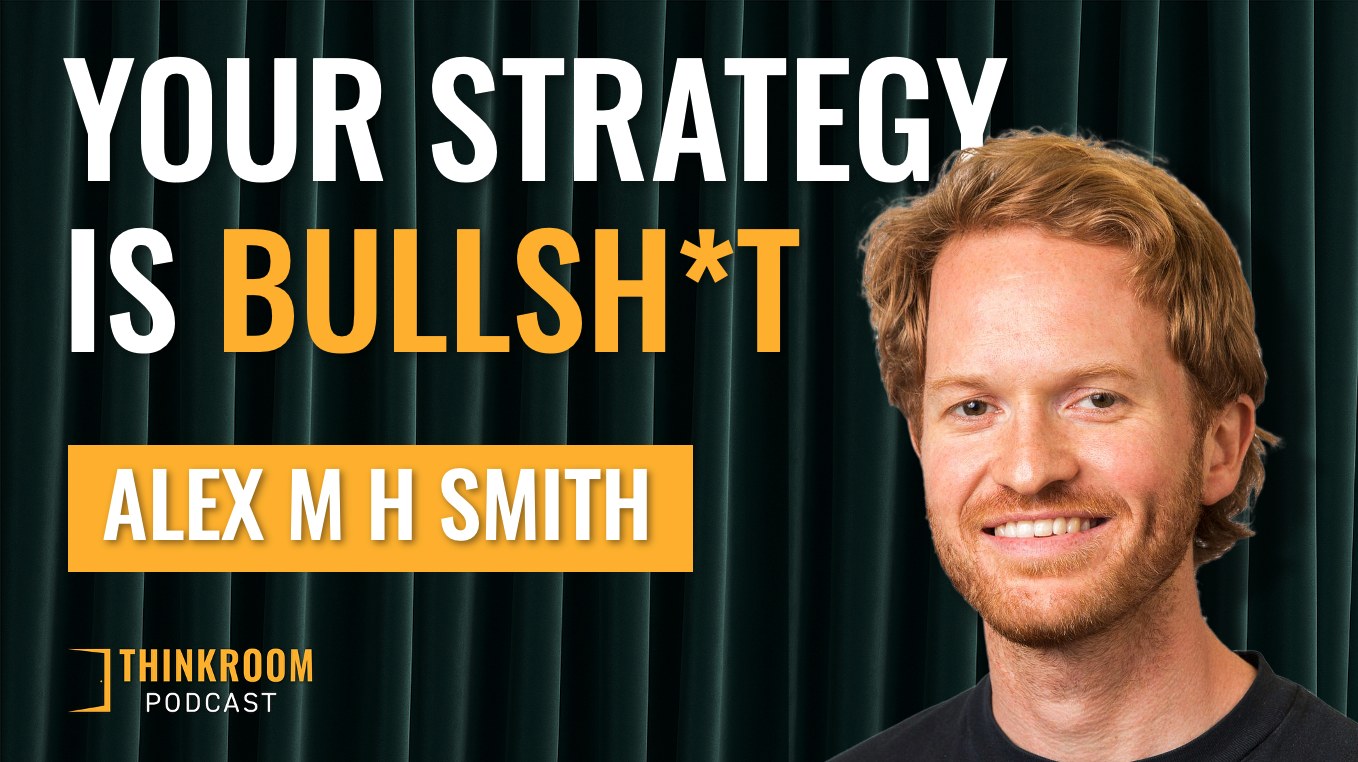
For most businesses strategy is a façade. PowerPoint decks are polished, mission statements are aligned. But underneath the surface, most companies are just reacting. In this episode, Alex M H Smith rips the veneer off our collective delusions about strategy and asks a far more interesting question: What makes a business fundamentally unignorable?
This isn’t a conversation about frameworks. It’s about the difference between businesses that magnetize customers and those that scramble for attention. At a time when AI, noise, and short-termism are eroding differentiation, Alex offers something rare: clarity.
If you’re a founder, executive, or strategic thinker, this episode is a mirror you might not enjoy… but won’t be able to look away from.
🎙️ Meet Alex M H Smith
Alex is a self-taught strategy thinker who stumbled into the field by obsessing over why some products don’t need marketing stunts to succeed. He’s not just another voice regurgitating Porter or Blue Ocean Strategy - he’s created his own language, grounded in direct experience and a deep intuition for value creation.
His journey from naive agency strategist to TEDx speaker and founder of the consultancy Basic Arts is rooted in one question: Why do some businesses attract loyalty, attention, and love without trying?
🔥 Key Insights from the Episode
✅ You Probably Don’t Have a Strategy
Most companies mistake a to-do list for a strategy. According to Alex, fewer than 1% of businesses have truly cracked the “unique value code.” Why? Because they’ve never asked: What do we offer that people want — and can’t get anywhere else?
✅ Only > Best
Trying to be “better” is a race to the bottom. Being the only one who does what you do? That’s strategy. But spotting true “only-ness” requires disagreeableness—a rare trait in consensus-driven companies.
✅ Strategy is Dictatorial by Nature
This may sting, but Alex argues that real strategic clarity almost always comes from a “benevolent dictator” mindset. Consensus muddies. Vision sharpens. So if you're a CEO trying to be liked, you may already be losing the game.
✅ Execution Dies Without Ruthless Prioritization
Even great strategies die in the hands of nice teams who can’t say no. Execution isn’t about doing more—it’s about killing what doesn’t matter. The true bottleneck? The psychological discomfort of deciding what not to do.
✅ AI Can’t Replace Judgment — But It Can Accelerate Strategy
AI won’t give you your breakthrough idea. But it can drastically speed up the patterning process if you use it right: let it prompt you, not the other way around. The future belongs to those who merge sharp human judgment with smart AI scaffolding.
▶️ Don’t Just Think Strategy. Feel It.
If you’ve ever wondered why your strategy document feels sterile — or why nothing actually changes after a strategy offsite — this episode will challenge your core assumptions. It’s a rare conversation that’s both intellectually provocative and uncomfortably practical.
Give Alex a follow on linkedIn and on Youtube, or at basicarts.com
Read the full transcript
134 Alex M H Smith
\[00:00:00\] **Johan:** Alex, welcome to the show.
\[00:00:02\] **Alex:** Thanks a lot for having me. Great to be here.
\[00:00:04\] **Johan:** You are, to me, one of the, the true kinda outstanding and, and unique voices on LinkedIn, on strategy. Uh, and I remember us speaking just a couple of days ago that there's, there's plenty of people on strategy, but you're one of the kind of pure strategists out there.
how, how come you ended up there?
\[00:00:24\] **Alex:** Uh, pure ignorance is probably the real reason was, uh, to sort of go at it, to answer your question in reverse, I think one of the main reasons is that there are so few people who are pure strategy. In other words, business strategy, let's call it, as opposed to a subset like brand strategy or something, uh, is, is because there's no market for this.
Nobody buys it and such market as there is only exists in very, very high corporate fields. So you'll have somebody like Rod Martin would be the obvious example of a pure play sort of high corporate strategist. And he can get away with that. 'cause he's dean of some business school and he's doing consulting projects for, you know, general Electric and Ford.
And so in, in that world it is a thing, but that's a very, very rarefied world and that can't support lots and lots of people. And so that's why I don't think that there are any other people who are stupid enough to do what I'm doing, which is in a sense what Roger Martin is doing, but for, you know, kind of lower businesses.
Uh, and so I ended up there because I was originally in. In a, a sort of marketing agency, ad agency. And, uh, this was a very small below the line agency. They did nothing approaching strategy at all. And I was just an account exec. But the good thing about a small business like that is obviously, you know, there's the potential for you to force your own path.
Yeah. And somehow I cottoned on to this idea that in big sexy agencies, there were people called strategists. Mm-hmm. And it was, and bearing in mind, I'd never met one of these people, I'd never worked with one of these people. I could only speculate about what they did. Um, but, you know, I guess in my head at the time, I thought, oh, it's something, it's sort of what happens in between.
Account handling and creative
\[00:02:23\] **Johan:** strategy has this kind of sexy sound to it, doesn't it?
\[00:02:27\] **Alex:** And it does have a sexy sound to it. Yeah. Uh, so basically I said. I had sort of minor renno in this agency because I'd set up their research and evaluation department basically just, you know, evaluating the effectiveness of campaigns.
Mm. And so this gave me free of internal credibility to say, Hey, why don't you let me set up the strategy department? Mm. Even though I have no what it is, I'm just gonna like do what I think it should be. And, um, and we'll see how it goes. And, and as it happened, it went very well. It went very well because the agencies that this agency was competing with, they also did no strategy.
So this simply gave this agency a little bit of competitive leverage where it didn't otherwise have it. And provided that what I did wasn't completely stupid and destructive, it was always gonna be a, a sort of a, a bit of a success. So in doing that, I obviously developed my own way of, uh, defining what sort of marketing strategy, comms strategy, campaign strategy.
Uh, and then as I was doing this, um, I started to notice basically that some clients that we had required a lot of strategy, by which I mean they required a lot of clever creative thinking to make the crap that they were selling seem appealing. Unique. Yeah. Whereas at Unique and all the rest of it.
Whereas some clients, the minority, they came along and you were like, damn, this thing is just really good. Yeah. Like, we don't need to do any song and dance number to sell this thing. We could, we could just say, Hey look, hey, check this out, and people would want to buy it. Hmm. And so I became very, very interested in, um, what, what are the qualities that, that, that that minority of businesses have, which essentially makes creative marketing be a sort of bonus for them as opposed to being the thing actually relying on Yeah.
Push their products. Uh, bear in mind I had no, I I I had no idea that the whole sort of like business strategy, so to speak, was even a field or that, you know, if I, that there were books like Blue Ocean Strategy and there were people like Porter and all the rest of it. I, I didn't know, I never heard of any of this.
All I thought was I was developing a completely unique new body of thought about what, uh, about a sort of magical quality that certain businesses had, which meant that they didn't have to sort of, um, puff themselves up mm-hmm. With Creative Mo. And I was, I was especially interested in that subset of businesses like Tesla Lush Monster for a while who had a, who had a zero advertising policies.
Yeah. I was like, damn, if you a business who can be cocky enough to have a zero advertising policy, you must be so amazing 'cause you've got so much gravity. Coming towards you. So I developed all these theories, um, about just by observing basically companies that I thought were doing this well and, and drawing the patterns between them.
And then I went out on my own sort of as a consultant and tried to sort of sell this. And I was calling it strategy, but I, in my head, it was a kind of quite a unique body of theory. And, um, I then did a TEDx talk, which, um, got selected by Ted as the video of the week or something, or the video of the day, however they do it.
So it got quite a lot of views, uh, all about my sort of theory and got this nice feedback on it. But one, one bastard said in the comments, oh, this is basically just like the Blue Ocean concept versus the red ocean. And I was like, what are you even talking about? Like I said, I'd never even heard of like Blue Ocean Strategy.
And then like a year, maybe like a year or two later, I thought, oh, I better read that book. And I read it and I put my head in my hands and I was just mortified. I was like, shit like. Everyone's just gonna think I'd basically ripped off this book. Yeah. And then I quickly started to see that if, of course it's not just Blue Ocean strategy, but actually all, you know, Roger Martin stuff, Michael Porter's stuff, all, all of this stuff is describing the same fundamental principles that I'd been observing, which are universal principles.
Nobody invented the concept of the Blue Ocean or anything. It's just a, a tur, they admitted the terminology, they didn't invent the dynamic. Hmm. Um, everyone's just applying, um, different terminology to the same fundamental concepts. And I was just the latest in the long line of people who had done that.
So there was nothing original in a sense about what I'd done at all. But, um, but then I realized that, okay, well, so I'm not this sort of like mega genius who sort of invented a whole new body of theory, but because I came at it from such an intensely naive, clueless place, um. I had, it basically created a whole new set of language to describe these things that hadn't been done before.
I mean, blue Ocean was a new form of language for it, and now I've got my own other forms of language for it. And when you put new language on something, it opens it up to a new group of people who were not vibing with the old one for whatever reason. And so, sure enough, I saw that. Well, look, I don't think there's the idea that you can run a business, found a business without having read something like Blue Ocean Strategy to me is just nuts.
I mean, it is insane that you would ever think to run a business without trying to grasp these most fundamental concepts and what the truth is of,
\[00:08:03\] **Johan:** of the founders that, like how many have actually done it. I mean, I've been in this field for quite a long time as well, and I'm surprised at how few companies actually have a strategy as, as compared to, to just a, a random collection of, of, uh, tasks and actions.
\[00:08:20\] **Alex:** People who've actually studied the field as in like read a book like, um, blue Ocean Strategy, not 0.1% or less. Um, people who have got a strategy, not because they've studied it, but 'cause like me, maybe they sort of intuitively grasp what needed to be done, maybe 1%. Um, then maybe another 20% who have a think they have a strategy, but what they've created is not actually a strategy, it's just something else that they've applied the word strategy to.
That's like another 20%. And then 70 plus, 70, 60, 70% are people who have never even, it's never even crossed their mind to think that. To, to think, to develop something which they would even call a strategy. So they're in, those are the people who are in 100% reactive mode. Hmm. That, that, that's my, that's my estimate.
Does that align with your experience?
\[00:09:27\] **Johan:** Yeah, uh, sure it does. Um, I think like my, my main experience has been with mid to large size companies and all of them will have a document that's called the strategy. Um, I do think
\[00:09:39\] **Alex:** so. They might be in 20%, for example.
\[00:09:42\] **Johan:** Yeah. But it depends also the definition of what is the strategy.
Maybe that's a good starting point to kind of spark the conversation a little bit. Having worked with strategy for so long as you have, what's your current definition of how do you know that you have a strategy?
\[00:10:00\] **Alex:** So the most, to me, the most accurate way of describing it is the way that you are gonna give people something that they want one, but that they can't get anywhere else for. But you two. So I, so it's, it's a sort of, um, a two part equation because. To me, everything comes back to the first principles of what is a business, what is any business on the planet?
And it doesn't care. It don't care if you are like Halliburton or a kid selling friendship bracelets. You are doing the same thing. And that is, you are obviously trying to generate a form of value that people will be prepared to give you money for. So we can recognize like, just common sense. Um, the more successful a business is at generating value, the more successful they'll be at collecting value that is the entire game.
So when we understand that, we then know, okay, well step one is we have to give people something they want. And most people understand that, that you, you don't have to be very clever and strategic to understand, alright, well we've gotta give people something that they're prepared to give us money for.
Where most people come unstuck is that they don't realize that in order for this to work, it has to both be something that people want, but it also needs to be something where the only form of supply. Because if I start a company selling socks and I can say, everyone wants socks, therefore isn't this gonna be a successful company?
The answer is no. 'cause I can get socks from a million different places and then I'm gonna be dragged down into the quagmire of battling the thousands of other sock brands to sell my socks. So, uh, so if, if you work out this fundamental equation, which like I say in, in my book, I describe it just as the unique value equation.
Or another way, another, another, perhaps even more on point way of describing it is new value. Because I have found that when you say unique value to people, they will bullshit you saying that what they do is what they offer is unique when it really isn't normally when you, yeah,
\[00:12:06\] **Johan:** I think there's a bias towards like really wanting your product, services, whatever, to be more unique than they perhaps are as well.
So as you're you, you're wearing like blinds on in a sense.
\[00:12:17\] **Alex:** Precisely. So I have found recently that if you say new value as in it's a form of value, that until you came along did simply not exist in your category. Um, that, that, that sets a slightly higher bar for people I've found, um, that fundamentally is the game.
That's the game of business. Um, and you can run a reasonably successful business that doesn't do this. As we discussed before, 99% of businesses have no strategy. There are, there are many ways to make a buck. There are many ways to skin the cat you can just hustle with in an unstrategic way and you can make it work.
Mm-hmm. It's a, it, it's only a tiny minority of businesses that actually crack the unique value code because they've actually engaged with the fundamental strategic questions. And of course those are the businesses. Which we all pay attention to and everyone talks about and who make ridiculously outsized profits compared to their market average, blah, blah, blah, blah, blah.
So I think that's another interesting side point to say that strategy is very much optional. It is not a requirement at all.
\[00:13:32\] **Johan:** Hmm. How much of this is a question of the core of the product or service that you sell versus more the, the, uh, marketing and the perception of the value of it? Can, can you have a, a fundamentally a SOX company that is truly distinguished because SOX aren't new?
\[00:13:55\] **Alex:** Uh, yes. So, um,
the next part of the next thing to consider, I think, um, which, which answers that question, is that if you are claiming to offer a new form of value in your, in your category. Thematically, you must be doing something new. This is another issue that I, I see where a lot of people will say that they're offering something new, but then when I say, what unique feature act model, whatever are you using to generate that, they can't tell you.
So you are, you are very, very typically when people say, oh, I don't know, let's say their business is all, is all about great customer service. And I say, interesting. What, what, what innovation have you developed that delivers outsized customer service? And they can't tell you beyond, oh, we, we, we, we just do good customer service care more so Yeah.
Or we just care more. Exactly. So that's completely hollow. It's nonsense. So there has to be some hard, undeniable, unmissable factual innovation somewhere within the business that unlocks that new value. Now. The thing is, is that that innovation, the, when we say innovation, our mind, it immediately jumps to product features.
And sure enough, a product feature would be the most obvious form of innovation to generate new value. But there are actually obviously a whole bunch. I mean, I, I, I, uh, I, uh, simplify it down to nine forms of innovation. You could say more, you could say less, but roughly speaking, I think nine covers it. So for sake of argument, um, you know, product features is one form of innovation, but another form of innovation might be like your, uh, having a unique form of distribution or route to market mm-hmm.
Or another form of innovation might be a unique bundling of two things that you could get before, but they'd never been bundled. Right. So, um, the, and also to your point about perception branding. Can be a form of innovation if it is sufficiently aggressive and outrageous that it moves beyond just being nice presentation.
So into something that you could call an innovation. So I would say that Liquid Death being the obvious example, did something so unique with their branding that we can class that as not just branding. We can class that as innovation. Mm-hmm. So you can even just do it. You, it can be skin deep is what I'm saying.
If you push it far enough.
so this hypothetical soc company, I would generally say it's far more levers at its disposal to innovate and generate new value than what most founders think about. Because yes, a lot of people, even in the SOC business, they will say, look, Alex, at the end of the day, we're just selling socks.
I mean, a soc is a soc is a sock. And it's like, no. So is not a soc, is not a soc is not a soc. I, I, I could, I could list 10, not necessarily good innovations, but I could definitely list 10 innovations off the top, uh, off the top of my head. So this is one thing that people sort of like need to kind of get over this, um, this artificially limited set of, um, parameters that they can change within their category.
\[00:17:18\] **Johan:** Hmm. So in, in my world, there's always been like a distinction between like strategy formation, which is the body of work that you are involved in, and then strategy, execution. Uh, and there's like between the different consulting houses, depending on, on like, uh, depending on where they generate the most money.
There, there's a debate, like where where is actually the, the most money being generated? Is it the, the yeah, the more elegant the plan or is it the ability to execute? Do you have an opinion on that?
\[00:17:50\] **Alex:** Well, in some senses, this goes back to my horribly naive background because even though now I've got a reasonably big reputation in the world of strategy, I remain incredibly green and inexperienced within the world of the sort of, in the, within the strategy industry.
Like I, I fundamentally do not know if we, I don't know, we just take like McKinsey or something. I literally dunno what they do, um, as in like the shape of eng and stuff like that. So I can, uh, uh, so I can only speak to my, to my experience. Um, in the past I, because I was coming at this from a sort of the far theoretical strategy development end, and with no executional experience, obviously that's the path that I've been walking.
And obviously over time from, from a starting point where I was like. Man, you just give them the idea that unlocks it all, and then how hard can that bloody be? You just get on with it and just do it. I mean, I don't see what the complication is. Obviously, over time I've learned the error of my ways and you start to see, oh, the richness and difficulty of executing, even the mo no brainer strategy, perhaps even, especially the most no brainer strategy is, is almost limitless.
So in my own work, fundamentally, I don't really want to get deeply involved in, in execution, but I, but I've had to have been dragged into that because in the early days of my consultancy, the success rate of me just sort of dumping a strategy on a client. That the client accepts. You know, they always like it.
They always say yes. They're always like, thank you Alex. This is what we wanted. You never, it is never been a situation where someone said, we disagree with this strategy, or something like that, that, that, that doesn't happen. Uh, instead what happens is they get very excited and they say, yes, thanks a lot, Alex.
And I'm like, I've done my bit. I walk away and then check back with the company in a year's time and nothing, everything's exactly the same. Yeah. Um, my, my estimate there is that probably only about 20, 30% of clients had the wherewithal to execute the strategy. Um, uh, which, and also from a, from a case study point of view, as an aside, for me, that was always still, now it, it's quite a big problem because when you wanna point to a case study, you don't wanna point to this fabulous strategy.
You want to point to a business where you can look and you can see the strategy the second that you glance at it. Yeah. And you are like, absolutely. Shit that's very like binary and clear and not
many of my clients have hit that benchmark. So over time, yeah, I've obviously had to start to develop more and more theory and ways of doing things in my own naive sort of bottom up way to try and, um, to try and fix that problem and increase the percentage of companies who do an adequate job of.
Executing. So, yeah, I mean, I, I mean, I'd be, I'd be interested in your experiences with, with, uh, with execution, because yes, again, this is something that I have somewhat been, um, kind of making up from the ground up. And, and just as an aside, by the way, uh, one interesting thing I've, I've observed, which I'm sure will resonate with you, is that clients tend to think that they have executed when they haven't.
So if you were to press these clients and say, Hey, whatever happened with that strategy project with Alex, they're not gonna say, oh, it was good, but we just didn't execute it. No, they, they, uh, uh, they'll say something, oh yeah, it's great and we're, and we're doing it, and this is what we're operating to now, and happy days.
But, and I'm sitting there like, what, what have you executed? What exactly?
\[00:21:45\] **Johan:** I think. My experience, the, the core problem of execution typically comes from an inability to prioritize what truly matters. So the, the absolutely biggest problems is you spread your attention too broadly across too many priorities.
And this, to me, really comes as a consequence of, of two things. One is it's even for these senior people, it's quite uncomfortable to say no to stuff. Like there's always gonna be more opportunities than ability to execute. And, and especially like there's been this, um. Push for more inclusion in general.
I feel in leadership, like there's been, there's push against the command and control style of leadership the last 30 years. Right? And, and part of how that has influenced the, the strategic process or the rollout and, and anchoring of strategy across large organizations is that you want to build engagement by asking teams to kind of contribute themselves and, and how can you contribute into this strategic framework that we've developed.
And what happens is, especially for the companies that, that don't really have a clear idea of what is our strategy, it's, it's more a collection of, of like somewhat. Connected bets that we do, like the strategy might look like. Okay. Um, we need to, uh, launch our business into the UK and we need to, um, increase the leadership across the company.
And we have this new product launch in, in the end of the year. You, you kind of call this collection of, of strategic initiatives. Mm-hmm. This is our strategy. And what ends up happening when you don't really have a clear picture of this with a big T in the beginning is our strategy. Yes. Uh, is that it. It becomes very, very difficult to prioritize and when things are difficult to prioritize managers on the lower levels, they already have difficulty to prioritize because what they're involved with is their kind of operational whirlwind.
And that's incredibly strong because you have all of the, the kind of behavior change that goes into strategy, like doing anything new, even if it's the right thing to do, it's gonna be difficult to get both into the teams and to the team leaders and to the team members. And you have the difficulty because it's quite unclear how this impacts my.
My day-to-day business in a positive sense. And I did think part of the problem with strategy in general is the kind of delayed gratification in a sense, typically strategic efforts, that the payoff horizon is quite long and there's a risk element to it. And, and especially if you bring in very like, practical stuff into it, maybe your, your bonus scheme is, um, optimizing for, for a very short time horizon.
It's like sales this quarter on the traditional service offering that we have and building up this new capability, this new offering, whatever it might be. It might be a two year thing until it really bears fruit and maybe the impact is really outsized then, but I'm incentivized now. So there's uh, so many things that goes on making this quite problematic.
And I do think. I don't know if this is a Nordic thing. I've been working mostly in the Nordics. Uh, but I do think that there are very few great strategy story storytellers, if that makes sense, because you have to build this vision of like this soc company in the future and how, how incredibly much better it's gonna be later.
But I, I don't, I don't find that many naturally gifted storytellers.
\[00:25:31\] **Alex:** Let, let me, uh, let me stop you there because that was just such a fabulous answer that like, there's just, there's just so much I want, I I I, I want to jump on there. Um, I can, I can see that, you know what you're talking about. Um, so, so like the, if I could just like address it in a coherent ordered way, so it's one thing rather than five things.
The,
obviously I agree with everything that you put there. These are all the exact issues. The fir picking up the first thing that you said, and this is one of my more controversial opinions, but it actually unlocks everything else. Like, um, I strongly believe that strategy is a dictatorial game. Um, it's for an autocratic, frankly, kind of arse holish leader.
There is not another way of doing it. I mean, maybe in theory there is, but in practice it doesn't happen. Look at every single great strategic business leader in history, all of them were quote unquote problematic personalities. Yeah. And people think that this, people think that this is a coincidence that Steve Jobs, Elon Musk, Jeff Bezos, Richard Branson, et cetera, et cetera, leave a trail of enemies and bad press in their wake.
This is not a coincidence. This is how it works. And go back to my point before that you do not need to take the strategic path. There's nothing wrong with being a nice organization that is democratic and inclusive and all the rest of it. You can do that. Do it, but it's just not this game. Because then linking this to your last point, this is a game of large risk, big value creation and vision.
And that can only really be driven by the unreasonable perspectives of, um, of, uh, of a dictator. Um, and also to the storytelling point, these dictators obviously are also gonna be the best storytellers. Like all these, again, these, why do people still watch videos recorded in like 1982 of Steve Jobs talking on some internal conference?
Obviously he was a great storyteller and like, uh, and uh, and, and this all came from his, uh, from his unreasonable dictatorial vision, which couldn't be further from being inclusive or democratic. So obviously what you have now, most founders and chief executives, just like most people, they're not naturally that person.
But you have to, in my experience, you have to kind of. Arm them as much as possible to be a sort of soft version of that person. And they're never gonna become, you know, the next Steve Jobs. But that's just statistically that's not gonna happen anyway. But that you don't need that. You just need them to be a little bit more of a, a little bit more of a dictator than they already were.
Hmm. Um, so, um, so yeah, I think that this is like people, they, they, they kind of have to embrace this because this is a sort of a, a visionaries game with all of the positives and negatives that go with that word. And, and they're just one little side point, which is a bit disconnected, but also just from something you said there as the, is, um, uh, you talked about the, um.
The delayed gratification. And this is also a problem that I have a lot, like I have my, my strategy program out at the moment with like trying to do the, this work sort of on mass with founders who have got less money, who like, who can't do afford a sort of like a direct consultancy thing. And so obviously you're trying to get testimonials and stuff like that, but I only dropped it like in November.
And yeah, the kind of the payback, it takes quite a long time because they've gotta execute everything and dah, dah, dah, dah before you can say, you know, a before and after number. But what I have found recently, and you can't always do this but you can do it most of the time, is it's really good to create a semi artificial situation where the business or the founder or whoever is able to get some positive blow back on the strategy before it's actually been properly executed.
So a simple example of this would be. Like if it's a, if it's a business that does pitching, it's very easy to say to them, Hey, you've got a pitch next Tuesday instead of, why don't you go in and say X rather than Y and just see if it lands better, even though we haven't really executed it and we can't sort of follow through on it.
And that way you can then start kind of, that to me is a very effective way of kind of trapping the business into a sort of like a situation where they kind of have to execute. They sort of have no choice but to execute because they've kind of, um, what's the word? They've, they've, they've sort of entrapped themself in it, if you know what I mean.
\[00:30:23\] **Johan:** Yeah. They connected in, uh, in front of customers, uh, on a value proposition that they not, might not have yet.
\[00:30:27\] **Alex:** Yeah. Basically. Basically. Yeah.
\[00:30:29\] **Johan:** Yeah. Yeah. Well, that's interesting. I think I agree. I, I think the value of, do you think that that strategy. Good strategy. Is it always simple to, uh, formulate and communicate, do you think?
\[00:30:46\] **Alex:** I do think that there are exceptions. Um, so my explanation of strategy I think is true in 99.9% of cases. But I think that when a business reaches a certain size and a certain level of resources, they, new games become available to them, which are not strictly in the value generation, uh, point of view. So like if you are a company like, I don't know, shell or something.
Mm. Like there's a whole additional layer of complexity about how you can like generate shareholder value. Yeah. Which doesn't really have anything to do with kind of creating market value now. This is, I think also why a lot of the classic strategy texts are over bloated and complicated because they're trying to write themselves to be relevant to the chief executive of Shell, um, let's say who represents like, uh, like a group of like, you know, 150 people on the planet who have got that way of doing things.
So to me, it's much easier to just essentially ignore the possibility of this kind of, uh, elite, hyper elite corporate strategy all together because then yeah, I agree. You do, you do start to, you do start to get in trouble, um, definition definitionally when you go outside of that. Well, well, yes. I, I think that, um.
I find it hard to imagine any situation where you could have a good strategy that you couldn't essentially describe to a disinterested person in maximum, like, you know, uh, 90 seconds or something like that. Because also part of it is, um, there's obviously the, the content of the strategy itself is one metric, but then there's also the ability, which I think is extremely important to describe that, to describe the strategy to someone who, who doesn't care.
That is a crucial, um, measure of the quality of a strategy that it can be at least somewhat academically interesting to like your mom. Or something like that. Because, because I do think that a huge part of strategy, maybe the bigger part of strategy is not necessarily is the idea a mechanically effective idea or not, because you never know that before the fact, and actually I'm not even sure such a thing even exists before the fact.
'cause I think the world makes space for new ideas. Yeah. Um, if they're executed with flare and aggression. Um, but I think that basically the idea, every strategic idea, it needs to have charisma. Um, because a charisma will obviously make it easier to execute 'cause people in your team will pay attention to it.
It shows that it has a bit of mischief, which means that it basically has a bit of contrarianism, which means that actually mechanically it must be quite good because it in some sense undermines the status quo of the category. So like it's also quite. I wouldn't say that there's no such thing as a boring but effective strategy.
I do think that they exist, but I think that they are probably the, uh, the, the, the minority. Uh, it, it, it, it's, it's gotta be something where you say it to someone and they sort of give a little chuckle and they're like, huh, yeah. I never thought of it that way before. That's cool. That's the response for a great strategy.
Well
\[00:34:33\] **Johan:** look for a great strategy. Uh, that's interesting. I never really saw it as clearly as you do when it comes to, um, like you don't have to play the strategy game in a sense. Uh, it's interesting to me because like, it, it is your opinion that you're kind of better off not playing that game at all in that sense because you, you have a tendency to build a lot of overhead with strategy as well.
Like it's a process that takes up time in, in a company and so forth.
\[00:35:04\] **Alex:** No, I don't think that I would go so far to say you're better off not doing it. 'cause I do think that you could do, you could do a kind of like a four out of 10 job. Mm. Which puts you better position than someone who did no strategy at all.
But you aren't really doing what we might call a visionary or disruptive strategy. So probably like every business should be doing a four out of 10 strategy, which, which in practice is basically gonna boil down to having a, a neat, mildly contrarian, uh, value proposition within their category. Anyone can do that without too much risk or thought, but most people don't.
Um, it's a, uh, and, and, and also that can be done. Somewhat superficially. So like the internal changes that you need to do for that, it, they could be pretty low risk. So you, uh, and all it really does is just make your business a slightly more sexy and vivid and coherent version of probably what it already was.
Mm. But, you know, I think, uh, the, did you know the book or come across the book, the Strategy Paradox by Michael Rainer?
\[00:36:19\] **Johan:** Uh, only as a title, haven't read it.
\[00:36:23\] **Alex:** Um, fabulous concept. A classic one of those books where like, you read the introduction and the, and you get it, and the rest of the, and the other 400 pages are just a, a, a repeat of it.
Um, but, you know, publishers ask for what they ask for, I guess, but it is, it, it's an incredible insight because he says the opposite of strategy is not failure. The opposite of strategy is mediocrity. Yeah. He says, as a good strategy makes you more likely to fail, not less. Mm. So that is, that's the strategy.
That's the strategy paradox. So I think I, I think it's really, um, really super insightful comment and yeah, it's, it, it, it could be logical to, um, it could be logical to embrace mediocrity, uh, and, uh, and, and even going back to the, um. Those things about running a sort of a, a kind of nice organization. Hmm.
Like I, there, I'm sure there are organizations which are simultaneously strategic and nice. Um, but broadly speaking, well maybe what are you even in this game for? Like, are you in this game to maximize profits and to aggressively transform the industry that you're in? If the answer is yes, then you really don't have any other choice.
But people are in business for other reasons, aren't they? Uh, though there are, and, and, and other reasons are not necessarily well served by. By getting too deep into this, I suppose.
\[00:37:59\] **Johan:** Yeah. It's not necessarily like thinking of it as, as good or bad. Uh, again, you don't have to play this game, but I wonder about what you said in terms of, I agree with that strategy probably is way more dictatorial than we're comfortable with in kind of the modern management philosophy.
But I wonder if you have to be, can you be a, a, a, a, uh, a pleasant dictator, if that makes sense? Uh, a people loving dictator, or do you have to be an asshole as well? Absolutely.
\[00:38:32\] **Alex:** Uh, no, I'm, I I, I, I think that you can, I think the way that, the way that I would think about it is that a natural asshole has a natural advantage, um, without even trying, but the, it.
They don't have an advantage because they're an asshole. They have an advantage because assholes have got certain sub qualities that are useful. Now, could those sub qualities exist without the other bad stuff? For sure, they could. Now look, I don't know, like I, I, I have no idea what these people are like, but you know, there are people certainly who there are highly strategic founders who have got, I'm not aware of them having bad reputations.
The founder of, um, lush, uh, the cosmetics brand, I think they're one of the great strategic brands. I've, I mean that they're one of those companies that certainly goes on and on about all of the kind of. Virtue signaling nice stuff under the sun, though I'd be quite surprised if internally they have this sort of hardcore SpaceX culture.
I'm sure that they don't. So maybe that's an example. Um, another example, a similar one is like obviously, uh, Eve Ard or however you say his name of Patagonia. Again, I don't know what he's like, but I've never heard anything bad. Hmm. So, um, so, uh, so no, I, uh, uh, I'm sure that you can have, I'm sure that you can have both, but I think that it's ultimately a, i, I guess it's ultimately quite a rare quality.
\[00:40:08\] **Johan:** Yeah, I think I agree. And I think you see the same thing across any domain really, with the uniquely talented individuals. If you look at sports, for example, yeah. You probably have to be very, very egotistical to become the very, very top level. And as you said, the Our Holiness is probably a. It, it's more a consequence of, uh, you finding the behaviors that re is rewarding in strategy, ability to prioritize, uh, don't mind if you go your own way, for example.
Tho those come way more naturally to you. Uh, I, I tend agree with that. Di disagree.
\[00:40:48\] **Alex:** Disagreeableness is a massive, massively important, um, factor in strategy and it's just a bit, it's just not a quality that many people have. Yeah. And those who do have it, it obviously comes with it, it, it, it, it comes with baggage.
Yeah. So, uh, I mean it's, it's one of the things that I, when people are doing strategy development, one of the first places that you've gotta look is you've gotta look for unique opinions that the founder, unique perspectives that they have on their category, that's like step one. And the funny thing is, is that in my experience.
Almost nobody has got any opinions at all. People think they have opinions, but they truly do not what most people call opinions are actually the status quo, but voiced forcefully. So, you know, someone will open a restaurant and you'll say, oh, what's your opinion on, I don't know, the restaurant business or something.
And they'll say, Alex, let me tell you, I think that good quality ingredients really matters. And I'm like, what the hell are you talking about? Like this, this is, this is not a disagreeable, contrarian opinion. You are just forcefully saying what everyone would agree with. And once you move all of those false opinions aside, there's nothing left because, you know, we don't, we, we, we naturally, we don't like to take a, uh, a, a a truly sort of lonesome path.
\[00:42:24\] **Johan:** Tell me about the, the kind of journey of discovery that you take your, your clients on. So you take on a new client, say that it's a mid-sized company, a few hundred employees, uh, maybe a few thousand. You are, uh, contracted by the management team in trying to, to nail down their strategy. What, what's the process like and and what are the, the kind of moments of clarity and, and the reasons behind those moments of clarity?
\[00:42:48\] **Alex:** So my, my broad thesis is that the client brings the knowledge and I bring the patterns in a sense and my responsibility. I don't need to know anything really about their business, just the basic amount that I understand what they're talking about. Um, and then all I have to do is really sort of pattern their knowledge.
Um. Some, if a, if a company wants to commission some form of research as part of the project, they can, and I think it can help. But I never make, well basically I basically, there's no research in almost all of my projects. I don't necessary. 'cause I don't think that, it's not about discovering new information, it's about looking at the information you already have in a different way,
\[00:43:41\] **Johan:** which is so super interesting.
Um, it's, by the way, it's completely the same thing when it comes to execution. Like we are never domain experts, uh, but we can for sure help with your ability to execute. Uh, because it's very generic across industries, even though all industries think that they're completely unique. Yeah. But I would, I would have expected that it would be more important when it comes to the strategy formulation.
Like, where do I fit into the market? But go ahead.
\[00:44:11\] **Alex:** So, I mean, I mean, I have to get, like, I have to get a basic amount of information. Mm. But I do rely on like, um, may, maybe foolishly, but I rely on a client understanding their own industry. Yeah. And at, at, in a generalized sense, a typically they do, and I don't believe broadly speaking, that there is sort of hidden.
There are exceptions, but broadly speaking, I don't believe that there is some magical, hidden piece of information that we could dredge up that would change everything. 'cause also another, another factor to consider, which I believe in, is that most industries are very mature and they've got multiple players in them.
And these players like, like vampires, have sucked to these industries dry of everything that you can uncover in a linear format. Mm-hmm. So you are not, and this is one, one of my, one of my, probably by far, my most, my least popular opinion that people don't, don't like the most, I don't think that you can learn much from talking to customers at all.
Uh, I think on a micro tactical level, you can learn a gigantic amount. And of course, because you, you, you refine things to make it as good for them as possible. But on a macro level, they're tapped out. They're tapped out. Right. Um, I think that this is a hangover from. 20 years ago when before the internet and everything else, when markets were less mature, you could in theory do a focus group with your customers and they drop some sort of bomb on you, which is just, there it is.
That's the answer. Nobody in our industry has ever heard of this thing, has ever thought to do that before. And here they are crying out for it. So we'll give it to them and then we'll make millions like maybe that, maybe that used to work. And occasionally, very occasionally it still works. But broadly speaking, those obvious answers are tapped out.
How much of that is a question of there? There's, I don't remember who said it. It's probably Steve Jobs, but like, if. If you were to focus group and, and figure out the car by the point that there's no cars in the world, and ask your customers, what do you want? They want faster horses, right? But you wouldn't get to the car.
Is that the argument or is this a different argument?
Yeah, yeah, yeah, yeah, yeah. That, yeah, that was the Henry Ford. If I asked my customers what they wanted, they would've said fast, faster horses. Uh, it's definitely, it's definitely a variant on that theme, which is interesting that he was saying that like 150 years ago when actually there was the, these market No, no.
Market was mature basically. So, uh, maybe he, so he was, he was a bit, he was a bit ahead of his time. Uh, but going back to the process, uh, after I've done basic fact gathering, just so that I understand enough to talk about the thing, um, I used, I used to have it more convoluted, and then in the end I realized that I was just, I was sort of.
Inventing work to give the perception of value to the customer that frankly just I didn't need to do uhhuh. Um, so I think it's be, I think it's best to just try and sprint at the solution as quickly and therefore as profitably as possible. So I like to do, the first bit of work is, um, retreat style, I call it, um, where just me and the founder, sometimes they wanna bring more people along.
The fewer the better. Mm. Um, one-on-one I would prefer one on two. Okay. One on three. Uh, after that, like I would try and push back on it.
\[00:47:47\] **Johan:** What happens when you get the c commit style? Is it just that it, it's not unique at the end of, of the retreat or, or what's the main problem there? It's
\[00:47:55\] **Alex:** the, it, it, it's not, it, it, it's the, did you watch the TV show succession?
Yeah. So I think that succession is by far the best sort of documentary case study of what real strategy looks like. Because when you look at how they do it, what happens is basically they have a chat and make a decision on their yacht at 1:00 AM which they then feed back to the bean counters in the boardroom to sort of rationalize the decision that they made in the casual environment.
Mm. This is just how strategy works. Strategy is not something that can be done in office hours or in the perception of office hours. In my view, it's strategy is essentially a kind of a social casual act. So if it's just me and one person and we have got no agenda and we've got no time limit and we're just shooting the shit that is where.
That is where you are most likely to dredge it up from. The more people that you add, the more formal and like a meeting it becomes. Hmm. And also people are probably less candid as well, because I want, I want the person to say very negative things about their business. I want the person to say very negative things about their colleagues, w whatever, because we just need, 'cause w we just, we just need to look at all the angles and sort of like, um, get as close to truth as we possibly can.
So, uh, and I haven't had the sort of courage or wherewithal to do this yet, but I've often thought that where I want to take this to is that, that actual first bit of strategizing. Yeah. At the moment, I, I normally do it in like Soho House or somewhere like that. Mm. Um, I, I, I, I love to do it in a public environment is another point.
I don't believe in doing things in, in, in, in private, um, uh, unless the founder's very sensitive in some sort of, um, secretive respect. If you can do it with other people around it, it also works better because again, it's all just about the lubrication of the conversation. Uh, but yeah, I would actually like to do it quite literally, succession style, you know, on a yacht or in some resort somewhere, or where like we're trying to get the person as far out from their office head as possible.
And then we have what feels to them a completely meandering conversation. But obviously because I'm, they're well versed in their business, I'm well versed in the patterns. So the whole time I'm just kind of patterning. The stuff that they are saying and the thing just naturally rolls until, I don't know, an hour and a half, two hours in or written most of the time.
By that point, you're already like, oh, oh. Like you said something there that if we were to look at it like this way or something that I know has got the, let's say the, the qualities of good strategy, even we obviously haven't sort of like tested it and, and kind of, um, sort of, uh, what, what's the word? We haven't, we haven't validated it, but we know that it has the right kind of, um, shape to it.
Uh, so you try, so you're trying to get to that sort of breakthrough in that. Completely social situation.
\[00:51:33\] **Johan:** That means that you must have, from your point of view, some type of eureka moment where the, the founder suddenly says something where you're like, yeah, there we go. There we go. That's it. And what's that?
What's that moment for you? Like, what is it that you typically find after the hour, the two hour mark?
\[00:51:51\] **Alex:** Uh,
I dunno if I could just sort of describe it as a sort of discreet thing. And normally, normally they won't say it. Normally, I guess I will be the one who says it, they trigger it. And I say it would be more, would be, would be more the way that it comes.
\[00:52:14\] **Johan:** But when you teach it to others in, in the, in the kind of courses that you're designing now, what, what is it that you teach them to look for?
\[00:52:22\] **Alex:** Ah, okay. So the very basic pattern. Which obviously when I'm doing it myself, I do it much more fluidly and broadly than this. Yeah, I can imagine. That's completely, that's completely useless as advice. So if we were to kind of systematize it, the basic pattern that you are looking for is to generate genuine arbitrary difference from the norms of the category.
Whether you've done that via opinions, whether you've done that by factual characteristics of the business as it is now, whether you've done that by sort of copying value offerings from other foreign categories, whatever. And then whether you've got some arbitrary difference exploring in what way could we imagine this being a value Hmm.
To, to the customer or to a, or what type of customer would, would actually get something from this? So where, this is where it very much differs from the ordinary process, which is like find customer problem, answer customer problem. Very broadly. Here we are actually starting with this. It's, we're doing the solution in search of a problem process.
\[00:53:45\] **Johan:** This is, has become quite technical. Do you think that you can give an example of, of the kinda before and after?
\[00:53:53\] **Alex:** so if we look at, um, the textbook example. Would be something like the Nintendo Switch where, okay, we look at the games console category, you've got, uh, two big players, um, PlayStation, Xbox.
They are very similar in terms of what they offer, and they're each just trying to be better than the other one. And they're duking it out. And who can have the more awesome, powerful gaming machine? Mm. Nintendo miles off. They, they, they can't compete on that standard category metric. So Nintendo are already different in that they're already quite weak.
They're already underpowered. So this is an example of let's say a sort of inherent difference within the business. And so you're like, okay, well at the moment I can't see how that could possibly be a good thing, but it is different. And I also know that there's no way that PlayStation and Xbox are ever gonna like voluntarily weaken their machines.
Yeah. So we are probably quite safe. The question is on what planet could this actually confer competitive advantage to us? Like how could this, why would anyone ever want a low powered machine? Now, of course, it enabled them to make the machine smaller, therefore the machine could be portable and this could then open up a whole new form of gaming.
So obviously not only is the, um, the switch portable and the PlayStation Xbox aren't, but it also lends itself to a different type of game, like party games, like Smash Brothers, stuff like that. So not only do they have that sort of functional benefit of like being portable, but they actually, there's a certain type of game which doesn't really exist much on PlayStation and Xbox, who are more like first person shooters and RPGs and sort of serious games.
These sort of like more kiddy or family friendly party games that you play in the same room as someone rather than over the internet, like bring it to your friend's house and will play overcooked or something like that. Like. This is a whole new territory that Nintendo is able to own completely all by itself without any competitive pressure from PlayStation and Xbox.
Also, plenty of people will buy a PlayStation and a switch, but you would be a bit weird to buy a PlayStation and an Xbox, although some people do that too. But it's, uh, but you know, it would be a bit of a duplication, and this is why Nintendo becomes the, the biggest console, uh, the number one console in the world.
In the world. But you see how, like the, the point is, is that like what Nintendo switch, the value that they provide to the market? Nobody was asking for this before. Nintendo Switch gave it the, before Nintendo gave it to them. Loosely speaking, I don't think that you could have researched your way to customer pain point solution, blah, blah, blah, blah, blah.
I mean, I, I don't actually know how that strategy was developed inside of Nintendo. I want to stress, I'm just, but the, the pattern of what happened out there in the real world is, is, is universal. Um, so they would take that to a very, let's take it now, to a very, very small business. So like one two hour conversation that I had with one founder where the pattern was largely the same.
And then that business rocketed its growth, its growth rate in the same way IT company, um, is a property management company. So, you know, they're the companies. If there is a big office building that is owned by a landlord, they manage the building. Yeah. So like. Maintenance decoration, cleaning the toilets, whatever.
\[00:57:31\] **Johan:** Which is interesting because it's a field that's very, um, difficult to, to see that there are really unique value propositions in very mature as well.
\[00:57:40\] **Alex:** Okay. Yes, yes. Very, very mature, but also very, very stale, which is a good thing about it. So you think about like, okay, what are people really normally offering in that category?
And um, uh, and basically obviously the landlord just wants his building to be run well. He doesn't wanna hear any problems. He wants it to be like, you know, the lifts are working and the toilets are working, and I just wanna have a well run building. And so these are basically glorified maintenance companies, essentially, which is, which is great.
Um, but it, but, uh, but in his case, um, I think, what was the actual nugget that un that unlocked it? It was like, it was a year and a half ago, um, in the, in the conversation. Um.
I'm not, I can't remember exactly what the particular thing that they currently did that took us down a different tangent was, but for sake of argument, the thing that jumps into my mind, whether this was it or not, was, um, was the, oh, I think, you know, they put their plaque on the outside of the wall, like, you know, building managed by TSP and they sort of wanna be quite proud about that.
And he was sort talking about how, you know, he wants people to kind of like think, ooh, TSP building, that's pretty cool kind of thing. Uh, and this then led uh, and then this then led to, well, uh, if, let's say you, these management companies are normally more in the background and you are saying you want to be in the foreground now, what exactly would that mean?
Well, this would mean that. If people knew that you were a T, this was a TSP managed building, maybe they would be more likely to want to put their offices in there than, than, than in another building. And then we talked about like, well, okay, so could, how would that be of value? What to the customer, to the landlord?
And we're like, well, what is the main thing that the landlord's worried about? They are worried about occupancy and they're worried about having, they wanna have as long-term contracts and rentals as possible. So this is the main thing they're concerned about. And so we basically got onto, well, instead of thinking as a management company as primarily being a maintenance vehicle, could we think of it as primarily being a marketing vehicle?
What if you were actually a management company whose entire offer was not built around, you know, will. Keep the toilets clean, that's a given. But whose entire offer was actually built around keeping your building fuller for longer? So we will essentially be judged not by the operational qualities of the building, we'll be judged by occupancy, which is something that management companies just don't take responsibility for.
'cause it's not their job, but they actually can do, because obviously they actually have a huge amount of marketing power in the way that they choose to run the building and the way that they and, and, and, uh, and all the rest of it. So, uh, so then you can imagine if you are a landlord and you're choosing a property management company, do you want the one who's just like, you know, giving you that sort of functional offer?
Or do you the one, do you want the one who says, however, however they end up doing it, it, uh, your occupancy rates are gonna be 30% higher if you hire us. And the length of your leases is gonna, are gonna be 30% longer. Yeah. 'cause of blah blah, blah. Wait, we do things. Um, so, uh. So again, this is like, um, uh, this is an example of how you sort of, like you begin with these unique qualities and then you extrapolate them to customer benefit.
Now, of course, I mean in that particular example, I suppose you could have interviewed landlords and the landlords would tell you, um, what's your biggest worry? Oh, occupancy, right? So you could come at it that way, but also. You don't actually need, this goes back to like all this, all this shit is obvious.
Almost always it's obvious 'cause I don't need to commission research to know that landlords care about occupancy.
\[01:01:40\] **Johan:** Yeah. So it's interesting because like, this is actually a type of, I don't know if this is a type of strategy, but one of the like strategic place that I've, especially in the business to business sector where you depend on, on generating sales to other businesses, a reasonable strategy is just to try to target your customer one level higher up than your competition.
But what you have to do then is to completely switch your value proposition and talk in, into, uh, the kind of scorecard of, of that person. So a typical example would be like most mature industries, they are. Sales logic is, is very governed by the procurement logic, uh, which always ends up in, in some type of cost scenario.
And it's a raised to the bottom of margins. Yeah. But if you can put your business in the context of the CEO, for example, and the CEO scorecard, how do my business actually impact your business as revenue, profit, or shareholder value? It's a much less crowded space. So I don't know if that's really a strategy, but it's for sure a play that I've seen as very effective, uh, in multiple companies.
\[01:02:56\] **Alex:** Uh, it's very funny that you say that 'cause I have had a very similar thought that like in a, yeah. In, uh,
there is a, yeah, there is a bit of a universal game in B2B, which I guess Yeah. Is, as you say, you sort of would summarize it as moving from a. We will do X service for you two, we will earn money for you. Yeah. By the process of that service, um, is, is definitely something which I think every b every B2B business, other than the ones who are already doing this, of course, would definitely be well served to spend two minutes just considering how that would fit for them.
And, and, and it, and it, and it is funny, you know, you do get, um, you do start to see like the same basic strategy mapped over different, uh, over different industries like the, um, uh, the, I I I, I, I wrote this piece a little while ago. I'm not sure how true it was, but I just did it for fun. But I do think it's at least partly true where I talked about.
How actually there are strategic eras that all industries pass through where there is a kind of macro strategy at any given moment, which broadly speaking, works for that industry. So from what I remember, like the, uh, the first, the first, um, effective form of strategy is supply based strategy. So that's when the industry, there's just not enough of the thing being sold.
Yeah. So if you read, um, shoe Dog by Phil Knight, everyone thinks of Nike as being this brand led company. Uh, but it isn't. It's a supply led company because they came to prominence at a time when people couldn't get good sneakers and they found a way to deliver good sneakers at scale. So that's basically how they became Nike.
So that was supply based. Then once the supply has been addressed, you move into an optimization, uh. Uh, territory where it is. Okay, fine. We can now get sneakers, so that's not a thing anymore, but, oh, look at all these like bells and whistles and features and like all these like little tweaks to sort of like make it sort of like the ultimate sneaker.
So a lot of industries, I think in the eighties, so the se sixties and seventies was supply eighties moved into sort of optimization eighties and nineties, and things become sort of more and more convoluted through the optimization strategy because everyone's trying to make things look complicated and expensive and, and fancy, which, so that then gives way to the democratization era.
Uh, and so like Apple is the arch example of the democratization strategy because obviously like if you think about like early nineties computers, let's say are very, very complicated and sophisticated and for quite sort of like hobbyist type people. Mm-hmm. And. How do you then make everything just seem super simple and easy and friendly and accessible?
So that's the natural, every, every strategic era is a response to the era that preceded it. Um, it's a response to the pathologies of the era that preceded it and most that all industries that are going through this at different times and different speeds. For the most part, most industries I think now are in the democratization era.
And most categories have got one big democratizing brand who's done extremely well in their space by basically being the apple of their space, whatever that looks like. And the question then comes, which I had to be more theor. I had to be more speculative on, which is what happens after the democratization era, which I don't know.
'cause I don't think that there are many industries in that space, but my punt. See if you, and I'd be interested if you've got another idea, but my punt is what I've called, um, humanization, which doesn't mean what people, I think, think it means in my case. What I'm saying is that like you have to look at the pathology of the previous era.
The pathology of de of Democratization is, um, Blanding. You have, have you, you know about Blanding and like, you know how all these businesses like Casper Mattress and WeWork and they all sort of become the same 'cause. These are all democratization plays and they all become very sort of sterile and every company looks the same.
So then the antidote to that is to inject actual people into the businesses. Hmm. So brands are a good example of this. So if you take like Logan Paul Prime, I think that this is a. I think this is a response to democratizing strategies where I now want something or liquid death would Beano another example.
Actually. I now want something that isn't friendly and bland and safe and easy. I want something that is very particular and very, um, like, and the reason that we often will attach to a human is 'cause obviously a human is one individual, so you can't get more particular than that. This is Logan Paul's drink rather than, you know, a a sort of universal drink.
Um, so that's my, that's my thesis of,
\[01:08:30\] **Johan:** it's interesting when, when you're talking about it, I, I was thinking about, uh, you know, the, the kind of adoption bell curve, right? You have the early adopters. Yeah, yeah. And the early majority and stuff like that. I wonder if there's a mapping of, of your, your kind of framework here over towards that curve.
Uh, so initially, yeah. Like customers in the very early adoption stages, they're, they're kind of fine with computers being at the hobbyist level and very complex and so forth. But if you're gonna open up your market to a broader audience, they're not interested in that. Right. And we, when we take that analogy or, or that analysis into what, what happens after the democratization?
Because you could argue perhaps that the democratization is when you enter the, the, the kind of late majority stage of a market.
\[01:09:18\] **Alex:** Yes, yes,
\[01:09:19\] **Johan:** yes. The question is how much is left of the market after that? It's like, is there even a play for that market outside of, of, um, either you say like, this market is fully mature there, there's the products are kind of what they are all the offers and the, and the, the, the, the analogy of the vampire that you talked about before, like it's completely suck dry for innovation.
We can't do that much more with like our, our things that are commoditized by this point. They are completely identical, uh, to, to each other. So the only play is to, yeah. It's interesting because we see so many industries going through this right now, right? Where you're trying, like, there, there's a reason why the idea of having a personal brand is becoming so widespread in terms of, of the value of it.
Um,
\[01:10:13\] **Alex:** exactly. Exactly. And so yeah, I mean that, what do you do when the market has been sucked dry and it's become, uh, and uh, and you have mass adoption? Well, basically you have to just start effectively being weird in some way, in a manner that appeal to the, there's a certain subset of those markets who, for want of a better term, they kind of think they're better or more sophisticated than the normies who
\[01:10:41\] **Johan:** entered their market.
Yeah. What you're probably trying to do, like the strategic plane reality might be you're trying to figure out. A subset of this market is willing to pay a higher price for the same service fundamentally, and we want to carve out Yeah. Only that subset of customers.
\[01:10:58\] **Alex:** Yes, yes, definitely. Uh, I mean, I think what Kate, what sprung to mind is, so it's not an example of something with a personal, I mean, liquid death is very much that 'cause I also think that that is an era in some senses of irony, because people who buy liquid death, for example, you can't get a more mature market than like bottled water, canned water.
People buy it almost in an ironic way for a joke. And it is, it's a tacit way of saying, I'm so sophisticated as a consumer that I've moved beyond Evian and what all the, what the Plebs drink. And I've now gone into this sort of meta commentary on this industry. And weirdly another example of that. If we think about like smartphone thing of the apple thing and smartphones obviously like being completely mature industry, and now you have the emergence of the dumb phone industry.
Yeah, yeah. Which again, is a meta play for people who think that they're too good, so to speak, um, for the, for the, for the category generic.
\[01:12:03\] **Johan:** Uh, but it's interesting if you have to find kind of the, the, the method trend that's probably not at all connected to the product and service that you offer and offer that.
So, so say the, the dumb phone, I had a another conversation around like, there's a broader trend with being constantly connected, right? Uh, yeah. And within the kind of elite stratosphere, you have enough. Time to reflect on that. This is probably not a healthy behavior, having, uh, notifications on your phone always.
So maybe five years ago, I don't know if this is something that would resonate with you, but I find it more and more that like I grew up with a father and a grandfather that was very, like, you get your permission to vote as a consequence of you reading the news every day. So like reading the news every day was the kind of that that you have to do that as a member of society, reading the news nowadays, being constantly bombarded by, by notifications of some new catastrophe somewhere in the world, that's not necessarily the best way of contributing well to society because you're just overwhelmed by stuff that you don't do anything about.
Right? So maybe the dumb phone is, is in reality, a, a kind of a comment on that. I don't like there, there's no reasonable argument to be that. Um, up to date with stuff. Uh, right. So finding the meta trend for the, the niche market that, that you're trying to go for the niche subset of the market, the most, uh, price in sensitive part of the market, what's going on in their part, uh, or in other parts of their life that might impact Yeah, like our business, it's very method at this point.
It's, but it's interesting.
\[01:13:53\] **Alex:** You could make, uh, i I if you want it to be a real, uh, strategy geek, I can already picture the model in my head because what you're talking about is like the, the, the adoption curve, um, strategy era's thesis is essentially kind of one. Half of the equation, which determines the shape of the strategy, but it doesn't determine the content of the strategy.
Mm-hmm. Yeah. Yeah. But then the, the trend, the meta trend, that is what determines the content. Yeah. So then you can basically mash together the meta trend and the strategy era equals the strategy. It's fantastic.
\[01:14:36\] **Johan:** It's fantastic. This is a new business line for you. Just, just go to the most mature markets and, and, and run this.
\[01:14:43\] **Alex:** That's not a bad idea. I mean, people have sold stupid things than that, haven't they?
\[01:14:49\] **Johan:** Right. Let's pivot, uh, for, for the kind of final section of this. Um, how is AI influencing strategy formation, do you think?
\[01:15:03\] **Alex:** I dunno how it is influencing it in terms of what other people are doing. I, I'm sure there's tons of stuff going on, but I haven't really kind of noticed anything remarkable. But in terms of what, where I see it going, uh,
so I mean this is just, this all is all just like personal opinions. So the, I think for me, and, and I also say this all by the way, very much as not an AI expert, so I'm just saying what I've gathered for me, the thing with AI is that it, it tricks you into thinking that it's something that it is not, because it speaks to you with sort of human patterns.
You very naturally assume that it is, you know, like a human brain, um, and that it's doing what a human brain does. Now, it, it, it's just common sense to say that LLM and a human brain, structurally, mechanically, whatever, speaking, have got nothing in common. I mean, nothing at all. The similarities are, are completely superficial when you look under the, under the hood.
Um, so logically they're doing different things, but unfortunately, you know, it, it sort of appears at first glance that they're doing kind of similar things. So what you have to do then is you have to. To my way of thinking, you have to determine, right, well, what does the human brain do that the LLM doesn't?
And what does the LLM do that the human brain doesn't? And when you then draw a line between these two things, then you can kind of create a, um, a, a partnership between them that's going to be effective. And in the case of strategy, I think that the two big things that firstly, can an LLM or should, can, or should it tell you what your strategy is gonna be now or in the future?
I think categorically, not now. Minor caveat, because most businesses don't have anything even remotely approaching a strategy at all. I will concede that just five minutes on chat, GPT is gonna give you something better than what most businesses have on the basis that most businesses have nothing. Yeah.
So I will, I will, I will concede that. Um, 'cause it could just say something that's like, very straightforward at a name, but dammit, at least they've got a little bit of like focus and clarity about what they're doing, which, which is worth something. But the thing that, like, AI is actually operating weird, weird thing to say.
It's operating with a real paucity of knowledge. It actually, it seems like it knows a lot. You've gotta bear in mind it only knows recorded information. It does not that. And there's much more unrecorded information in the world than there is recorded information. It knows very, very, very little about your business because you can sort of break your business down into sort of bits of information that could hypothetically be recorded.
You know, it would fill all the great libraries of the world because actually there's, there's a lot going on, which most people won't bother to write down and feed it to an LLM. So, you know, a hell of a lot more. Than the LLM does about the situation with your business. So that's one thing. And then the second thing is that obviously they don't think they, they don't, they don't reason they don't have judgment.
So when it says such and such is a good strategy, it doesn't bloody know. Only you can actually pass the judgment. And we've all experienced that sicker, fancy issue with Theis where like you can, because they're very ar articulate, it can, it can sort of, um, steal man any stupid thing that you say to it.
You know, you can think of any dumb opinion and say, give me an argument for why such and such is true and it will do an amazing job of it. So how can you trust that?
\[01:19:05\] **Johan:** That's another thing as well that I think is a little bit dangerous. It has a bias to agree with you as well. So it has a bias exactly. To convince you that your existing ideas are great.
\[01:19:13\] **Alex:** Precisely a huge issue. And then people say, and then people say, oh, well that's fine because you can, you can train it. To do. You could say, oh, no, no, like, challenge me, but that isn't any better. 'cause then it just arbitrarily challenges you. The point, the, the point is, is that it is not using judgment, it's just doing patterning.
Um, so like, but it looks like judgment. So to me we have to think, okay, look, the human being has to do the judgment and they also have to provide the information because they just know more. But the LLM is amazing at some things, which most people are terrible at, which is, like I say, it's the knowing structurally what a good strategy looks like, um, and, uh, applying.
Simple patterns though. One of the strategy precepts that I talk about a lot is the only is better than best precept. So it's a very weak strategy to try and outperform your competitors on the same terms. Instead, it's much better to be like doing something that only you do. Mm-hmm. Now what I've found that human beings, most of them are incredibly bad at noticing the difference between an only strategy and a better strategy.
Like, and you could tell them a million times and they just keep on making the same mistakes. They just don't like get it. But the AI never makes that mistake. They understand exactly, because these, these are word games and this is what AI are all about. It's about sort of seeing the patterns in words. So if you put in a insipid, you know, our strategy is to provide excellence kind of crap.
The, the, the AI can immediately say, like, A computer says no, does not compute. That is not a strategy. So where this all comes out in my mind is that like we think about, um, and then of course they could also understand the pattern of strategy development as well stretched out over time. So I think that in other people, we have this idea that like the human being prompts the ai, the human being asks the AI questions and then the AI answers those questions.
But in the world of strategy anyway, I think this is completely wrong. It think should be exactly the reverse. The ai Yeah. Um, understands the patterns. The AI prompts the person, but it's the person who has to input the information and also the person who, when the AI says, all right, well, based on that information, when we put it through the strategy, meet grinder, here are four potential angles.
The person has to use their superior knowledge and wisdom to say. Three of those angles that they're all strategies. 'cause the AI's done it, they're all structurally perfect, but three of those strategies are just fucking stupid and no one's ever gonna pay for that. But that one, that one I can see what, and so to this end, I like, so in, in my program I, I've, I've obviously thought a lot about this, so I've built this exact thing that we are describing and it's very early days and to, so I, so seeing how the people in my program, like how it can help them, and what I've seen is, um, it can arrive at a pretty solid hypothesis, which is very likely better than what they would've done by themselves.
Mm. In about 20 minutes. Yeah. Which is insane. But, so the speed is just like amazing when you've sort of like when you get, when you train it to carry them through the process. But, um, it massively needs the human judgment. And so then what hap what the way that I do it, they do that, they then bring it to me, and then we actually discuss it like with, with, with our judgment hats on.
And, uh, and we then sort of change or deny or whatever what, what created and, and that act, that judgment process that could take, and it's not difficult. Like in principle, it can take just like 10 minutes. Yeah. So what this, what this amounts to is I think a pretty solid 30 minute strategy development process, which I don't think gets you to the ultimate answer in all worlds because the AI is operating on a narrower set of parameters than you would do if you were doing a proper strategy project.
But my God, compared to what people, uh, would otherwise have. It's, it's crazy. It is crazy.
\[01:24:04\] **Johan:** So that, that's how I'm currently seeing it. That's interesting. I, I, I like your approach to it and I think the more that you end up actually working with ai, the more conscious you become of like, these are actually the point where I, as the human need to be.
'cause it's very, um, it's very easy to get drawn into the game of delegation with ai, uh, and completely delegate like the human facul faculties around yourself. Uh, and I think you're, at least that happened to me. After a while, you get drawn back in. So my hope is that. Like, obviously the maturity around AI is quite low right now, so most of the people are doing the same kind of, they're, they're delegating as much as they can and taking themselves and, and the unique value that they bring outta the equation in the allure of being more productive and doing more things, uh, faster.
Uh, but I do think that there, for most people, there will come a point if you have any like unique value where you feel like, wait a minute, this was too far and you need to go back in. And I think this is a really good example of it. I think in, in my part of strategy, which is more the execution phase, it's incredibly useful because when you look into execution, the majority of the problems say that you actually have prioritized and you've done the, the kind of strategic work that you need to do.
Especially when you try to scale it to then an organization, it can quite quickly become both more complex because it's more, I. Voices diluting it. But what ends up happening a lot of the time is that you lose a lot of the actionability. What does this actually mean? What do I do tomorrow that's different?
Versus today their AI is fantastically good because a lot of that isn't necessarily built around the idea that we do something that unique for the first time. It's a lot of times is that we, we just wanna implement whatever best practice around how we digitalize our warehouse that's already available.
We don't need new shit. Uh, we just need the, the best practice. And, and there it's fantastic in terms of we build, obviously software for strategy and like the strategic planning capabilities. If you give it a direction of this is where we want to go, these are the bets that we wanna make, just make us as good as the best in class.
And the actual strategy part is rather that we combine these two elements that are new, but the elements themselves aren't new. Right.
\[01:26:32\] **Alex:** Yeah, that, yeah, that, that is so true. And, and, and one thing that I would add to it is that it's also much more disciplined than people are. Oh yeah, for sure. So like one, once you tell it what the strategy is, damn it, it will stick to that strategy.
And I can tell you like the bloody founders and chief execs and whatever, they do not do that. Mm. So that is, so that is, um, that is a huge advantage of it, um, uh, of it as well. So, yeah. No, I, I, I, I could see that within execution. I haven't actually, I haven't, I haven't thought about that very much, but now that you mention it, yeah.
No, it would be like, I mean, it's a game changer in both contexts, but I think it's a particular game changer in execution for shop.
\[01:27:16\] **Johan:** Yeah, absolutely. And it'll be interesting to, to, uh, we talked about that briefly in, in the call we had a couple of days ago, but it'll be interesting to see the response of, um, the bigger consultants houses out there.
Um,
\[01:27:29\] **Alex:** well, what I will say is that like, uh, wishful thinking maybe, but look, if, if I, if I'd had my way, AI would've never come about it. It, it's, it's made my life easier, a hundred percent. Um, and it's just very, very annoying, um, on a basic level to have to like, adapt all the shit that you are doing to something which is being forced on you from the outside.
It's like, obviously I would just rather not, rather not have to do that. And I think where we are now, the equilibrium that's been reached is pretty decent and I think quite kind of like manageable now. I don't know where it would then. And not, and it hasn't been too destructive. Um, there, the further that it evolves, the more destructive it becomes in unpredictable ways.
And, uh, I'm hoping like, p people think that these things evolve forever, but they don't. And, and I think it's weird how little people acknowledge that. Like, like all technologies hit a point of maturity where they effectively don't change. I don't know, like TVs have not changed for like 30 years to all intent purposes.
Um, and smartphones like are, like the iPhone and the modern smartphone, there's really not much that you can say. It's just a, it's just a polished version of the same thing. So like there will come a point when this technology will, will hit a wall and yeah, candidly, I just really hope that we are close to that point because.
There is, there is a level of destruction that I think this could certainly wreak on any form of expertise based business, which would not just be bad, which would not just be bad for people like you and me on a selfish basis, but I also think would be broad, more broadly economically ruin us. Um, because at the moment people will, people still do respect, expertise, unique points of view, dah, dah, dah, dah, dah.
But what happens if we get to the point where chat GPT or whatever becomes the single source of truth whereby why would I even bother ever departing chat GPT as a platform in the first place? Yeah, absolutely. And then you sort of, and then you become a, kind of like a snake eating its own tail situation.
So it's not, it's not to say that the thing is better or worse than you or me, it's more to say that like. People will never be aware that you or may even exist in the first place because they are locked into the platform.
\[01:30:15\] **Johan:** But I, I think it depends on, on your, your kind of idea of how far forward will this technology actually develop.
Because say that it stops somewhere around here, it, it gets good enough that the reality that, that you are talking about actually comes true. It's so good that you wouldn't need, at least in the short term, the expert if everyone then has availability to those tools. Everybody fundamentally served by the same.
So, so there's, there's no standing out in that market because everybody has the same tool. So then probably there's an argument for if you wanna stand out based on that, you need something else, right. Another tool, perhaps a human again. So maybe it's a, it's a question of will go through a period of time where unique expertise won't be as valuable, but it'll be valuable again.
\[01:31:15\] **Alex:** Yeah, yeah. Hopefully. And I, I, I also, I suspect that there will be, and I think a lot of this will annoy a lot of people, but I suspect that there will be a certain stubbornness from the human race about people, quote unquote irrationally preferring human beings to do things when everyone will say, well, that's just so stupid because the AI could have done that and it could have done it much more cheaply and blah, blah, blah.
And yet people are stubbornly clinging on to, uh, to working, to working with other people even when it is. Illogical. Yeah.
\[01:31:52\] **Johan:** You see that as well in like artisan, uh, stuff all around, right? Artisan bakeries and whatever. You can buy a really sheep loaf of bread anywhere, but you, you pay \$10 for \$20 for, for an artisan baked bread.
A certain subset of the markets, uh, certain markets perhaps, I don't know if you want a, a artisan, uh, airbus plane or, or if it's just some markets that are inherently like suitable for, for industrialization and, and, and kind of standardization.
\[01:32:26\] **Alex:** The, the one and the one other factor I would contribute as well, which I, I can't really see AI being able to disrupt, but I could be wrong, is that people love brands in all sorts of categories.
People love brands. Now, if you, if you're a single source of truth, by definition, you can't be. Multiple brands, right? Mm-hmm. So like there are different brand, for sake of argument, there are different brands of strategy. Well, there aren't really, but like, let's just say there were, um, then, you know, it's, uh, people want to buy from like X brand or Y brand and they want to have the experience and the whole flavor and vibe of XY brand and y brand.
So like there's a reason why there's thousands of different brands of handbag, even though, well, like any, like a a a plastic bag would do the job of a handbag perfectly fine, which would be the kind of the, the, the, the AI logic. But people are always gonna want to have that, that, um,
\[01:33:27\] **Johan:** is it tribe signaling almost?
\[01:33:29\] **Alex:** Yes. Yes, exactly. Yeah. So I find it very hard to imagine how AI could really encroach on that part of human nature.
\[01:33:39\] **Johan:** It'll be interesting really to see how much I. You're very active on LinkedIn. And LinkedIn has changed a lot the last half year, right? Um, yes. It'll be like most of the stuff, and, and I'm guilty of this as well, but most of the stuff is, is, uh, at some level AI generated and it can be good, then it can be bad AI generated, but there's a lot of bad and air generated stuff that looks identical right now.
I do think that there'll be a pretty hefty penalty, uh, on those creators that are leaning just on AI for everything. Like there, there's no human element left here. And I, it's interesting, like I didn't think this would happen as fast as it has. 'cause when AI first came along, we heard a lot of voices on, on like, yeah, but you can, you can, especially for people that hadn't used AI themselves for writing for example, there was this kind of elitist opinion on Yeah, but you, you can kinda smell AI generated text and I do think.
You really can smell AI generated text, not necessarily for the same reason that I think those voices initially said, but right now you can really smell AI generated text. Um,
\[01:34:53\] **Alex:** do you think though, I mean, I'm like, I I think it's a little bit better than people give it credit for, but you're broadly speaking, you're probably right.
Unfortunately, the issue is more one of volume than, than quality because like quite simply, if there's more, if there's just more stuff being generated on LinkedIn, let's say everyone's reach is gonna get less. And one of the, the, the main reason why AI has been bad for me, not to an extent where I've necess necessarily felt it, but you know, I am cautious and it's one of the reasons why I'm now moving onto YouTube is that one of my massive competitive advantages was that I can write.
Incredibly quickly. Um, and, uh, and, and, and broadly speaking very well, most people can't do that. So I was able to create an incredible volume of content with very little effort. Hmm. Two years ago that was a monstrous advantage and just, and now it just isn't. Yeah. And that's, and that's really, and that's really damn annoying.
\[01:36:02\] **Johan:** Yeah, yeah. No, I agree. Like the, the quality of text isn't necessarily the problem. Uh, the, the problem is
we were. Giving the opportunity to kind of mediocre thinkers to come across as thoughtful communicators in a sense. And, and we've been kind of filled, or at least linked into my opinion, has been filled with stuff that is just repurposed thinking a lot. Like there's very little unique thought in, in a lot of it, more than it is a problem with a text in itself.
\[01:36:40\] **Alex:** It's, you know, it's, it's a really interesting point even before ai. If you think about good social media content, good, and that's good LinkedIn content, whatever the truth is, is that there's a lot of value in people pumping out stuff about best practice if their audience doesn't know best practice.
And a lot of the time that is the case. Right. And that was, that was already true. So you could argue that in a sense it hasn't really, other than the volume, it hasn't changed that much because people were already pumping out best practice material, which was harder to come by. Now with ai, they can pump out much more best practice material.
Uh, and it's also really, it's the come by in ai. Just ask ai, right? Because you Yeah. And exactly. As soon as you start, as soon as you get in the habit of asking AI for best practice advice, you are like, I really ever read another carousel about, you know, how to get a hundred followers on LinkedIn or something ever again.
Mm-hmm. Um, uh, and so yeah, the, and so yeah, the unique thought, it does remain. It does remain. Valuable. I'd never really thought about it that way, but yeah, I suppose that it does. And it does just then just put more premium on, um, on you, on you generating fresh concepts.
\[01:38:12\] **Johan:** Yeah, and I think that's probably the generic lesson for like how to survive in, in the kind of AI era, really reflect on what's uniquely your voice.
Uh, and that goes into like how, like how I work with AI as well, especially. I've been guiding a lot of management teams through the very early stages of AI adoption. 'cause the, the, um, one of the kind of initial feelings, especially from from like senior managers that are typically a little bit older as well, is that they, they behave around AI as they would on Google.
They ask a pretty, like when you start Googling stuff, you do it because you don't know, right? Uh, so you ask a question and, and then by browsing the results, you kind of slowly navigating towards where you want to go. That approach in AI doesn't work that well. I, I find like you really need to think a lot before you ask.
In a sense. That's how you get value back from AI spend a lot of times in really zooming in on what's the, the core part of what I'm trying to do here. And I find it incredibly positive for my thinking because it forces me to think longer and harder at the problem before I attack it in a sense. And I think that's a very positive thing, but I don't.
Think necessarily that's the average experience of how you use ai? No.
\[01:39:33\] **Alex:** you have to use it with a degree of discipline and discernment that most people just aren't gonna bother with.
And going back to the point about how it, it gives you the impression that it's doing things that it is not actually doing. Mm-hmm. And so you have to manually override, um, you have to basically constantly be thinking. On a technical level, how has the LLM created the response? Yeah. That it has given me and based on my loose understanding of that, how much do I trust the response?
Hmm. Uh, and uh, you, you know, you, you might have seen those viral clips going around where people like give it a picture and they then ask it a hundred times in a row to uh, exactly. Replicate the picture. And then they show you like the how weird the picture the picture evolves, which I think is really interesting.
'cause I think that really sort of shows you kind of under the skirt, so to speak, of how it works because it obviously isn't replicating the picture. It's doing some form of statistical pattern recognition where it's sort of saying statistically, what do I think this picture might be? Hmm. So it is doing something which compared to like a human understanding of the question is intensely stupid.
And we can see that particular hack. How stupid it is. But we do, it doesn't occur to us that it's always doing this. Mm. And sometimes that process is gonna yield a fantastic answer, and sometimes it's gonna yield an un an untrustworthy answer. But how can any of us be expected to o to, to operate under this level of, um, sort of judicious, um, uh, thoughtful kind of filtering of what we're seeing?
We're not going to, we're just gonna say, tell me this, and I, and cheers. I got it. You know what I mean? So it's like, yeah, absolutely. But, but it's interesting. Oral hazard built into it.
\[01:41:35\] **Johan:** It's interesting, like how would we know, like this is new to all of us. So I, I do think it's a fair assumption to say that, that we're, we're learning the limitations as we use it in a sense.
And I grew up in, in a school where like internet was pretty new. So, so how you, uh, evaluate sources was something that we really had to train on. Right. Uh, and I do think it's gonna follow a similar path. Like, yeah. Okay, so this is, this is a new thing. You have to watch out for hallucinations or whatever it might be.
And how do you deal with that from, from like your, your, uh, like how, how do you structure your thoughts around that problem in order to get the benefits without the, the, the problems around it and probably, we'll, we'll find similar things and the model will control better and better for certain things, uh, but.
Here and now. I think the recommendation, as we've come back to multiple times during this conversation is you have to be conscious about what's, what's kind of your value, contribution, and care enough in a sense. I think that I hear that between the lines of what you, what you speak as well about the strategy.
Like you have to care enough if you wanna play this game at all and be successful, you fundamentally have to care about the game.
\[01:42:48\] **Alex:** Yeah. Uh, yeah, that's right. And I guess like there is so much, and I mean I, I, I love all this content as much as the next guy, but there is sort of, ever since maybe Tim Ferris and the four Hour work week, there has been this incredibly mechanical understanding of business where there is this, there is this sort of theory that.
If you build the kind of the perfect machine with the right ClickFunnels and CTA here, not there, and blah, blah, blah, you are gonna create this sort of automated money printing machine. Um, and AI has taken that to a new level because I don't think anyone's actually made done this successfully yet, but they, people act like they have, where you basically, you know, you see the odd tweet where someone says, you know, I've built a 10 million revenue business where the AI did the entire thing all completely by itself, and I did nothing.
Yeah. And it's sort of like, and it's all, it's all sort of bollocks, but it's sort of it, but it contributes to that idea that like, if I could just stack enough kind of like tactics on top of each other, hacked, then, then, then, then this thing is gonna work. Yeah. And as long as people, and, and it's very.
It's very hard to resist because it's a real siren song to think if I design my funnel in the right way, I'm gonna earn millions. Uh, and obviously there is also a lot of best practice value in all of that stuff. Uh, but, but yeah, it, it fundamentally doesn't work because you do actually need, for any successful business, there is a bit of magic somewhere in there, which the, the grit that makes the pearl.
\[01:44:41\] **Johan:** Yeah.
Fantastic.
Hey, Alex, this has been a fantastic talk. Thank you so much for your time. Where can people find you if they're, they don't follow you? I think you're a fantastic voice on strategies. I would highly recommend a follow.
\[01:44:55\] **Alex:** Uh, well, on LinkedIn you can find me as Alex Mh Smith. The mh is very important 'cause obviously Alex Smith is an un googleable name.
Uh, it's not just because I'm pretentious. And, uh, um, and also then, uh, you know, the, the best stuff is on the newsletter, the Hidden Park. And if you just go to, um, basic Arts, uh, a rts.org/newsletter, then you can sign up there and at all. And obviously check out the YouTube channel, uh, which is Alex mh Smith, uh, as well.
\[01:45:30\] **Johan:** Fantastic. Thank you so much.
\[01:45:32\] **Alex:** Cheers.
That was Alex M H Smith on ThinkRoom — where exceptional minds think out loud.