
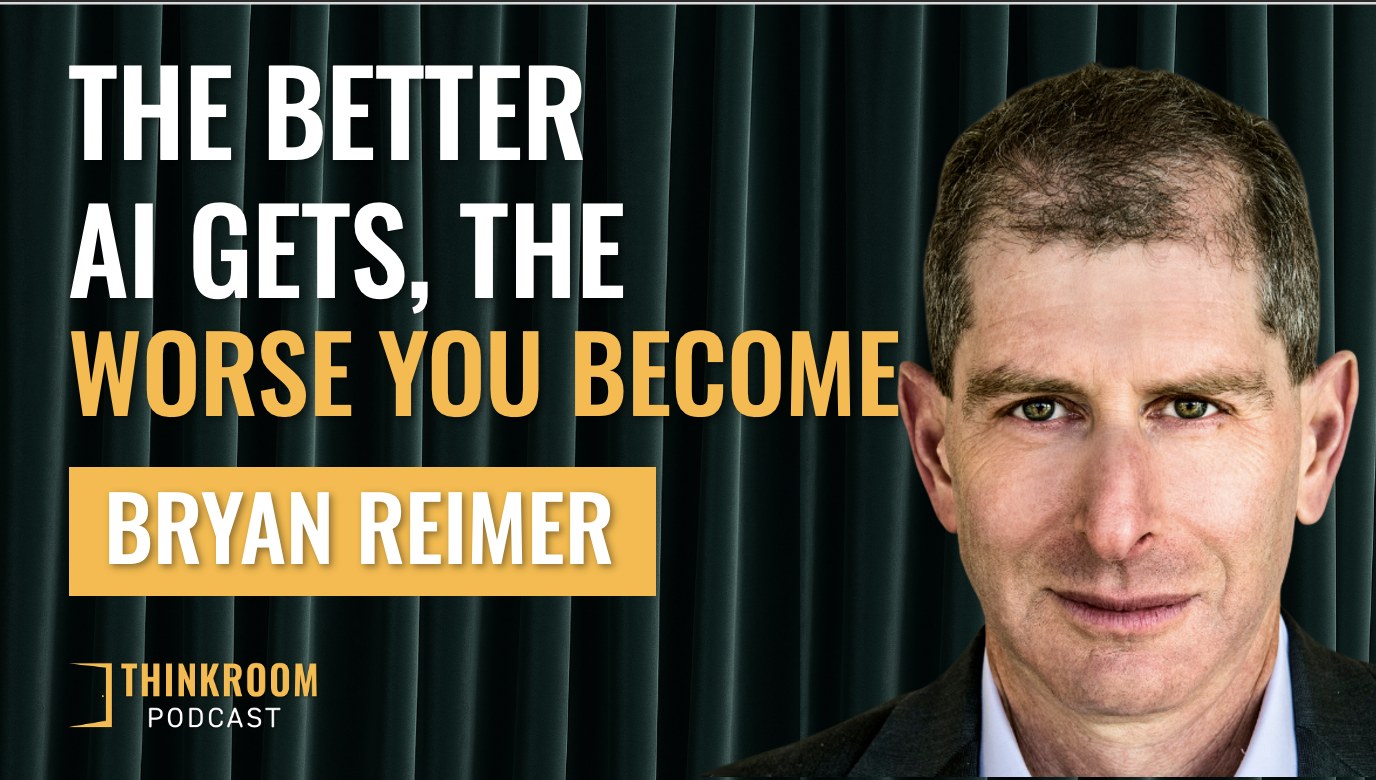
Prefer audio? Listen anywhere
Every disaster follows the same pattern: highly automated systems, humans relegated to opening doors and watching screens, and then suddenly asked to intervene in a crisis they no longer understand.
Bryan Reimer has spent 25 years studying this exact failure mode. His warning is simple: the more you automate, the less capable you become at supporting that automation. Your skills atrophy. Your assumptions grow dangerous. Your attention wanders. And when the system reaches its boundaries, you're not there anymore.
Now apply that to every knowledge worker in your organization using ChatGPT.
This episode is a blueprint for navigating what Bryan calls "the year of the human". Not because machines are failing. Because we're finally waking up to the real question: Are we building AI that replaces us, or AI that amplifies what we're capable of?
🎙️ Guest
Bryan Reimer is a Research Scientist at MIT AgeLab and Associate Director of the New England University Transportation Center. He's published over 350 academic papers, advises AI Sweden and Autoliv, and just released the book "How to Make AI Useful – Moving Beyond the Hype to Real Progress in Business, Society and Life."
What makes his perspective rare: he's watched the automation trap play out across three decades of disasters. Self-driving cars. Aviation. Nuclear plants. The patterns are identical. And they're now showing up in every enterprise deploying AI without understanding the human factors underneath.
🔥 Key Insights
✅ The Automation Paradox: Better systems, worse humans
When automation does the work, we stop learning. Our neural activity drops. Our expertise erodes. We begin making assumptions about what the system is doing (it's not always what we think). Most critically, we trust it just a little too much. This isn't speculation. It's documented across every safety-critical domain. And it's happening right now in your organization with chatbots.
✅ Copilot vs. Autopilot: The fork that defines your future
Some people ask ChatGPT to write their essay. They're not building skills. They're outsourcing thinking. Others "jam" with it. Back and forth, iterating, treating it like an intellectual sparring partner. Same tool. Completely different outcome. The first path leads to atrophy. The second creates what Bryan calls "superworkers" who can do with AI what a team of 20 couldn't do before.
✅ 2026: The year of the human
After years of tech-first thinking, Bryan predicts a pivot. Time Magazine made AI person of the year in 2025. But the winners in 2026 won't be those deploying more AI to replace humans. They'll be organizations deploying AI that enhances what their teams can actually do. The competitive advantage isn't automation. It's amplification.
✅ Unlearn as much as you learn
75% of major organizations still aren't using AI in any meaningful way. Some actively forbid it. The resistance isn't about technology. It's about mindset. History repeats itself, but that doesn't mean we want it to. Leaders need to unlearn old assumptions about control, measurement, and what productivity even means. A 35-hour work week might not be crazy. Swedish unicorns prove you can build world-class companies while taking summers off.
✅ Learn to play more
There's no textbook for this. When we were children, we went to sandboxes. We experimented. We tried to create things we'd never seen before. That's the only path forward with AI. Create low-risk environments where you and your team can experiment without financial consequences. Ask Claude, Gemini, or ChatGPT weird questions about things you already know well. That's how you learn whether it's right, whether it's wrong, and where the edges really are.
▶️ Listen now
Bryan's final thought: We started inventing technology to help us, not replace us. Maybe it's time to remember that.
Read the full transcript
One of the things that, uh, fascinated me with your work is the idea of the better.
A automated system is kind of the worse a human gets. Can, can we start there? Jump straight in. Can you tell us what you found there?
the more we automate the, the less the human is able to support that automation. Um, we can look at multiple disasters globally, um, from Uber's self-driving vehicle accident, or the, uh, operators relegated to, to a couple different input tasks, but not really capable of attending to the road, to,
you
know,
countless air traffic, um, incidents where the automation, um, was doing things the pilot was not aware of.
Um, three Mile Island. Um, another great example, um, and even the, the metro in, in Washington DC were, were operators, um, in what was supposed to be a highly automated, um, mobility system. Um, were relegated to, to really opening and closing the doors. Um, and at the end of the day, very little and then all of a sudden they have to do something we're not really capable of stepping in.
So a few things happen. First of all, um, as we automate more our expertise and our skill level, um, rates. We learn by doing. So when the automation does for us, we, you know, in essence, uh, flex that wet computer, the mind mm-hmm. Um, less robustly. Um, second, we begin to make assumptions about what the automation may or may not do.
So some work on automated driving parking systems. Years ago, the assumption many users made was, the system is going to automate parking well, it's gonna turn on the turn signal as well. You know, so it's just the assumption is the automation's doing stuff that's not clear to us. Hmm. But perhaps most importantly, attentively, we begin to wander the automation's functioning and we begin to, to, to step back a little bit, just trusting it a little too much.
All of these are known factors, um, but that doesn't mean that automation can't work. We need to engineer around these known elements to be successful in developing highly complex social technical systems that have to work in safety centric environments like driving. So I believe strongly automated driving will win over the long haul.
Hmm.
in a time where we're looking from an enterprise perspective into automating a bunch of different processes, right?
Through ai. Um, your background is like, you come with quite a pedigree. Maybe it's, it's a good idea to spend like two minutes on, on what have you done in terms of academic studies to, to be able to, to kind of state the predictions and the, and the, uh, different opinions that you have here today.
So I've been working in areas of transportation safety, leveraging AI tools for years, working and, and strategically using and, and thinking forward in what AI may be able to solve for over 25 years.
Um, I've published, um, nearly if not over 350 academic articles of variety degrees from op-eds to, to hundreds of referee conference and journal papers, spoken extensively globally. with industry, helping them chart strategies, um. In terms of Sweden, um, I sit in a research advisory board for auto leave, um, and a advisory board for AI Sweden, which is a national AI center within Sweden.
So I've had some deep connections, um, in Sweden for over a decade now. Uh, great innovative culture, fun to work with, um, and great to visit during the summer.
what, what's interesting here, Johan, is that, you know, many of the tools that I worked the grad student tool for 25 years ago, leveraging AI to solve problems that were quite frankly, unsolvable at the time, you know, now, now solve themselves in the split second using modern computing and modern AI frameworks, which is really fun to watch.
But the fundamental underpinnings, you know, really haven't changed that much. Um, neural networks are still the fundamental foundation of a lot of what we're doing,
and I think. From reading your, might be good to mention as well, you just released a, a new book on, on AI and then, we'll, we'll get into that soon.
But one of the things that kind of struck me from that conversation is that we have a tendency to overestimate the speed in which these transformative technologies kind of have a real world impact. Like this self-driving car has been two or three years away for, for 20 years. Right. Uh, what can we learn now standing in what is still kind of the beginning of, of like wide scale AI adoption from previous generations of, of these types of, of changing technologies?
Do you think?
That's a great question and, and I think that as humans we are much better predicting the future. Then we are protecting the timelines. You know, there are a couple of illustrations out there of, of technologies that seem to just work overnight. I mean, the iPhone is, is the one that sticks in, in, in many of our minds, but these are rare occurrences.
Um, most of the time we have a vision of where we'll get to. Um, you know, Jetson like science fiction is, is definitely something that, that, that, you know, I can see us getting to over, over the course of a century or two. Um, but how fast, you know, look is a technological marvel breakbeat through curve that, that two decades from now we have flying cars everywhere.
You know, probably unlikely. Um, although I, I think we'll see a few by then. Um, more likely, you know, several decades out. Um, if not, you know, years beyond that, these transformations will occur. So when we think about AI in particular, um, today we're talking about the fusion of machine expertise with, with human skill.
Hmm. Um, and the blending of, you know, humans and machines isn't new. It since the advent of, of, of, of computational systems, um, the explosion of personal computers, you know, we are using machine intelligence in doing unique ways more and more years after year. AI is just an accelerate on that today. Um, why, because we've finally gotten to a point where, you know, AI is really useful to the average consumer, the average employee, the average decision maker in, in, in ways that actually provide utility.
In the years past, you, you, you might send a team to optimize a process system or optimize a automated driving algorithm and AI tool, but people didn't feel, see that in the same way. Hmm. Um, chatbots today have, have really just revolutionized how we see ai and, and it's just the first of many steps along a long and winding path of the seamless integration of, of advancing AI into our lives.
Uh, in the book we talk about it is perhaps, you know, it's today we're living through the, the modern electric ferry, you know, from the early 19 hundreds when, when we were thinking about the advent of electricity. I, for one, believe AI today is, is just, you know, the, the broader peripheral use of electricity in modern sense.
And it will continue to grow and it will continue to build from here on out with lots of ups and downs, um, in the technology development, um, and the financial supporting mechanisms that enable, um, companies to invest.
If we assume that the learnings from, from the self-driving cars and how the human skills kind of atrophy over time, what do you see as the enterprise version of, of a driver who's forgotten how to drive a car?
that's a really good observation and pickup here, Johan, and I think that is very well known that skill atrophy is going to occur. Um, you can just look at the studies, um, in, in recent months in neural activity when you're using, uh, chat bot. But I think that where studies do fail is that it's, it's it's relegating to the chat bot.
And that's why collaboration or copilot versus autopilot is so important. Hmm. That we need to learn to use these tools as collaborators where we're thinking more about the strategic elements and maybe a little bit less about the tactical elements, but much like driving, um, we are going to become novices at certain things.
Um, so I mean, let's, let's bring this down to the foundations. Do you want to drive a car without power steering? Without, um, you know, automatic transmissions, um, electronic stability control, they still automation, um, you know, very simple, um, advanced, uh, several decades ago. But as we automate more, our skills to respond to growing situations are going to erode.
We need to take about less about the automation equation, more about the driver supports to ensure that we are there when the automation reaches its boundaries, um, to work collectively, collaboratively, um, to form a better system. So when we think about today's chat bots, and this is a huge worry about, uh, in the educational systems and chat bots are just a modern embodiment of ai.
Hmm. Um, well, relatively simple in some sense, but complex in the underpinnings. Um, we're thinking about AI that, that many people are relegating way too much to looking. Write me an essay. I'm not learning to write that essay. I'm not building the skills. Other people, um, are, is my co-author, Magnus would say, jamming with the AI engine and going back and forth thinking about, hey, much like a, a physical collaborator.
I now have an electric collaborator who allows me to iterate, uh, more succinctly, more thoughtfully in new and unique ways. So I think it's how we as a society begin to use these tools. There is one fundamental foundation that we need to remember. As a human race, we tend to be lazy. The average individual would love to rest, sleep, watch tv, sit in a chair, you know?
So we need to begin to think about what those guardrails are so we don't become over reliant on the automation ai, and we become a partner with it. Um, and that's, I think, gonna be the hard part for society to wrestle with. We'd love to automate it, you know, people out of work because people would rather go to the islands on vacation.
But the reality is, is human race, we need to, to collaborate, we need to think we need, just think in new and modern ways with new and modern tools.
you could say that the car, in the non self-driving version of it, it's, um, decreased our ability to run long distances probably.
Right? So, so like everything is, is a, a extension of, of some other function. And when we look at. How we collaborate with our ai, at least to me it begs the question, what am I optimizing for? Like, what are the core things that I want to keep and what are the core things that I'm completely fine with delegating in the same sense that I, I have no problem that I use a calculator for very complex, uh, math, right?
I, I don't feel that I'm less of a human or less capable. Like where, where do you feel that in order to, to get the right balance of, of partnership and, and driver aids, if that makes sense. Uh, when you look at knowledge work, for example, what are the due delegates and don't delegates?
You know, that's a really good question.
Um, and, and I don't think there's a right size fits all for everybody. No. Um, I think there is a, a, a huge diversion among, uh, the human species and, and cultural differences and, and incorporation differences in trust in technology roles. Um, by and large though, I think that. At minimum, um, today's embodiments of AI are spell check grammar check calculators on steroids.
I do not think we should be putting work forward, whether that's a simple email or, um, developing a, a a, an essay or a report without leveraging modern AI tools for grammar, spelling and improving what we're doing. Um, you know, products like Grammarly are great illustration. You don't have to go all the way to ChatGPT to get better sentence structure.
Mm-hmm. It is not always right. I mean, humans hallucinate. Why wouldn't you expect AI to hallucinate? It doesn't understand all the context, but you know what, it gets 90% of it correct. And, and that's why we're humans in the loop there. So that's that, that's the floor. And I don't think there is an organization globally that shouldn't be leveraging, um, tools like this to help.
Employees, students, um, individuals in their home, um, improve what they're doing no differently than, than than spellcheck has been doing for years. Um, the question becomes for many of us, what is the more optimal way to use modern AI? And, and, and it's form for chatbot. Some of it is draft something that I wanna say that I believe is the right thing, and then get, use it as an opinion.
I'm trying to, to write an article for this audience. What do you think? How can I hone it? Okay, great. It provides me feedback, No, differently than a physical colleague would've before. Hmm. Um, yeah. That information is regressing to the mean. It it, but it has a good context of what that audience is likely to be.
It's provides me with value, input, but the decision all becomes mine in the end. And one can go back and forth in, in honing you, you know, this could read differently, this could read better. I understand why there's a whole bunch of extra words in here, and I'm trying to speak to a senior executive, which means reducing word count is more likely to get it read.
Yeah. Um, I, you know, I, for one, love using, um, on chat TP to say, okay, which slides could I remove for stor from a story? You know, I think they're all important. I know they're all important, but I only have 25 minutes with an audience.
Hmm.
on the other hand, many individuals, um, suffer from a, a, a, a difficulty being able to ideate, come up with a new idea and think about an approach.
So, okay, I now have a problem. I have to solve X, y, z. Any ideas I can begin working from? Now these are, you know, fine and dandy ways to begin using these technologies today. Um, I think there's a lot of potential to upskill, um, elements of the workforce. Um, but I think the fast fast flyers, the highest performers in our organization are going to accelerate by finding new ways to integrate AI tools into their workflows.
So I think we live in a society here today where the folks who are resisting these tools are going to be, begin to be the ones, um, who are falling further behind the ones misusing and abusing them. Um, even further behind, you know, slopping a major issue. Yeah. But the two groups, either the high flyers that, that are really trying to find ways to optimize.
What I can do as part of my work, you know, is a small percentage of your workforce that, that you, that's vital. I think they're gonna continue to accelerate, move forward faster than we can imagine. And then I think a huge swath of the workforce is gonna get upskilled here. But I do not believe we're gonna have the massive job loss that many would like to believe is going to occur.
I think we're actually gonna find new roles and new ways, much like many technological revolutions in the past. We don't understand the processes we're trying to automate well enough to bring AI and just automate 'em. So the reality is, is that we're actually probably gonna create more jobs than we loses.
Although, to live in current geopolitical, uh, stresses will we'll frame a lot of layoffs as AI related layoffs, but in reality, they're not. They're just, you know, you know, moving segments of the populace around. Um, and, and changing job roles and reducing man count or head count to um, uh, changing business climates.
if you're a CEO. So what I hear you saying is fundamentally like either you can focus on raising the floor, the, the worst performers in turn in the analogy of the spellchecker, right?
Or you can raise the ceiling, like fundamentally build capabilities that wasn't possible before. And if you were to reason as a CEO, what would be the, the kind of way to a sustainable competitive advantage? Or is it both?
I think it's both. Um, I think some individuals are, are going to think about new ways and accelerate your organization forward.
But I can raise the floor for everybody. So I, you know, I expect things to be improved across my organization and still, I don't expect, I, I don't expect the frequency of emails to flow around with grammatical structure problems that people can understand and interpret them. I expect the tone of emails in my organization to be much more perce professional, assertive, you know, you don't have to think about this stuff as much anymore.
Um, now are the tools optimized to provide that? No. I mean, look, I, I, I love Grammarly. It's great tool integrated into everything I do, but it's not reframing stuff natively yet from my tone of what I want my professional voice to be and it's gonna, in the future, become much more personalizable. Yeah. Um, 'cause at the end of the day, we don't all wanna be vanilla, but we also can't, you know, maybe you have a hundred different flavors we can work from, but that's about it.
Yeah. And it's interesting, like there's a certain sample ignorance when, when you start upgrading. Your text for the first time with chat d pt and you ask it to, to refine arguments and, and this is the target audience and so forth. You see a massive improvement typically because we're all not authors that are brilliant at writing.
Right. I see two things, and this is just my, my own experience that, that I don't necessarily think that everybody notices at this point, and it has to do with tonality. One thing is that you start realizing after you've done. 10 or, or five or something of the same text. It's very repetitive. It's, it becomes very boring.
Your own text sound the same, even though like the content of it might change a little bit. And the second thing is that it sounds the same to everybody else. So I think it's a really good idea to start thinking about tonality, like what is truly my tonality? And, and be aware of the fact that if you're only looking at your work, you see such a little sample and it's most likely gonna be identical to everybody else.
And it's quite simple to, um, uh, to work with tonality. One of the things that I, I, whenever I work with a, with a senior executive or something that does right thing, just ask them, what's your favorite author? Who do you wanna sound like? And just mimic that, you know.
But look, the same is true for your podcast here, is that you're bringing on different guests to change the tone of the situation.
But you're doing the, the pre-reads, the how do I want my tone to move around? Otherwise, you know, if you ask every guest, do you have on the same 15 questions? Um, you know, like, it's boring after a while.
Yeah, it does.
So you, so, you know, that's not success. Success is bringing human creativity into this. And, and, and that's where the, the inter fusion of, you know, human skill and, and machine expertise can really occur together.
Hmm. So when we think about what these AI tools can do, you know, right now Only so much in the future. Definitely more, but changing the nature of how we work with technology to for the better. Um, not, we need to really get outta that mindset. As I mentioned earlier, humans are default lazy. That's gotta become a non unacceptable answer.
You know, if I was a CEO sitting in an organization, now work slop, which is just using an AI output for stuff, you know, really needs to become an unacceptable form of, of output, um, you know, easily grounds for termination. Why? 'cause if the cost and risk of just asking the AI bot to do something and passing that along as your own, you know, that that's just something we're not looking for here.
And if the cost of that is severe, people will refrain from, from, from delegating everything to the ai. If the cost isn't there, you're gonna find a lot of people doing that.
I I think you make a good point in terms of work slop and, and taking accountability completely outta the room when delegating to ai. And I think there's a conversation that needs to be had there. We also have the other side, like the secret cyborgs. So people that have automated stuff, but they don't wanna tell anyone because they know that the only reward that they'll get is more of the same work.
Right. And what's a good incentive structure? Have you, have you found any like really good incentive structures, uh, in enterprises?
So my message to a few, few senior leaders at this point is that, look, we need to embrace in, in our organizations. To think ahead. Um, traditional academic structure is not gonna teach people how to use these tools.
They're moving too fast. Hmm. So give your organization the liberty to explore in exchange for the liberty to teaching. I'm gonna summarize easily here for, for the purpose of this, but, you know, give everybody two hours a week to play with AI tools, assuming that they, they bring back, um, what they learned positively and negative to that organ, to your organization so everybody can move.
So the, the, the lead performers are gonna, you know, begin talking about things that are way out there that are gonna help bring up the floor. but at the end of the day, they have the incentive, much like Google used the, the, you know, the ability for early employees to, to pursue other opportunities and learn.
Yeah. You're building that incentive structure in the organization. We need to teach my organization within my culture to move faster. Um, so, you know, we need to incentivize learning. We need to incentivize unlearning old practices and, and and thinking forward with new tools. And it's not that, that, that, that means your organization has to overnight change.
It's just your organization needs to be thinking about how these new to modern tools enabled by AI in a lot of cases can really augment and improve processes, save money, expand resources, develop new products, and the like,
Moving back to the, uh, to the CEO and, and what's on top of their mind. I, I think everybody's seeing this massive change on the horizon, but we see very different responses.
Um, I think most CEOs and most organizations have. Some very decentralized trials, uh, of AI going on at this point. And, and what I hear a lot from, from leaders in general is that they have a tendency to see further out on the line, the implementations, but they, they struggle to understand the value for them as leaders.
Um, you bring up this really interesting point around the, the Alta Vista trap, and I think that's a relevant discussion to, to have right now. What was that? Can you roll that out for us?
the search engine, you know, concept that, that we had many moons ago, um, in AltaVista was, we're gonna ask this anything, it's gonna produce an answer. And, and I think that's really a, a, a great parallel to modern chatbots. Um, here years ago we had the idea of, of what, you know, AI and search could provide, but it took us decades to really embody that. and I think it's a great illustration of, we have some, some ideas of where the future, whether that's driving, whether that's information technologies, whether that's augmenting our move away from the smartphone to some other parts, smart personal device, you know, we have visions, but the embodiment and execution of that.
Often takes more time than we realize. So I think it's important that as society plays with, you know, as I said before, the modern embodiment of AI in large language models in chatbots, we recognize this is just a stepping stone. You know, and these tools are going to continue to evolve to provide us things that we never even dreamed of.
Yes. Will we manage our finances in the same way in the future? No. Um, are there professions that are gonna disappear? Yes. But are there professions that are going to be augmented? You know, I don't want stock advice from a robot. I want stock advice from somebody who has a human connection to me. But I want them using the AI tools to do synthesis in ways that, that they wouldn't today.
same in the medical field. Um, I think, you know, the successful doctors in the future are going to be using AI tools to, to diagnose. Or to assist in the diagnosis. Hmm. But at the end of the day, I'm not looking to go to a robot doctor with a vanilla voice telling me that I have, um, a serious disease. Um, I'm gonna want to talk with a human because humans bring to each other a sympathy, a connection that we just don't have with electronic copilots.
If you've been listening to this podcast for some time, you know what I think about ai. I'm deeply excited about it, but I also see companies struggle with it. And you know that I think it's not primarily due to technical reasons compared to previous revolutions, let's call it the internet wave. Part of why we struggled initially was that, well, the infrastructure wasn't built out.
We didn't have online credit card payments and whatnot. But the difference with AI is that the infrastructure is already here. The technology is so much more capable than we actually use it right now. The problem for most C-suites that I talk to CEOs and senior managers is that they actually, they know about the importance of ai, but they can't seem to get to that position where they truly understand how is AI making me fundamentally more competitive?
I understand that it can save costs hours here and there increase some some productivity number, but how do I distinguish myself on my market? Like the ones that that truly survived. The digitalization era wasn't a bookstore that got a website, it was the Amazons of the world. So where you truly find the transformation of what we do today and how can we unlock things, serve customers that we never could do innovations that weren't ever before practical, that type of innovation, the primary problem that I see in all honesty is.
At the C-suite, you don't really understand the technology and not understanding the technology for the sake of understanding the technology, but for the sake of having a strategic discussion. So that's why I started Grail. I stand right smack tab in the middle of understand the technology. I understand strategy and execution, and bringing these two together is what we do at Grail.
So if you understand that this is something that needs to happen. Then we should talk thing is slots for this. Spring is already filling up. Grail has been in the works for some time, so I've already had engagement for the spring. But what I'm looking for is that one CEO in each market that truly wants to make a dent in the universe.
So if you're that guy or that girl, please head over to Grail that works and let's talk.
Having said that, it's interesting on, on the kind of blind tests, especially on the ability to show empathy. Uh, and I know there's been studies done in, in the medical field that that AI interactions score higher on the empathy test. And, and surprisingly to me, I think it was in McKinsey's latest AI at the workplace, one of the biggest use cases for AI is like personal partnership and therapy, which it was completely unexpected to me.
That doesn't surprise me because many of us fear there's things we want to talk to a human about and there's things we're embarrassed to talk about to a human about. Yeah. So you, we've been asking Dr. Google everything for years, right? Mm-hmm. Why? Because I don't wanna call a clinician and ask about stuff that I'm not so sure I wanna describe this about myself.
You know, many of us are, are, are shy in nature at some point. So, so therapy is a great example and, and unfortunately where a lot of these systems do fail is back to our driving example. Um, we're okay blaming humans for 1.3 million, um, traffic fatalities a year. We're not gonna be okay blaming robots for that.
Yeah.
So, you know, if we look at automated driving systems, whether we talk about cruise, um, whether we talk about Uber, um, you know, no one who's out there, has sustained their, um, moment in the negative sun. Um, when, when something occurs, every organization that is. Know, perforated robots and, and safety centric environments like driving has disappeared.
So is is, you know, why should we believe that that's gonna be different for, for Waymo here in the us? I think culturally different, China might separate. Um, Baidu had a major incident the other day that, that, you know, they seem, you know, the ability to move things in authoritarian society like China forward, ev even with risks is different.
So I think people, you know, have a native and tendency to allow humans to error. But at least today, and I think this will change over decades, we look at machines to be much more perfect. So my expectation from a, from a robotic doctor is that that is going to be perfect. Whereas my expectation from a human is that this is a little art blended with a little science.
Mm-hmm. There's no reason we call it the medical arts and no, not the medical sciences. Um, because medicine is a little art in science. Um, if you move to robots, we're looking for science. So I think when you think about use of robots for therapy and all, I think, you know, there are applications there, but there's things that it's going to be missing and there's things that are going to be advancing.
And it's probably great case of a little of both as a much more optimal solution in either end.
Yeah. And I think the handling the exceptions is also a really interesting point. And similar to, to your 1% when, when automation fails from the automotive industry. So when it comes to, Making available, like light level of therapy through chatbots.
I think in general that's fantastic, right? But we also have cases where, where people are really sick and the chatbots are the complete wrong solution. Right? And this is just one example. Obviously this is going to be going to be across multiple modalities.
And the same's true in on the clinician side, the, the human is not always right.
Um, but we're okay with humans being wrong. We're not, you know, we as a society aren't really, really ready for machine error to cause harm to humans in the same way.
So I, I read, I think it was Neil Degrass Tyson who had an example around. So, uh, traffic fatalities with deer accidents in the US is quite high.
And, and a really good solution for that is to reintroduce some of the big cats, uh, into wild nature with a potential downside that they steal a baby or two, and the number of babies that they steal will be lower than the traffic fatalities that they fix. Right? But we're still not happy with the solution.
So there's, it is not just a robot versus it, it's something more moral or, or philosophical going on there as well.
Yeah. And that I think will change over decades. So I think we will begin to trust robots. I mean, the Japanese society in particular has trusted robotics much more than a lot in the rest of the world.
Mm-hmm. Interesting. Yeah. And, and
I think that will occur over time. Um, so I think the concept of therapy robots has been in Japan for, for years. You know, that'll occur around the rest of the world. It's just gonna take time. We evolve and machines tend to change quickly, but humans evolve over time. And, and for some of us, hey, we're lead adopters, we'll move a little faster.
For many of us, we're tech laggers and, and I've seen enough, it doesn't really help as it worth my time. Um, so I do think we will. Uh, change over time, but this is, this, this is a tagline I've been talking about a little bit, and then especially around, you know, executives, we need to unlearn as much as we learn.
You know, history does tend to repeat itself, but that doesn't mean I want history to repeat itself. That means I need to unlearn some of that to relearn I how I want the future to look differently. Um, so being flexible, um, you know, i, I is really key to charting a new path and at times sticking with that.
And that's, you know, a little bit of the hard part of democracy versus the authoritarian cultures that, that are, that are leading elements, uh, development in the world right now. You know, sometimes we can't keep bouncing back and forth, you know, um, playing ping pong with ourselves. Um, you know, electric vehicles are a great debate these days, you know, you know, in the US I like to think about a donkey and a mule playing ping pong with, with, with a climate future together.
You know, you know, path would be fine if you stuck with it, but right now, you know, we can't stick with things.
What are some really. Practical, you need to unlearn this type of advice, especially to leaders?
it wouldn't surprise me, 75% of major organizations out there still aren't using AI in ways that make sense. Um, I had a phone call from, from a friend the other day, you know, a multi-billion dollar company and they have not touched AI and they don't allow their employees to touch ai.
So I, they think we need to unlearn stuff like that quickly. Now, what's the tolerance? Where do we wanna leverage these technologies? You know, lots of organizations still rely on pen and paper to do things. You know, pen and paper's been out for years. Right? You know, I, I, I write down notes 'cause I still, that still works for me.
But many people, everything's digital these days. So there are value propositions to moving to that new society. Um, you know, driving's another piece. Um, you know, we, we, we don't drive the old fashioned way manually much anymore. I mean, yeah, there's a couple antique cars out there still, but, you know, why are we still building things that we drive the old fashioned way?
We need to be thinking about the mindset where we're really working collaboratively with different elements of automation and take that mindset forward. Um, you know, not thinking about building cars the old fashioned way, building cars that work to some degree of automation supporting us in different ways.
Um, moving more and more from automating for the sake of technology to automating in ways that supports us as humans to do better. You know? Hmm. I think it's really moving from a tech first mindset to a human first mindset That's really critical for society today, and we've been on this juggernaut of tech first for, for so long, but where do we technology really work?
It works where it solves a human purpose to make people money, to save people money, to make life better, but not because it was just technology. It works because it helps us.
Have you written or thought a lot around, uh, kind of how we measure productivity for knowledge workers?
Because I think this is part of the equation as well. So it's when, when you look at the return investment for ai, it's so easy to fall down into the kind of sheep cost saving automation things because it's very short term provable here and now. But I don't think it's necessarily the road to the, the great value of ai rather potentially the opposite.
It's something that cloud tos really, really quickly and there's no competitive mode around it. But, but making the bigger bets, that's more capability building, let's say you probably have a way longer horizon before you see the returns.
yes, and I think it's one of the key pieces in how to make AI useful.
Um, my new book with Magnus is the Real Power of AI and is its inability to amplify human expertise. Hmm. I agree with you, this automated way, reduce workforce component is really short term thinking. Um, some things are always going to remain human. There is a role for human judgment with the machines that's going to evolve.
It's not, you know, it's not what the human's role was in 1980. It's gonna be something very different. But the real power, AI and technology is to amplify our skills to work more effectively with computers. That doesn't mean automation doesn't take certain things away from me. Um, it sorts my email. Um, it, it, it, it sensors information coming to me.
Spam filter's been around for years. It's just a whole lot better now. Um, but the ability to amplify my productivity, you know. Maybe the concept of a 35 hour week isn't wrong. Um, you know what, you know, what are we living for? Are we living to work or are we living to live? Hmm. Um, many of us are, are, are working to live.
So if you, if you could use this automation and make us a little more productive and justify a little more of life, oh my God, would that be great? I mean, I enjoy what I do work-wise, but I enjoy what I do in the weekends even more with my kids. Um, otherwise, why would you have kids? So I think that the, the power of amplifying human skill is where we need to be focused.
And I think organizations and leaders in particular who focus their organizations on amplifying the expertise of their workforce are building tools that amplify their consumers capabilities. Those are the organizations that are only best of the long haul.
what, what are the early decisions from a, a senior leader that is stepping down the, augment the super worker, the capability, uh, building path.
technology always evolves faster than our institutions. Um, and in many cases, their egos.
Hmm. Um, but the success point is where there's utility to either creating new business product, making us money, finding small savings, usually doesn't, big savings usually don't work out. It's, it's, it's shaving things off the edges that work. Um, you know, um, moving from the foundations that, that society has been pitching around.
Automation, automation, automation to augmentation, to support, you know, letting AI handle the small, tedious tasks. Humans are really not good at shifting transmissions, having two hands, putting all your strength and turning the wheel. Okay. You know. Remembering to turn the thermostat down every night. Okay.
You know, we, we remember nine outta 10 nights, just not 10 outta 10 nights.
Hmm.
Okay. You know, remembering that most failures in AI are not really technical. The AI does what it was programmed to do. They're human. Hmm. So, you know, the systems have to be well thought out before you can automate 'em. You know, and this is why automated driving has been, you know, a few years out for, for 20 years now or more.
I mean, our first, you know, the first news items on automated driving are a hundred years ago, you know, is that, you know, you know, implementation, integration and imagination, um, matter more than the models to drive this stuff. Hmm. So we need to think out of the box, not think about replacing. Um, us
earlier on we talked about like what, what are the, um, what are the, the human skills to double down on, um.
Would you say that, that the, the smartest path is to kinda look for your strengths or your weaknesses to start to augment?
That's a really good question. Um, and I don't think it's a one size fits all answer.
Yeah, fair.
Some of us,
need help on strengths one day and weaknesses another day or, or, um, and, and all, some of us more weaknesses than strengths. Um, but I think in different roles you're looking for, for different things. Um, so, you know, in software design, um, mitigating errors and, and mitigating weaknesses for, for some climates maybe more important than improving productivity and strengths.
Um, in other climates, thinking out of the box, the strengths are really to work on moral. Um, so I think this is, this is where modern leadership needs to start thinking to employee development. Um, you know, look's no mystery. You know, we don't come out of school with all the skills needed to, to, to manage our strengths and weaknesses effectively in the workplace or in life.
Um, you know, many of us need support in different ways. Look, executive coaches have existed for years to help some leaders get stronger. And so some of us improve weaknesses in our leadership structure. Um, so I think that we need to be thinking about the use of AI on both of those angles. Um, and it's, and very much creating, you know, this is where some of these new roles are gonna occur.
The coaches needed to help us make those decisions of where do I wanna fit, enhancing my strengths, improving my weaknesses, and how do I use these tools effectively integrated into my workflows? Yeah, because I, I was thinking about my own. Go ahead. Sorry. I was gonna say, we, we look for easy binary decisions.
It's A or B, and in many cases it's A and B.
Yeah. Now I was thinking back to my own path and, and the, the years that has gone, because I think I've been leveraging down things that I already was quite strong at. 'cause those things are, are also easier for, from a motivational standpoint, I get better at what I'm already good at.
I, I double down on my competitive advantage. Uh, so for me, AI mostly is, is for thinking partner, thinking deeper, getting more context, more research into my thinking. Uh, applying tons of different strategic frameworks or innovation frameworks to questions. And these were already things that I was quite good at, but I, I would almost say like if, if I was sitting with somebody who was completely new.
At the ai, that would probably be a pretty good framework because it keeps you engaged, a recent come back, whereas I think most pe, most automations focus on our weaknesses in a sense.
the, the word you used partnership is really critical here.
Yeah. Um, you know, I, I now have a partnership with electronic support in ways that I had partnerships with human support in the past. So, you, you look to communicate something publicly. You went to your communications team for edit. You went back and forth five times and, and to improve and shape something.
Now my first step is to go to my. Electronic copilot, get refinements from there. Um, and then go to preferably the, a, a smaller communications team for, yeah, I need a human check that I'm really meeting all the pieces that I thought I was meeting because I still want that human, that, that human checkpoint in there.
Um, maybe I don't need a communications teammate of 20. I only need a communication as leader made of one of two or two. Okay. Where does other roles go? Well, those roles go, you know, you know, optimally to creating more honed content. Um, unfortunately as, as we see the statistics these days, God knows how, what percentage, whether it's 50%, 75%, and 90% of content online is AI generated now.
Hmm.
Um, but as opposed to AI augmented or ai, um, you know, uh, co-pilot or co-creative. Um, so I think we need to be thinking about whether it is a pure regression to the mean, based upon AI's ability to interpret everything that was given or. Or or something that came from, from human creativity.
One of the things, uh, being very practical here that, that I got a lot of value out of was spending a lot of time kind of categorizing together with ai what are the patterns of my thinking? So whenever I approach a new question, how do I approach it?
What are the really like hallmark for you ones brain type of things and produce a pretty hefty like context file and that context file I can reuse for so many different things. So that was, to me, something that was surprisingly valuable. And I, and I feel in general that I, I now, at the end of, of 25, building up these new systems becomes increasingly fast because I've built a lot of stuff.
Before. So like it's, it's super difficult in, in the beginning and then understanding good prompting, but now building up a new Claude project for something super specific is, is like half an hour because I have so many templates to work off of
I'm a ChatGPT user and you know, the, the memory of what I've done in the past, have I ever written something like this? I can't remember what I wrote a year and a half ago. Yeah. Um, you know, I can go searching for hours on that and yes, you have no you haven't.
Um, synergistic articles may be A and B. Okay. You know, it's just a modern embodiment of search. Mm. That, that is, is at hyper speed. So, you know, these are the ways that we can begin to augment. And, you know, I've been thinking about this this morning. It's a little differently than stuff before. And, and it's connecting these synapses for me Hmm.
Um, in ways that we just couldn't before. Uh, so I think we, you know, we're among the leaders here, though. I think there's a whole lot of folks out there that are just exploring the nuances. And I think there's a whole nother large swath of the population that, that is scared of these tools being able to do what they really can do.
Mm-hmm. Um, and the longer folks stay away from 'em, it's, it's, it's, you know, much like when the advent of the personal computers showed up in, in, in the eighties, you know, the folks that weren't embracing learning this quickly were folks that, that were left behind for years. Mm-hmm. Some of them caught back up, but it took time.
I think there's a lot of fear there as well. Almost like deer the headlights syndrome going on. Like it's so scary. I see my own, uh, all, all of my capabilities being automated so quickly, so it's so crazy to think about.
So I, I freeze and I think probably that's true for, for quite a lot of people, sadly. again, coming back to the, the kind of senior leader audience. So there's a balance between rushing ahead, implementing things without proper forethought into, um, safety standard or security practices or whatever it might be.
Uh, so you say, okay, we, we should probably approach this. A little bit more thoughtfully, but that's also being used, I feel as an excuse not to do anything, if that makes sense. Where do you feel like, how far should you have come as an enterprise to not clearly be behind the, the, the kind of the average, uh, enterprise by this point?
Uh, that's, that's an important point. I think there are a lot of organizations that are far too in on the, the AI financial bubble of today. Um, I think, you know, they've gone way too far over the edge in, in their investments and they ROI required on those investments just to, you know, it, it's quite frankly not going to occur.
Just,
it's like the actual investment in ChatGPT, for example. The
ChatGPT is just one of those. I think there are many other organizations out there that, that spent just fortunes and, and, and, and when you think about the math of the ROI, it would have to be so massive that it, and what's important about that math is that, you know, it's also, it's kind of assuming the technology's not gonna evolve from here fast enough.
And I think that the reality is, is what OpenAI has done with chat tp, you know, somebody else will create something else that we're, we don't even know the framing of the language, the letters of associated with now much like, you know, large language bo uh, models and chat bots, revolutionize things a few years ago.
Someone else at some point, whether it's five years from now, 10 years or 20 years from now, will do that. You know, and some organizations will become new, IBMs establishing themselves and lasting a hundred years. And, and some organizations will look more like Yahoo. The brand will survive, but, but nothing else really there.
Look, I, I think about, you know, alphabet, right now, it's a great illustration of a company. Is it going to be become another IBM or is it going to become another Yahoo? And, and, and, and I don't think anybody knows. Hmm. So if I'm a leader today and, and in an organization, I'm really thinking about starting small, scaling smart and piloting AI narrowly, I wanna know it's going to work for specific use cases strategically, whether that's customer service, whether that's coding before accelerating the expenditures and the mission critical roles or large scale adoption.
Um, you know, I think there's just too much rush of we have to do something, we have to do it faster. As opposed to a real thought about what are the processes I'm looking to solve? Um, now if you are a small startup, you can do that process solutions step you know, creating something new, much easier than, than if you're, you know, P&G Autolane Volvo.
Um, you know, you know, big companies need to slow down and think strategically. Um, you know, we, we tend to be so operationally, uh, focused that, that we have to execute quickly if we forget the strategic steps. Okay. What are we trying to do? Why? How can this work? Can we prove it before I spend a billion dollars on this implementation?
Hmm. Um, I also think that that goes hand in hand with fostering trust and transparency in, in your organization. not hiding that we were looking to use or using ai, you know, making it visible, setting the guidance needed that, that, that folks feel empowered to use what's okay in their organization.
So there's a lot of folks in organizations using chat GTP on their phone because their organization won't let them use it. Yeah. Um, you know, whether that's in academia or, or that's in perf in professional societies, um, you know, we need to build the trust that we're, we're using tools and we're thinking about really smartly how they can fill holes.
They're not going to transform and change everything we do overnight. It's going to take time. That may be a year, that may be two, that may be five or 10, but very few technologies are like a light switch all of a sudden just transforming society. Um, so simply.
if we were to summarize 2025 from the AI and in the enterprise space, what was the completely expected outcomes and what was the unexpected outcomes?
So the completely expected outcome to me is that this, this balloon keeps being pumped, uh, solar and fuller of, um, hot air and overinvestment. Um, but I think to me, there's this shift. The unexpected is there's an embracement and shift in the populace that its use of AI tools occurring. People are seeing value in what they can do and what they can help with.
Um, I think people are starting to move beyond this synthesized list of information at search to provide, to looking for, you know, information that they can actionize more effectively.
Hmm.
I think 2026 becomes the year we focus on the human's role and, and really human-centric ai, you know, after years of, so over-focusing on the technological advancements. I think the new frontier in, in, in 26 becomes the human factor here. Yeah, okay. We can get better. Um, you know, so I think organizations that are leading here will recognize the competitive advantage doesn't come from deploying more a AI to replace humans.
It comes from deploying useful AI that enhances the capabilities, uh, of their teams and their consumers.
I think that's a super interesting point in itself. So the more familiar and almost to the point of experts people get with these tools, I see two major shifts. One One is, as a consequence of the technology, you start reflecting way more about the essence of humanity.
And I think that's like a brilliant thing that I didn't see. And the second point is kind of ethical concerns. At least for me, uh, and the downstream consequences of a, a kinda robo centric implementation of AI on our society. And on the one hand, it, it's great that, that a lot of, of like the senior voices and now, now I'm not talking about the kind of automation bros on LinkedIn, but actual credible voices, right?
Um, on the one hand it's great that, that we're raising more of these concerns and starting talking about it. On the other hand, I think it's kind of scary because it also means that those things are very hidden from plain sight. Uh, so a, a implementation of this technology that. Thoughtful carries pretty negative externalities.
Just moved two, three years out.
Yeah. Well, under this, you know, move towards a human-centered framework and, and in and I, and I think 2026, I think it's the year it's human again, if that makes sense. Um, and I think that you're gonna look for a better understanding of what AI should do for us. Hmm. Uh, I think that the, the fundamental question is moving beyond the fascination of, of technology to, to thinking about is AI generally useful and where, and, and, and that really revolves around, you know, a lot of the thought points.
And when Magnus and I started putting together, um, uh, how to make AI useful, um, you know, our goal was to start thinking about, okay, what's the future? What's that look like? Yeah.
because it's also a question of, of how do we integrate with this technology in a not just useful way, but actually healthy way.
'cause we don't want to implement AI in the same sense that we implemented the social media, for example, where it's something that's completely everywhere and everybody seems to kind of agree on that. This is, is a, is a mostly horrible thing, but it's very like, intuitive to us as humans. And I think AI has carries very similar traits, right?
That it's very intuitive to move down a path of atrophy, if that makes sense.
Yeah. And, and you look at the cover Time magazine, you know, the person of the year is ai. Um, you know, and, and I, but I think the person of the year in 2026 is 180 degrees from that. It's, it's a human, um, you know, the role of, of a human.
We need to get back to why are we here? We're here to live, we're here to do, we're here to enjoy. And, and technology can enable that. It doesn't necessarily need to replace that. And I think that's where that human-centric aspect of AI really shines, is that let AI do what it does best to help us do better.
Um, and to just moving out of the tech first mindset to a human first mindset. And once we do that, if we, I should say, I should rephrase that, if we can do that mm-hmm. I think we will find new prosperity in society if we continue to push forward with this tech first mindset. We will never find the, the usefulness to us in the same way that that really improves human life as we know it.
it's interesting you talked about the a 35 hour work week before, from a individual's perspective, that'd be awesome. Right. But I wonder how the politicians of the world look at this because it's kind of dangerous as well to, to, if we're in a, in a global economy where we need to compete with, with everyone, right.
And we make a fantastic decision for, for. The humans of our society, but at the expense of the economy of the society. Like, is this realistic? What, what's your real, because I love the worldview that what you're painting, that 2026 will be about the humans. I would love if that happened. What, what's the realistic outlook on that question?
Look, the realistic side is that you, you have lived in Sweden for some time, while the weather is far from perfect during nine months of the year. It's gorgeous during the summer. Um, the reality is the Sweden's take enormous part of that summer off and swish summer is, is four to six weeks, but they come back retuned to think more effectively.
Hmm. So we can look at, you know, the balance of an overstressed, American populist that works constantly and looks forward to a, a, a long holiday break of a whopping week. Yeah. Versus the Europeans and, and, and some of the Nordic cultures where, you know, a more rest is, is built into our cultures. And you say, Hmm, at the end of the day, look at some of the Swedish unicorns with far less capital than, than Silicon Valley.
Um, you know, this innovative companies from Spotify to Low Bowl that, that are just, that are just growing in Stockholm these days. Why? 'cause it can be balanced more effectively. And then, you know, you know, obviously the French had been on a 35 year hour work week for some time. Um, and, and many world looks at the French as lazy and, and I don't, you know, yeah.
Just the end of the day, maybe the French have a better look on, on the value of, of why we're here. Hmm. Um, we are blessed, um, if, if for many of us with, um, the opportunity to live and to do and, and, and, you know, some people work for work, uh, that's life. Hmm. Most of us are working to live. Even if we incredibly enjoy what we do to work, um, it's working to live.
So how do we find that new balance? And is AI the tool that enc corks that? And to me, you know, that's where the possibilities of technology lie is, is helping us do better. Um, and, and if that's not a 35 hour work week, that's just improving transportation safety by magnitudes, that's fine too. Yeah. Um, you know, or making.
The simple things o of cooking dinner and finding ingredients I need even easier because, you know, yes, grocery shopping becomes automated. It's one of the mundane things that I hate every day. I wish, you know? Mm-hmm. I do like the, the delivery services, but I need it by the minute. 'cause I never remember that, that I, that I want spice A or spice B, and all of a sudden I'm out of it.
Yeah. I think that's a really good point. And it's easy to kind of, um, take that into, to your own life, right? Just work more isn't necessarily the best answer to, to get the best output of your life. Like periods of taking a step back, periods of reflection. I think a lot of high performers the last five years has discovered meditation, for example, as a brilliant example, how to get to, to the kinda essence and the clarity of, of what needs doing, not just we need to do stuff right.
very rarely will you find an individual who says, I want wish I worked more.
Yeah. You have that expect as well. You come back and
say, okay, the expertise says, I wish I lived more. we are only on this planet for a short period of time.
How do we make that most useful? And AI can be a partner that really, to me, accelerates that. So I think that, look, do I do, I really feel that that AI in human-centered ai, you know, is going to be, um, the prediction, you know, for, for 26. Um, I darn hope it will, and I hope we get out of this Silicon Valley mindset that, that Musk Jensen, and others are pushing of tech, tech, tech, tech, tech.
Well, there's a reason they're pushing it. They're gonna make money with that. You know, corporations are, are, are gonna win there, but at the end of the day, we should be as human species asking for more. We want the technology to support us to be better. Yeah. Otherwise, why are we continuing to invest here?
And, and I, and I do think that that companies, um, out there, you know, you know, NVIDIA's a great example. You know, Nvidia can do really well in a human-centric world too. Maybe it's not quite as good as a centric world that that needs to automate everything in the next quarter, but over the long haul, ugh.
If GPUs are the answer to neural networks, NVIDIA's gonna do fine and dandy. Um, but we can do that being much more focused on societal issues in the, in, in the balance.
in Europe we have a lot of, of like really family run businesses. Businesses that have been around for, for a hundred years or so that are looking right now like the big losers on AI because they really haven't done anything. I hope that part of the answer to why that is, is. Just because what you're saying, we need to integrate the values of this company into, into the place that we're making.
We want to ensure that we're not just profitable this quarter, but that we can take care of, of our employees and, and a lot of these more value driven companies might, if you play this out. I'm being a little bit optimistic here, I think, but this is how I want to think, at least if you play this out, it's more about understanding what can AI do for us as a company over time, rather than just to technology.
So perhaps even though Europe right now is like looking like the bigger, biggest loser in, in the international race between US and China, maybe it's something that will end up quite positive for Europe.
I think that's possible. I think there's, there's, there's, there's regulatory efforts in Europe that, that are problematic as well.
And GDPR and data protection is European ai, privacy access, data access. You're not necessarily data access is, is know data is the, is bottom goal. Mm. Um, and I do think we need to be looking at frameworks that allow data to be used more effectively. Healthcare data is a great example of, of, of all the health privacy laws are not allowing us to do with the, the Israelis did during COVID, um, modeling trajectories of the disease in ways that, that, that, that are prevented when, when we own our data versus society can leverage our data.
Not that I believe my name should be attached that data, but, but you know. There's elements of of my health profile, my financial profile, that can help society at large. Um, and, and, and quite frankly, when it is being used to the positive proactive of presenting disease, managing disease, public health in general, um, you know, I've, I have a lot better feelings of consenting and letting mine data be used.
So, so maybe, you know, GDPR can't change, but my ability to simply consent and donate my data, um, much like a blood bank could enable that. So I do think actually Europe's gonna come out more ahead in the long term because I think slow and study tends to win this race. Um, I think these large capital investments in the US and China, um, they'll work out in some specific situations.
But the bubble is going to burst in, in and in, in ways that the Europeans may be a little more protected from. Now, if you can tell me which organizations in Silicon Valley are going to be best positioned when the Buble goes pop? You know, I, I, I, I think that you, you're clearly betting on the right stock portfolios and you probably should be talking here.
You should probably be spending your time on Wall Street. Um, I think the AI fundamental technologies are more like a balloon. Um, they're gonna go up and down over time. We need to find those use cases. I think your smaller organizations that are thinking strategically forward are, are really aligning themselves with that philosophy I told you earlier, start small scale smart and pile narrow.
We can't take the risks of, of, of looking for transformational investments that, that potentially saddle our companies wi with debt that we can't afford over the long haul. I mean, that is what Silicon Valley is doing right now. You know, debt loads that are monstrosities, you know, trying to bet on. We have to be the survivor of the fact.
Hmm. Um, you know, I don't think there is a survivor. There are multiple survivors. Um, but I do think there are some organizations that, that are bread and butter brands right now that will look more like Yahoo. Um, yeah. AOL than IBM and Microsoft.
And it's interesting when, when we speak about the AI bubble there, there's a lot of talk around the AI bubble right now.
Um. I think again, you, you talked about, we, we have a preference for, for like binary thinking, right? It's a bubble or it's not, not a bubble. I think if you nuance it down to looking at that, this is actually multiple different things. You have the valuation bubble there. I completely agree with you. That is pretty reasonable that we'll see a lot of, of the investments into the AI companies burst.
But then you have the infrastructure that's being built. So even though the bubble actually bursts, a lot of the infrastructure is still left right. And can be used cheaply by whatever comes next. And you talked about how, how we like the, the chatbots aren't probably the final evolution of it. And I, I read a really interesting example of this, how, I think it was back in the early 19 hundreds, there was a bubble in the bicycle industry.
And during that bubble there was a, a tremendous amount of investments that. Fundamentally like tube steel and ball bearings. A lot of things got invented in, in the kind of bubble frenzy, right? Bubble popped. But what it enabled fundamentally was Henry Ford and the car revolution later on, because you had all of these technology, uh, already available and cheap and so forth.
And I think that's probably going to be the case for AI as well, that the chatbots that we see today is, it's the evolution that we see now, probably not the final evolution. Right? And then you have a completely different time, uh, scale, which about it's, it's about the human capability building side of things, right?
That has nothing to do with, uh, the financial bubble, right? How I actually use AI and how we train our leaders and organizations that runs whether you have a bubble or not, right?
I, I firmly agree. Look, I think the technology is a balloon. It's gonna go up and down. I think, you know, we'll find new uses for the technology.
We'll find new uses for the infrastructure. Um, you know, I'm betting that, you know, what many of the server farms are being built for right now is not what they'll actually be used for. Mm-hmm. What's interesting is, will they have the value of, of, of dollar for dollar or, or, or, or more, or at the end of the day, they're really sold for pennies on the dollar.
Hmm.
You know, you can bet that, again, you know, we're, we're, we're having the wrong conversation. But I don't think anybody knows, I think the investments are being made kind of blindly. Um, we have to keep up with the Joneses being the model. Yeah. As opposed to, okay. We do have a, a long-term value proposition for our shareholders here.
Um, you know, look, the, the joke around the US in, in much the financial world is, is a lot of these companies have not figured out they're investing in ai, but they haven't figured out a main money in ai. You can't invest without having an ROI in mind. Um, we're seeing expenditure levels that it just don't make sense.
We will find ROI it just may have nothing to do with the companies that are investing in the infrastructure today. Yeah. That's interesting. And, and, uh, talking about the open AI as an example, like the business model is, is kind of. Shaky, right? Because you have your, your core product gets, I don't know how much better each year, 40 times better per year or something like that in, in raw compute. But the cost goes down like eight, nine times like that.
That's a pretty scary business model. I don't know how that's sustainable.
we don't know inside Sam Altman's mind what their ultimate goal is. I mean, look, is the ultimate goal of open AI to, to, to provide a new search engine that transforms the internet economy and economics away from, from Google.
Who holds who, you know, who's owns so much for so long. Or is it to coexist and, and, and provide people a new experience? You know, and, and, and, you know, Gemini, ChatGPT copilot at all exists in, in unison, you know, much like operating systems, you know, where are they going strategically? We don't have a window there.
Um, you know, I, you know, I wish we were using this as an opportunity to reinvent away from the ad driven economy of the internet, but I, I, I fear ads, you know, much like Netflix and, and Amazon primes ads will be back. Yeah. Um, you know, um, I wish it weren't true, but I, I suspect that they, they'll be shaping us in new ways.
Is, is, is open AI looks for new revenue streams in interesting ways that, that they're subliminally put information in front of me all over the place.
Yeah. That's such a scary proposition. I wasn't actually aware of that until they did the code red that they pulled back the, the kind of a push towards an ad model in, in ChatGPT.
But that to me is super scary. Like the persuasive nature of these models and then introduce the, the ad driven revenue model. Uh, that's pretty scary. I mean, look,
most of us don't realize how much negotiation is going on in the back room for our attention. I mean, you, you click and search for something is that there's a negotiation going on, uh, for fractions of, of cents on what ads to put in front of us.
Yeah. Um, you know, it is a whole economy in the background, uh, functioning around, you know, you know, pulling and driving and pushing our attention.
outside of, of the year of the human, what are some predictions for 26? It's been a lot of talk around the agentic AI during 25, and then once we've starting to try to industrialize and scale the, the kind of proof of concepts agent has been quite difficult.
Uh, even for, for the earlier adopters. Where do you see that going?
Look, agen is just automation by a different name to me. I mean, it, it's cool name, but we're trying to to to automate a lot there. And, and, and, and, and I think that we are moving too far on the automation side and a lot of folks with use of Ag Agent ai.
Uh, again, it, it's a cool name, so it really rings well, but is, you know, these are bots beginning to make decisions for us. Um, and are there applications where that works? Absolutely. At the end of the day, many business decisions are made upon relationships. Relationships make some of the strongest business decisions because, you know, I'm negotiating for a, a product sale and I, I know I need to get this done before the Christmas holidays.
And, you know, Johan, we've always worked well together. How do we get this done today? So this is off our, you know, okay. Win-win from both sides. Yeah. Okay. So it's the integration of lots of database backbones, but our experiences and our personal relationships that drive business, um, Agentic AI is kind of taking, is we're just trying to automate a lot away there in, in, and I'm not saying that there's not areas that, that, that, that fits really well, but we just looking beyond the human's role a little bit there, a little too far.
Honestly, I don't think, you know, I think a Gen AI is just another tool in the quiver. I mean, all of these technologies are really cool, but they are tools. Are often talked about, well, outside of, of, of their functional capabilities. It's almost like a universal screwdriver that's gonna solve everything.
The reality is, is we still need different size screwdrivers and, and different shape screwdrivers for different applications. And AI tools are no different. Each of these tools has values and limitations. Yeah. Um, and the next new tool comes across and it's gonna solve everything for us. No, it's not.
It just has positives and negatives. You know, deep learning out of ODE right now. Right's, deep learning models that are solving lots of interesting problems out there and today. But, but we don't talk about it. It's just, you know, that's, that's yesterday's news.
Yeah. exactly.
So when we think about 26 more, I, I, I, I do think it's the year where the financial components start to get.
Scrutinized to a greater degree. I mean, trees don't grow to heaven. The financial markets are quite high on ai. Can this really continue for, uh, another couple of years? Probably not. Um, I think global economic slowing will, will, will shape this. I think we're going to see some moderate size, um, pullbacks in workforce that will be blamed on ai.
You know, much like Amazon laid off Hmm, um, 30,000 last year and, and, and said it's about ai. You know, I think that's about economic slowing, you know, efficiencies in different directions. It's not all about ai, but I think we're gonna see a lot of blaming on AI is in, in 26. Um, easiest way to to, to deal with the political forces globally.
You say the technology's working, it's great. We're investing, well keep our stock price up, but we're gonna reduce our man count. Um, you know, it just, that's again, short-term thinking. So I think that's gonna be a big headline in, in, in 26 of AI's gonna, you know, the headline's gonna be AI's replacing workforces, but the reality is, is that there's much more fundamental underpinnings under there.
Do you see, I know this is probably not your area of expertise, but, uh, we haven't seen that much movement in the, the kinda legal area.
Uh, during 25. We haven't seen, uh, big class action lawsuits from, uh, copyright infringement or, or the 30,000 employees at Amazon being laid off. And, and what happens when these companies, as we saw with Klarna for example, they were quite early with this kind of massive AI related layoffs, and then they realized, Hey, this doesn't really work as we intended it.
So we, we started hiring people back. Or do you think that the, there there'll be so much political protection around the AI investments, for example, from the Trump administration that we won't really see that much happening on the legal space?
I don't think you're gonna see the legal sides.
Um, I, I, while there are clear copyright issues that have been decided in courts and others to go, um. You know, the workforce reductions are, everybody's expecting AI is gonna help reduce workforce. I mean, this is the expectation that automation is going to work. So, so why, you know, what's, you know, we've been talking about this for three or four years now, right?
So, you know, or longer, um, I think multiple organizations are realizing the fact that, that, that simple storyline doesn't really work in reality, but in terms of, of, of the philosophical view, it'll stick. Hmm. I, I don't think we're gonna see massive, you know, it's hard to sue that you automated away my job.
Um, you know, that that's not gonna work so well. Um, I don't think that's gonna work on the Trump administration either. Um, I think that, you know. One things AI is going to do is provide performance metrics that are much more copacetic, that that allows us to, to, to highlight the performance elements we're interested and, and deprioritize the performance elements we're not.
Hmm. Um, you know, I think that our ability to put a performance metric on any individual, um, you know, again, what performance metrics are, right? Which ones are wrong in doing so from a less biased way than we ever would've before, yes, AI has biases, but so do humans. Yeah. Um, you know, so, you know, you know, there's don't, you know, don't mystify the fact that, that an HR department or, or leader comes without bias.
They come with a lot of bias. It was out of how they were educated, how they were built, what was the, the structure they grew up on. Um, you know, what's their philosophy, culture? That's all bias. Hmm. It's human bias.
Yeah. And there's a lot of human bias. And it comes kind of back to, to your idea of we're more fine with humans making mistakes than we are robots, uh, from from our conversation.
Yeah. Look, look, we, we look at traffic enforcement one, you know, we worry about the bias of who the law enforcement is gonna pull over, but we're even more concerned with the bias of how the machine intelligence may take it. Mm, absolutely. There's a traffic light, there's a traffic camera, and I believe in the US the other day, that issued a couple thousand tickets because the speed limit number in the traffic camera was wrong.
Okay. I mean, simple. I mean, simple. This machine, this is programmer error. No big deal. I mean, yeah, but it's just laughing at how programmer or in an automated system you can create, you know, God knows how much trauma of how many 18-year-old kids got traffic tickets and their parents screaming at 'em how they can get a traffic ticket when the reality is it was, it wasn't my fault.
No, it wasn't.
Yeah. Yeah, exactly.
I was thinking when we talked about like the, the, the idea of an atrophying brain. Like, I don't know if I were to be, what would be able to be as effective in my role as I was before chat g BT came now having experienced ChatGPT
because that's because the two of us are examples of individuals who, who are moving and leveraging these tools as co-pilots in life to advance what we're capable of doing on a daily basis.
A hundred percent.
We're not relegating to the robot, we're using the robot as a collaborator. Now, quite frankly, I'll, I'll frame it to you this way, without ChatGPT, you would've had a TE team of 20 and needed funding levels to create what you're doing now.
Hundred percent.
That, that now. You're able to automate and do faster.
You are not, you as an individual are doing more leveraging the electronic expertise that you would never have been able to use in, in human expertise. 'cause you never could afford it. I'm the same way. Yeah. Um, you know, it, it's, it's how do we use the electronic expertise to accelerate what we can do for society?
And that's because we're both, you know, fast thinking performers who are trying to invent the future as opposed to individuals that are, that are showing up at work every day to do an engineering job or job that, that, that, that are, you know, they might enjoy, but they're not trying to reinvent themselves overnight using every tool imaginable around.
That's fantastic. Hey, to close, close this, uh, this conversation out. What is the one most important advice that you'd give to, to like the individual? Like what are, what, what's the New Year's resolution to get the most out of AI for 2026 to make?
I think that the, the New Year's resolution is learn to play more.
Um, there is no textbook on how to really use these tools. Hmm. Um, when we are children, we go to sandboxes. We learn to play in a sandbox, we experiment, we play, we, we, we, we try to create things that we never imagined because we, we never saw them before. We watched another person. We learned a little bit from them.
Um, but create safe, low risk environments for you, either personally or, or your team to experiment with AI and new technologies that, that have very minimal, if any, financial, uh, fallout, but allow us to think and recreate how these tools can help support us effectively. Not replace us, augment us, but it's all back to the foundations of we learn through play.
We learn really well by playing. That's the only way we're gonna explore where these technologies can really help us. Um, by the time, um, folks academically study these technologies, there'll be a new round of technologies that it is well beyond. So if you wanna benefit in 2026 from, from the, um, evolution o of ai.
Start playing. Use your holiday period to ask Claude, ask Gemini, ask chat GP your copilot new and interesting questions. Have a couple jam sessions on a topic that's cool and interesting, especially when you know a lot about, because then you can begin to think about whether it's right, whether it's wrong.
Understanding that ai, much like humans, has an opinion. It's built upon human expertise. So why would you expect it to be perfect? You know, it's going to hallucinate much like each of us do. We base things upon what we know and we evolve from there. And the same is true for the AI engines. So when you play with things, you know, you can begin to say, Hmm, clearly basketball's not played like that.
Um, you know, and like that's an interesting area of where it's thinking beyond. Let's ask it about that. Let's start questioning it much like a human.
Hmm. Fantastic. Brian, thank you so much for coming on. This was fascinating to take part of a lot of nuggets of, of wisdom and I, I really do hope that 2026 becomes the year of the human.
That sounds like a brilliant thing to aim at.
I, I, I think that would be the best thing for society in general is we think about us, um, as opposed to it's all about technology. At the end of the day, let's use technology to help us as a human species and a human race evolve. And, and that's why we started inventing things.
It wasn't to replace us. It was to help us. Yeah.
Thank you so much. That's a, a good note to end on for the theme, how to make AI useful. Thank you, Brian. Thank you.
There we're at the end of the episode. I think it's so amazing that almost 70% of you actually listen to the end of the episodes, especially for long format. I'm, I'm so thankful for that. Like the engagement numbers is fantastic. Before we leave each other, two things, first off. This episode was sponsored by Grail and I'll make no secret about Grail is the company that I'm starting.
So it's the future of AI and how can we unlock value that's not just automation, but actually building towards a future that we want to live in, like a future where I want to work augmentation. So head over to Grail Works to know more. Secondly, I'd appreciate so much that you listened to this podcast.
Even though 70% listen to the end, almost 70% are not subscribed either. So if you can give, a like button a subscribe to all my channels. We're on LinkedIn, we're on Instagram, we're on TikTok. Apparently, uh, we have an awesome webpage There's so much more content, like yes, the reels and so forth. But what, what I really would like to push for is that every week I publish a long format article, which is the pinnacle of my thinking.
So it's the most interesting thing that I come across that week, either in podcasts or in other endeavors. I try to write about it towards you, a senior leader, like what is the crucial takeaway from the most important part of my week, let's say. I publish that on LinkedIn and on my webpage podcast. Thank you so much and see you next time.
That was Bryan Reimer on ThinkRoom — where exceptional minds think out loud.